Category: Woodworking Tools

Woodworking Tools: Discover top-rated hand and power tools, buying guides, and tips for every skill level. Build smarter — compare, choose, create.

  • What Essential Woodworking Accessories Should Every Woodworker Include? A Complete Guide to the Best Woodworking Accessories

    What Essential Woodworking Accessories Should Every Woodworker Include? A Complete Guide to the Best Woodworking Accessories

    Quick Answer

    Every woodworker should include measuring and marking tools, quality clamps, sharpening equipment, dust collection accessories, workbench upgrades, safety gear, and smart storage solutions in their toolkit.

    These woodworking accessories improve accuracy, efficiency, organization, and safety while helping beginners and experienced craftsmen produce consistently better woodworking projects.

    Key Takeaways

    • High-quality woodworking accessories improve precision, efficiency, and project quality.
    • Measuring, marking, clamping, and sharpening accessories are essential for accurate woodworking.
    • Dust collection and safety equipment protect both your health and your workspace.
    • Well-organized tool storage saves time and extends the life of your woodworking tools.
    • Choosing accessories based on your projects and skill level delivers better value than buying everything at once.
    • Investing in durable accessories reduces mistakes and improves long-term woodworking performance.

    What Essential Woodworking Accessories Should Every Woodworker Include?

    Woodworking is about more than owning power tools and hand tools. The accessories you use often determine how efficiently, accurately, and safely you complete each project.

    Whether you’re building furniture, cabinets, decorative pieces, or DIY home improvements, the right woodworking accessories can transform your workflow. They help you make cleaner cuts, achieve tighter joints, maintain your tools, and keep your workshop organized.

    Many beginners focus on purchasing larger equipment while overlooking smaller accessories that make everyday woodworking easier. Experienced woodworkers know that investing in the right accessories often provides greater improvements than upgrading expensive machinery.

    This guide explains the essential accessories every woodworker should own, why they matter, and how they contribute to better craftsmanship.

    Takeaway: The right accessories maximize the performance of every woodworking tool you already own.

    What Are Woodworking Accessories?

    Woodworking accessories are supplementary tools, attachments, storage solutions, maintenance items, and safety equipment that improve the functionality of your primary woodworking tools.

    Unlike major power tools such as table saws or routers, accessories enhance how those tools perform.

    Examples include:

    • Precision measuring tools
    • Clamps
    • Sharpening systems
    • Router bits
    • Saw blades
    • Dust collection equipment
    • Workbench accessories
    • Tool organizers
    • Safety equipment

    These accessories for woodworking increase accuracy, reduce wasted materials, improve safety, and help projects progress more efficiently.

    Primary Tool vs. Accessory

    Primary ToolSupporting AccessoryBenefit
    Table SawCrosscut sledMore accurate cuts
    DrillDrill guideStraighter holes
    RouterRouter bit setGreater versatility
    ChiselSharpening stoneCleaner cuts
    WorkbenchBench dogs and holdfastsBetter workpiece stability

    Takeaway: Accessories unlock the full potential of your woodworking equipment.

    Why Are Woodworking Accessories Important?

    Many woodworking mistakes happen because of poor setup rather than poor technique.

    The right accessories help eliminate common problems before they occur.

    Improve Accuracy

    Precision measuring and marking tools ensure that every cut starts correctly.

    Useful accessories include:

    • Combination squares
    • Marking gauges
    • Digital angle finders
    • Precision rulers
    • Measuring tapes

    Accurate layout work reduces waste and improves the fit of joints.

    Increase Efficiency

    Accessories eliminate unnecessary setup time and repetitive adjustments.

    Examples include:

    • Quick-release clamps
    • Magnetic bit holders
    • Router tables
    • Drill stops
    • Quick-change sanding systems

    These small improvements save considerable time across multiple projects.

    Enhance Safety

    Safety accessories protect both the woodworker and the workshop.

    Important examples include:

    • Push sticks
    • Featherboards
    • Hearing protection
    • Dust masks
    • Safety glasses
    • Dust extraction systems

    Maintaining a clean and controlled workspace reduces the risk of accidents and long-term respiratory issues.

    Produce Better Results

    Well-maintained tools consistently deliver cleaner cuts and smoother finishes.

    Accessories like sharpening stones, honing guides, polishing compounds, and blade cleaning solutions keep tools performing at their best.

    Takeaway: The best woodworking accessories improve every stage of the woodworking process—from preparation to finishing.

    What Measuring and Marking Accessories Should Every Woodworker Own?
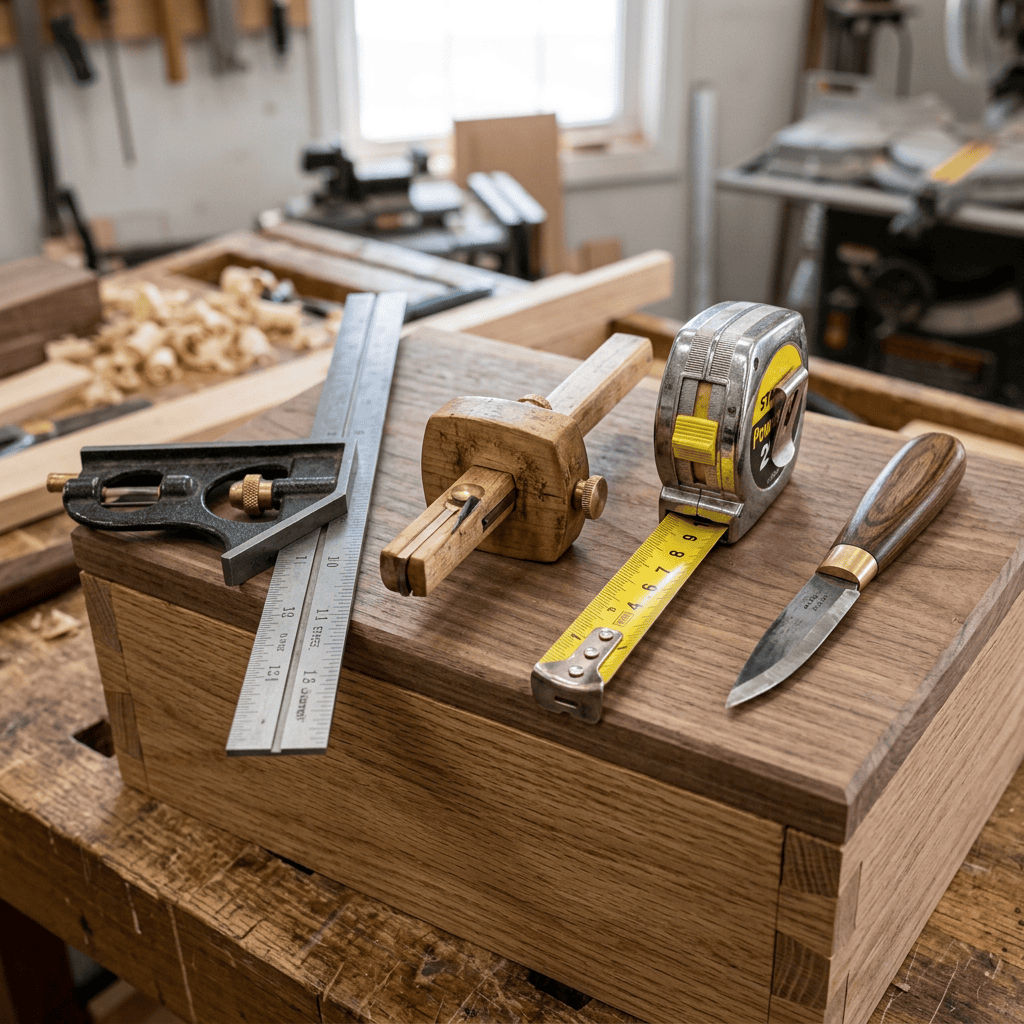
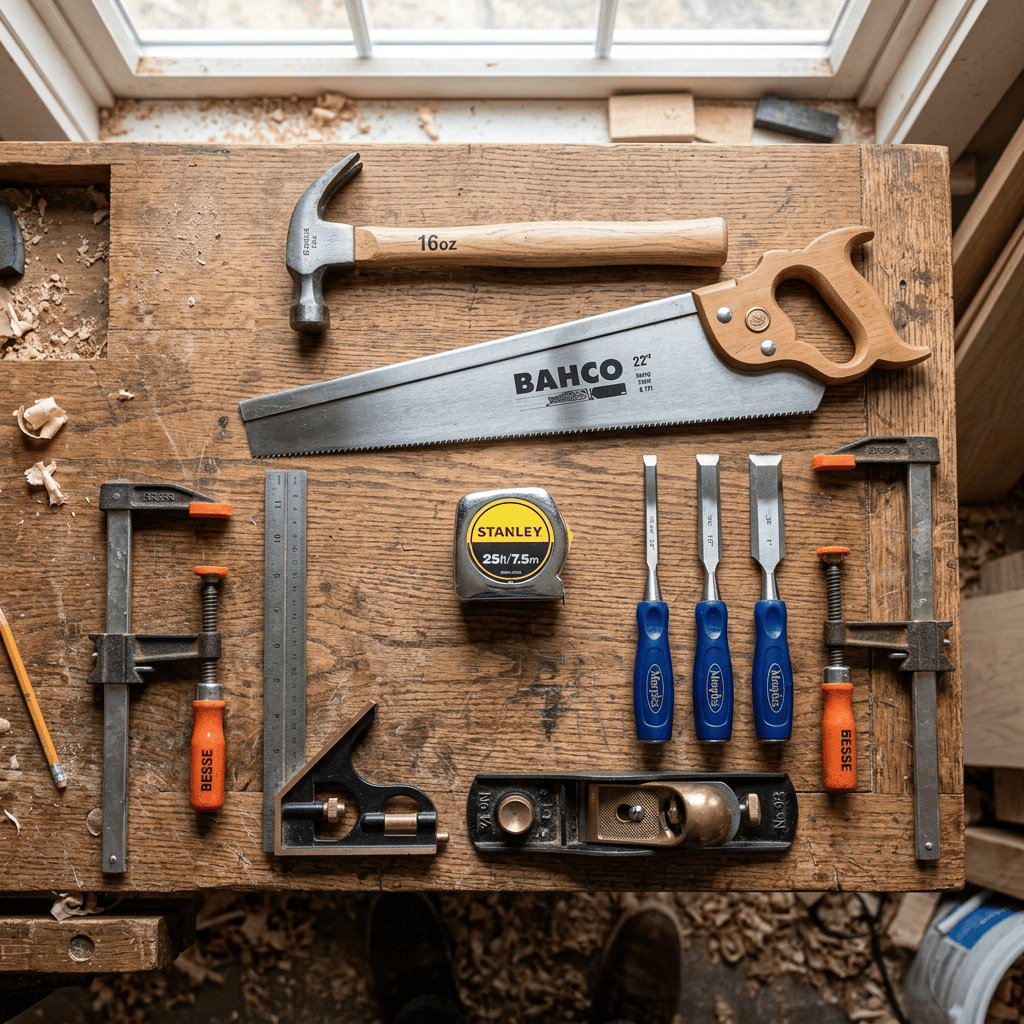
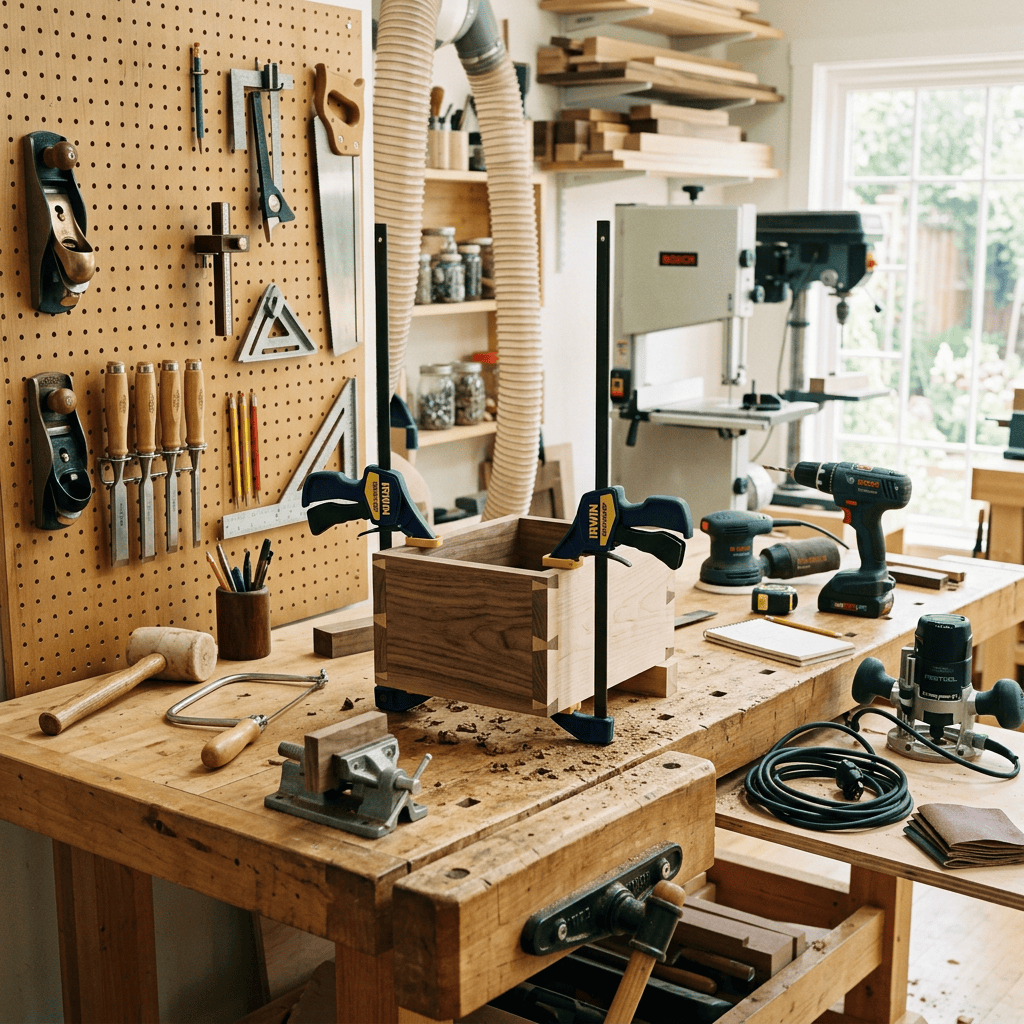
    Essential woodworking accessories including combination square, marking gauge, tape measure, and marking knife for precision woodworking

    Accurate measurements form the foundation of successful woodworking. Even expensive tools cannot compensate for poor layout work.

    These are among the most valuable essential woodworking tools and accessories for any workshop.

    1. Combination Square

    A combination square is one of the most versatile measuring tools available.

    It helps you:

    • Mark 90-degree angles
    • Check blade alignment
    • Measure depth
    • Verify squareness
    • Lay out joinery

    Choose a model with etched markings for long-lasting accuracy.

    2. Marking Gauge

    A marking gauge creates clean, repeatable layout lines that improve the accuracy of joints such as:

    • Mortise and tenon
    • Dovetails
    • Rabbets
    • Dados

    Unlike pencils, marking gauges score the wood fibers for more precise cuts.

    3. Digital Angle Gauge

    Modern woodworking often requires precise blade and fence adjustments.

    Digital angle gauges quickly verify:

    • Table saw blade angles
    • Miter saw settings
    • Router table adjustments
    • Bevel cuts

    This reduces setup time while increasing consistency.

    4. Precision Tape Measure

    Every workshop should include a durable tape measure with:

    • Easy-to-read markings
    • Strong blade lock
    • Durable housing
    • Accurate hook

    Consistency matters more than brand—use the same tape measure throughout an entire project whenever possible.

    5. Mechanical Pencils and Marking Knives

    Fine layout lines create more accurate cuts than thick carpenter’s pencils.

    Many experienced woodworkers prefer marking knives because they create crisp reference lines that improve joinery accuracy.

    Measuring Accessory Comparison

    AccessoryPrimary PurposeBest For
    Combination SquareSquareness and layoutEvery project
    Marking GaugeJoinery layoutFurniture making
    Digital Angle GaugeBlade setupPrecision cutting
    Tape MeasureGeneral measurementAll woodworking
    Marking KnifeFine layout linesPrecision joinery

    Takeaway: Precise measuring and marking accessories reduce mistakes before the first cut is ever made.

    Which Clamping Accessories Are Must-Have Tools for Woodworkers?
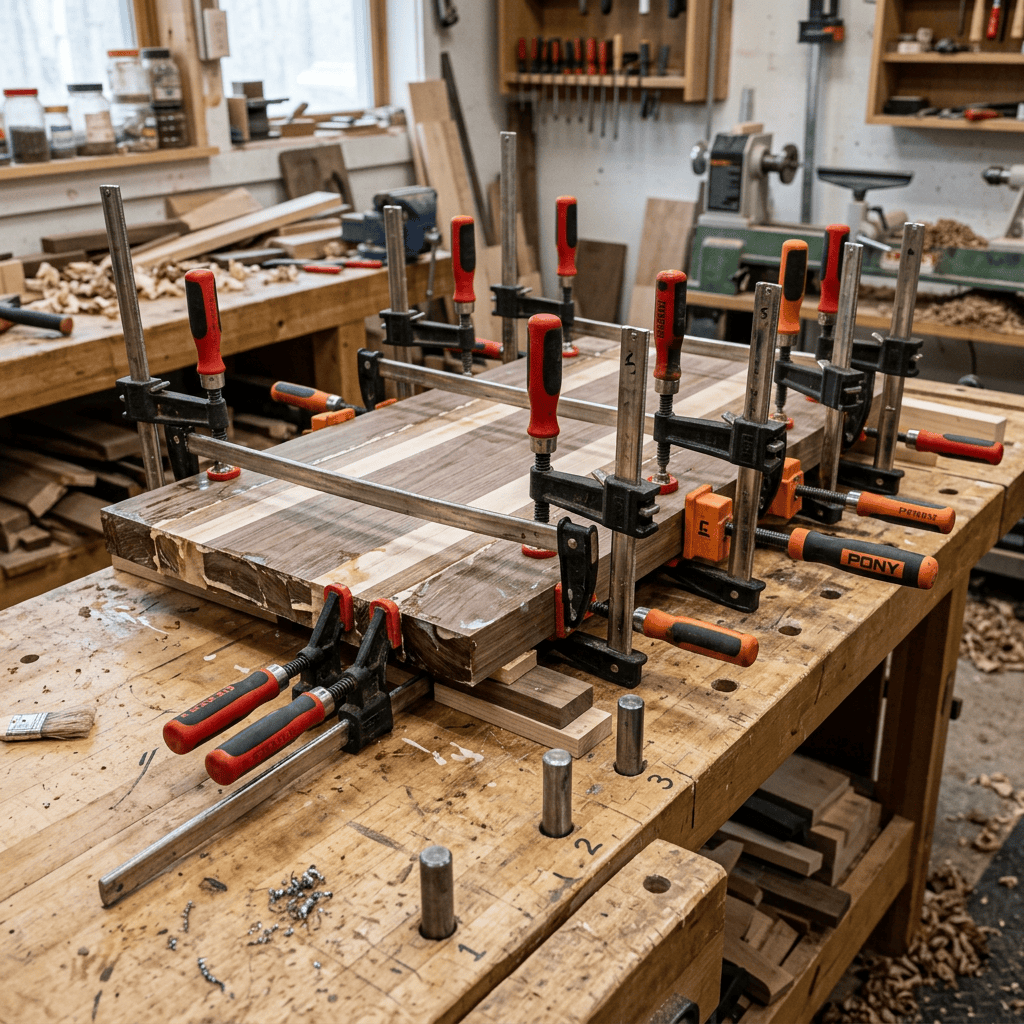
    Woodworking accessories featuring bar clamps, bench dogs, and parallel clamps securing a woodworking project

    Clamps are often called the extra set of hands every woodworker needs.

    Without adequate clamping pressure, glue joints can shift, assemblies become misaligned, and projects lose accuracy.

    Every woodworking shop should include a variety of clamp styles.

    Bar Clamps

    Bar clamps provide even pressure across larger glue-ups.

    Ideal for:

    • Tabletops
    • Cabinets
    • Shelving
    • Large frames

    Longer bar clamps offer greater versatility for furniture projects.

    Parallel Clamps

    Parallel clamps distribute pressure evenly while keeping workpieces square.

    Although more expensive, they are invaluable for high-quality cabinet and furniture construction.

    Spring Clamps

    Spring clamps are perfect for quick holding tasks such as:

    • Temporary positioning
    • Holding templates
    • Securing lightweight pieces
    • Dry fitting assemblies

    Corner Clamps

    Corner clamps simplify assembling:

    • Boxes
    • Cabinets
    • Picture frames
    • Drawer construction

    They maintain accurate 90-degree angles while glue dries.

    Clamp Pads

    Clamp pads prevent metal clamp jaws from denting finished wood surfaces.

    They are inexpensive accessories that protect hours of woodworking effort.

    Choosing the Right Clamp

    A good rule is simple:

    Buy more clamps than you think you’ll need.

    Most experienced woodworkers find themselves using multiple clamps during nearly every project.

    Takeaway: Quality clamps improve glue-ups, increase accuracy, and make complex woodworking assemblies significantly easier.

    Which Sharpening Accessories Keep Woodworking Tools Performing Their Best?
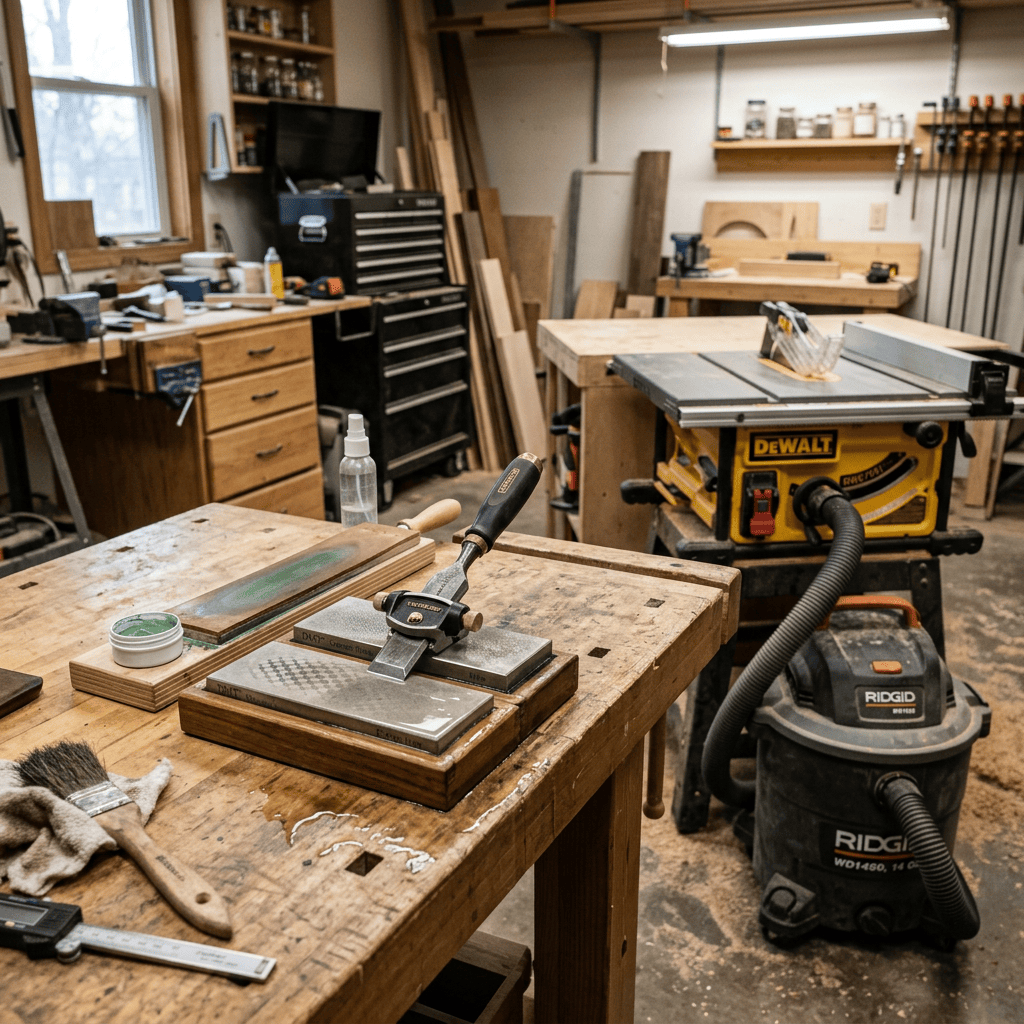
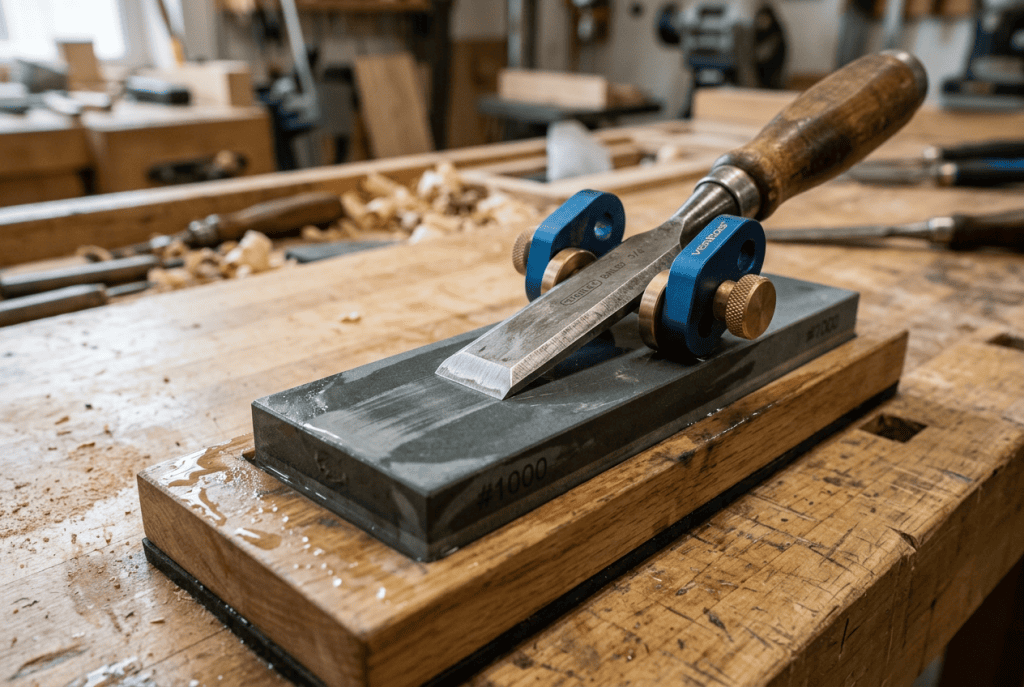
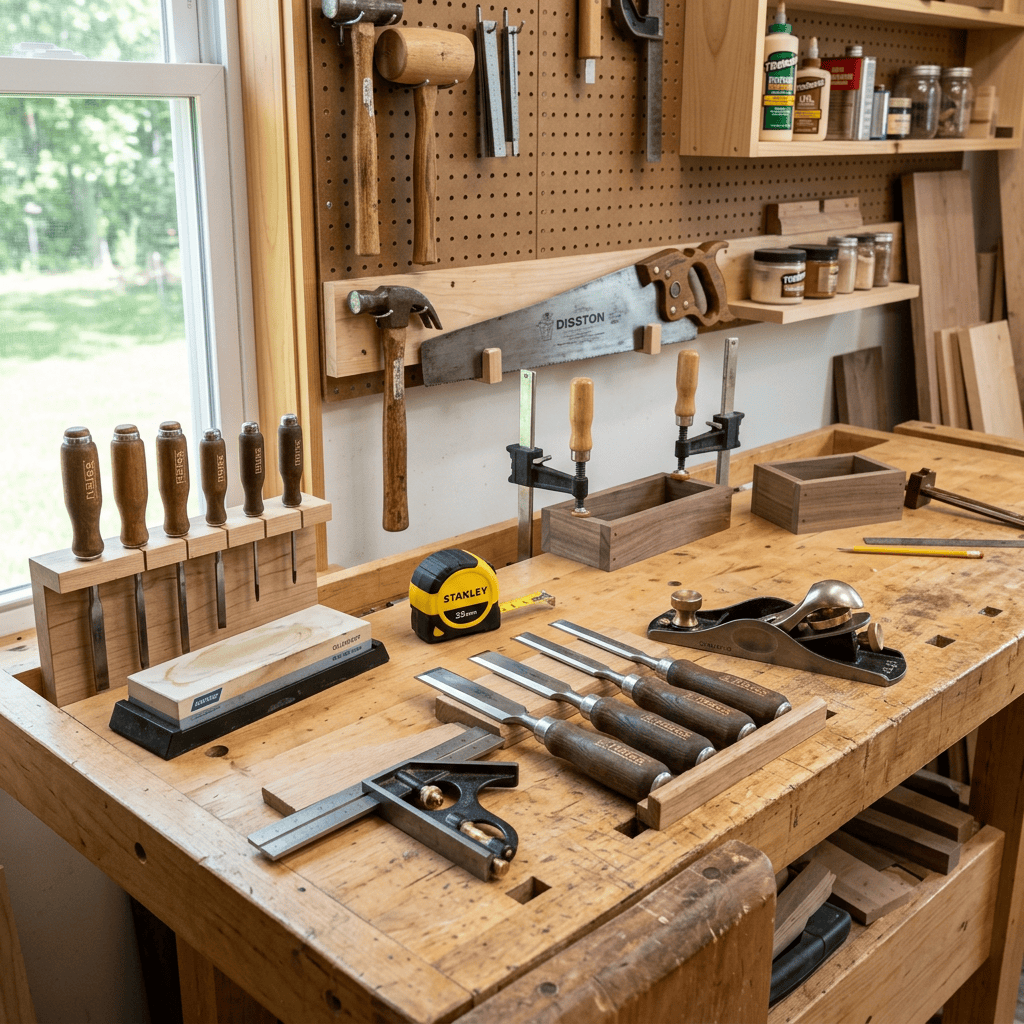
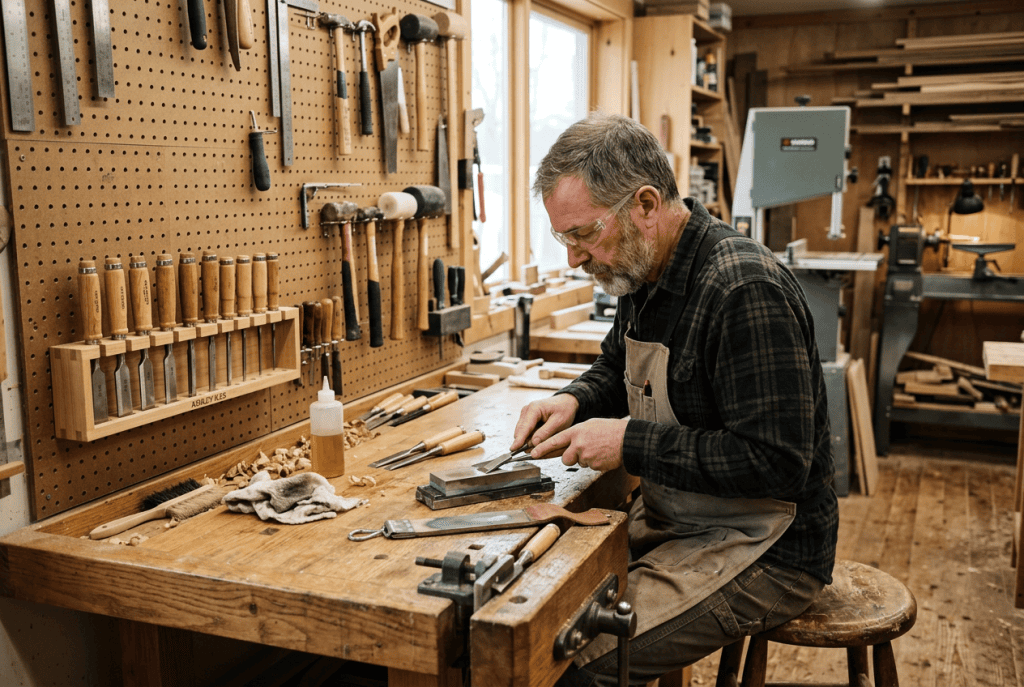
    Woodworking accessories including sharpening stones, honing guide, leather strop, and dust collection system in a workshop

    Sharp tools are safer, more accurate, and require less effort to use. Unfortunately, many woodworkers invest heavily in premium tools but overlook the accessories needed to maintain them.

    A regular sharpening routine keeps chisels, plane irons, carving tools, and even some cutting blades performing like new.

    1. Sharpening Stones

    Sharpening stones are the foundation of tool maintenance.

    Popular options include:

    • Diamond stones
    • Water stones
    • Oil stones
    • Ceramic stones

    Diamond stones are especially popular because they remain flat, sharpen quickly, and require minimal maintenance.

    2. Honing Guide

    Maintaining a consistent sharpening angle is difficult without assistance.

    A honing guide:

    • Holds the blade securely
    • Maintains a consistent bevel angle
    • Produces sharper cutting edges
    • Reduces sharpening mistakes

    It is an excellent investment for beginners learning proper sharpening techniques.

    3. Leather Strop

    After sharpening, a leather strop removes the microscopic burr left on the cutting edge.

    Benefits include:

    • Razor-sharp edges
    • Cleaner cuts
    • Reduced tear-out
    • Longer edge life

    Adding polishing compound further improves the final finish.

    4. Blade Cleaning Supplies

    Pitch, resin, and sawdust build up on cutting tools over time.

    Keep these supplies nearby:

    • Blade cleaner
    • Rust remover
    • Corrosion protectant
    • Cleaning brushes

    Clean blades cut faster, generate less heat, and place less strain on power tools.

    Takeaway: Maintaining sharp tools is one of the simplest ways to improve woodworking efficiency and achieve cleaner, safer cuts.

    Which Dust Collection Accessories Improve Woodworking Efficiency?

    Woodworking creates large amounts of dust that can affect both your health and the quality of your work.

    Fine dust settles on finishes, reduces visibility, and can damage power tools over time.

    Proper dust collection is one of the best woodworking accessories you can purchase.

    Shop Vacuum

    A powerful shop vacuum is the starting point for most home workshops.

    It can collect dust from:

    • Sanders
    • Miter saws
    • Router tables
    • Drill presses
    • General cleanup

    Look for models with fine dust filtration for improved air quality.

    Dust Separator

    A cyclone dust separator captures larger debris before it reaches the vacuum.

    Advantages include:

    • Longer filter life
    • Better suction
    • Less maintenance
    • Improved dust collection efficiency

    Dust Collection Hoses and Adapters

    Different tools often require different hose sizes.

    Keeping several adapters available allows quick connections between machines without interrupting your workflow.

    Air Filtration System

    Even effective dust collection leaves airborne particles behind.

    An overhead air filtration unit continuously removes fine dust, making the workshop healthier and cleaner.

    Dust Collection Comparison

    AccessoryPurposeBest For
    Shop VacuumGeneral dust collectionSmall workshops
    Cyclone SeparatorExtends vacuum lifeFrequent woodworking
    Hose Adapter KitUniversal connectionsMultiple machines
    Air Filtration UnitRemoves airborne dustIndoor workshops

    Takeaway: Effective dust collection protects your health, keeps tools cleaner, and improves the quality of finished woodworking projects.

    What Workbench Accessories Make Woodworking Easier?

    A sturdy workbench is essential, but the right accessories make it significantly more versatile.

    These woodworking tool add-ons improve stability, precision, and workflow.

    Bench Dogs

    Bench dogs fit into holes in the workbench to hold workpieces securely.

    They work especially well with:

    • Planing
    • Sanding
    • Routing
    • Hand tool work

    Holdfasts

    Traditional holdfasts provide fast, secure clamping anywhere on the workbench.

    Many experienced woodworkers rely on them for everyday tasks because they install and release in seconds.

    Bench Vise

    A quality bench vise supports countless woodworking operations.

    Use it for:

    • Sawing
    • Chiseling
    • Hand planing
    • Carving
    • Sanding

    Choose a vise with smooth operation and solid clamping pressure.

    Non-Slip Bench Mats

    Rubber bench mats prevent delicate workpieces from sliding while protecting finished surfaces from scratches.

    Takeaway: Workbench accessories transform a basic table into a highly efficient woodworking workstation.

    How Can Woodworking Tool Organization Improve Productivity?

    An organized workshop saves time, reduces frustration, and protects valuable tools.

    Many professionals say organization is one of the easiest ways to improve woodworking efficiency.

    Wall Storage Systems

    Pegboards, French cleats, and slatwall systems keep frequently used tools visible and accessible.

    Benefits include:

    • Faster tool retrieval
    • Better organization
    • More available workspace
    • Improved workshop safety

    Tool Cabinets

    Drawers protect precision tools from dust and accidental damage.

    Use foam inserts or drawer organizers to prevent tools from shifting.

    Portable Tool Boxes

    For contractors and hobbyists working in multiple locations, portable storage keeps essential accessories organized and protected.

    Hardware Organizers

    Small bins simplify storage for:

    • Screws
    • Nails
    • Dowels
    • Biscuits
    • Pocket-hole screws
    • Router bearings
    • Drill bits

    Clearly labeled organizers reduce project delays caused by searching for hardware.

    Workshop Organization Checklist

    • Store frequently used tools within arm’s reach.
    • Separate hand tools from power tool accessories.
    • Label storage bins clearly.
    • Keep sharpening supplies together.
    • Return tools after every project.
    • Clean the workshop before finishing for the day.

    Takeaway: Good woodworking tool organization improves efficiency, protects your investment, and makes every project more enjoyable.

    Which Tool Add-Ons Offer the Best Value?

    Some accessories dramatically expand the capabilities of tools you already own.

    Rather than purchasing new machines, these add-ons often deliver greater value for less money.

    Router Bit Sets

    A quality router becomes one of the most versatile woodworking tools when paired with multiple bit profiles.

    Useful bits include:

    • Straight bits
    • Round-over bits
    • Chamfer bits
    • Flush trim bits
    • Rabbeting bits
    • Cove bits

    Buying a complete set is often more economical than purchasing bits individually.

    Premium Saw Blades

    Replacing a factory blade with a premium blade can significantly improve cut quality.

    Choose blades based on your work:

    • Rip blades for cutting with the grain
    • Crosscut blades for cleaner ends
    • Combination blades for general woodworking
    • Fine-tooth blades for plywood and veneered panels

    Drill Guides

    Drill guides ensure perfectly straight holes without requiring a drill press.

    They are especially useful for:

    • Furniture assembly
    • Shelf pins
    • Dowels
    • Precision drilling

    Magnetic Bit Holders

    These inexpensive accessories speed up screw installation while reducing dropped fasteners and frequent bit changes.

    Takeaway: Small tool add-ons often provide some of the highest returns on investment in any woodworking shop.

    Common Mistakes When Buying Woodworking Accessories

    Avoid these common purchasing mistakes to build a practical, efficient toolkit.

    Buying Everything at Once

    Purchase accessories based on the projects you actually build.

    Expanding your toolkit gradually helps avoid unnecessary spending.

    Choosing Price Over Quality

    Low-cost accessories often wear out quickly or produce inconsistent results.

    Reliable measuring tools, clamps, and sharpening equipment are worth the investment.

    Ignoring Safety Accessories

    Eye protection, hearing protection, dust masks, and push sticks should never be considered optional.

    Protecting yourself is more important than upgrading tools.

    Neglecting Tool Maintenance

    Even premium woodworking tools lose performance without regular cleaning and sharpening.

    Routine maintenance extends tool life and improves project quality.

    Poor Workshop Organization

    Disorganized shops waste valuable time and increase the risk of misplaced or damaged tools.

    A thoughtful storage system keeps your workspace productive.

    Takeaway: Buying quality accessories strategically—and maintaining them properly—delivers better long-term value than purchasing the largest collection possible.

    How to Choose the Best Woodworking Accessories

    Before purchasing new accessories, consider these factors:

    ConsiderationRecommendation
    Experience LevelBeginners should prioritize measuring tools, clamps, and safety equipment.
    Project TypeFurniture builders benefit from precision layout and joinery accessories, while DIY users may prioritize portability.
    Workshop SizeCompact shops benefit from multifunction accessories and efficient storage.
    BudgetInvest first in accessories used on nearly every project.
    DurabilityChoose trusted brands known for precision and long service life.

    As your skills grow, expand your toolkit with specialty accessories that support your preferred woodworking style.

    Takeaway: The best woodworking accessories are those that solve everyday problems, improve accuracy, and make your workflow safer and more efficient.

    Common Questions About Woodworking Accessories

    What are the most essential woodworking accessories for beginners?

    Beginners should start with high-quality measuring and marking tools, a variety of clamps, sharpening supplies, safety equipment, and basic dust collection accessories.

    These items improve accuracy, safety, and confidence while helping new woodworkers develop good habits from the beginning.

    How many clamps does a woodworker really need?

    A common saying in woodworking is that you can never have too many clamps. Start with six to eight clamps in different sizes, then expand your collection as your projects become larger and more complex.

    Are expensive woodworking accessories worth the investment?

    Not every accessory needs to be premium, but precision measuring tools, quality clamps, sharpening systems, and durable safety equipment are worth spending more on. Better accessories typically last longer, provide more accurate results, and reduce frustration.

    Which accessories improve woodworking efficiency the most?

    Accessories that save time every day include:

    • Quick-release clamps
    • Digital angle gauges
    • Magnetic bit holders
    • Bench vises
    • Dust collection systems
    • Tool organizers
    • Premium saw blades

    These upgrades streamline workflow and reduce setup time.

    How often should woodworking tools be sharpened?

    The answer depends on usage, but cutting tools should be sharpened whenever they require additional force or begin producing rough cuts. Frequent light sharpening is generally better than waiting until blades become extremely dull.

    Is dust collection necessary for a small workshop?

    Yes. Even hobby workshops generate fine wood dust that can affect both respiratory health and project quality. A shop vacuum combined with a dust separator provides an affordable and effective starting point.

    What’s the best way to organize woodworking accessories?

    Store frequently used accessories near your primary workbench. Use labeled drawers, pegboards, French cleats, and hardware organizers to keep everything visible and easy to access.

    Should I buy accessories individually or in kits?

    Starter kits often provide excellent value for beginners, while experienced woodworkers usually benefit from purchasing individual accessories that match their specific needs and preferred woodworking techniques.

    Why This Matters

    Every experienced woodworker eventually discovers the same lesson: exceptional craftsmanship depends on more than owning expensive machinery.

    Well-chosen woodworking accessories improve every stage of the building process. Accurate measuring tools prevent costly mistakes before the first cut.

    Reliable clamps ensure stronger glue joints. Sharp cutting tools produce cleaner surfaces that require less sanding. Effective dust collection creates a healthier workshop and improves finishing results.

    Perhaps most importantly, the right accessories help you work with greater confidence. Instead of struggling to compensate for inadequate equipment, you can focus on developing your skills, refining techniques, and enjoying the creative process.

    Whether you’re building your first bookshelf or crafting heirloom furniture, investing in practical, high-quality accessories will continue to pay dividends for years to come.

    Expert Insight: Rather than purchasing every available accessory, prioritize tools that solve recurring challenges in your workshop. A carefully selected toolkit often outperforms a larger collection filled with rarely used items.

    FAQ

    What are woodworking accessories?

    Woodworking accessories are supporting tools and equipment that improve the performance, accuracy, safety, and versatility of primary woodworking tools.

    Examples include clamps, measuring tools, sharpening equipment, dust collection systems, storage solutions, and specialized tool add-ons.

    What woodworking accessories should every beginner buy first?

    Beginners should prioritize a combination square, tape measure, marking gauge, clamps, sharpening supplies, safety glasses, hearing protection, dust collection equipment, and basic workshop organization systems.

    These accessories provide the greatest improvement in both safety and project quality.

    Which woodworking accessories improve accuracy the most?

    Precision measuring and marking tools—including combination squares, digital angle gauges, marking knives, and quality rulers—have the greatest impact on accuracy. Proper clamping accessories also help maintain alignment during assembly and glue-ups.

    How do woodworking accessories improve efficiency?

    Woodworking accessories reduce setup time, improve tool performance, minimize errors, and streamline repetitive tasks.

    Accessories such as quick-release clamps, premium saw blades, magnetic bit holders, and organized storage systems allow projects to progress faster with fewer interruptions.

    How should I choose the best woodworking accessories?

    Choose accessories based on the types of projects you build, your available workshop space, and your budget.

    Focus first on accessories used during nearly every project—measuring tools, clamps, sharpening systems, safety equipment, and dust collection—before purchasing specialized add-ons.

    Final Summary

    The essential accessories every woodworker should include in their toolkit are those that improve precision, efficiency, safety, and organization.

    Measuring and marking tools, quality clamps, sharpening equipment, dust collection systems, workbench accessories, tool storage solutions, and carefully selected tool add-ons all contribute to producing better woodworking projects.

    Instead of trying to buy every accessory available, build your collection gradually by focusing on the tools that solve everyday workshop challenges.

    Quality accessories not only make woodworking easier but also help protect your investment in primary tools while improving the consistency of every project.

    Whether you’re just beginning your woodworking journey or upgrading an established workshop, investing in the right woodworking accessories is one of the smartest ways to enhance your craftsmanship, increase productivity, and enjoy the woodworking process for years to come.

    For additional woodworking guidance and safety information, visit WOOD Magazine, Fine Woodworking, and Occupational Safety and Health Administration (OSHA).

    Ready to build smarter and faster? Discover professional woodworking plans, expert tips, and time-saving techniques with the Woodworking Shortcut guide. Get instant access today at:
    👉 https://besthomeshed.com/WoodworkingShortcut/

  • How to Maintain and Sharpen Woodworking Tools: The Complete Guide to Woodworking Tool Maintenance

    How to Maintain and Sharpen Woodworking Tools: The Complete Guide to Woodworking Tool Maintenance

    Quick Answer

    Proper woodworking tool maintenance involves cleaning tools after every use, preventing rust with protective coatings, storing them in a dry environment, sharpening cutting edges using the appropriate method, and routinely inspecting tools for wear or damage.

    Consistent maintenance improves cutting performance, extends tool life, enhances safety, and reduces replacement costs.

    Key Takeaways

    • Clean woodworking tools immediately after use to remove resin, sawdust, moisture, and debris.
    • Sharpen cutting edges regularly instead of waiting until tools become dull.
    • Protect steel surfaces from rust using light oil, paste wax, or rust inhibitors.
    • Store tools in a dry, organized environment with proper humidity control.
    • Use the correct sharpening method for each type of woodworking tool.
    • Inspect tools frequently for loose handles, chips, cracks, and excessive wear.
    • Consistent maintenance improves precision, safety, and woodworking tool longevity.

    Why Woodworking Tool Maintenance Matters

    Whether you’re a professional carpenter, hobbyist, or DIY enthusiast, your tools determine the quality of every project. Sharp, clean, and well-maintained tools produce cleaner cuts, require less effort, improve accuracy, and significantly reduce the risk of accidents.

    In contrast, neglected tools become dull, rusted, and difficult to control. They often damage wood fibers instead of cutting cleanly, forcing you to work harder while increasing fatigue and safety risks.

    Simply put, investing a few minutes in regular woodworking tool maintenance can add years to your tools’ lifespan while improving every woodworking project.

    Takeaway: Proper maintenance saves money, improves craftsmanship, and makes woodworking safer.

    What Does Woodworking Tool Maintenance Include?

    Woodworking tool maintenance refers to the routine care that keeps both hand tools and power tools performing efficiently.

    It typically includes:

    • Cleaning woodworking tools
    • Sharpening woodworking tools
    • Rust prevention
    • Lubrication
    • Proper storage
    • Regular inspections
    • Handle and hardware maintenance

    Common tools requiring maintenance include:

    ToolMaintenance Needed
    ChiselsSharpening, honing, rust prevention
    Hand planesBlade sharpening, sole cleaning, adjustment
    HandsawsCleaning, occasional sharpening, rust protection
    Carving toolsFrequent honing and polishing
    Router bitsResin removal and inspection
    Drill bitsCleaning and sharpening when appropriate
    Plane ironsFlattening, honing, polishing

    Takeaway: Every woodworking tool benefits from routine care, regardless of how often it is used.

    How Often Should You Maintain Woodworking Tools?

    Maintenance depends on usage frequency.

    After Every Use

    • Brush away sawdust
    • Remove resin and pitch
    • Wipe away moisture
    • Dry tools completely
    • Return tools to proper storage

    Weekly

    • Inspect cutting edges
    • Check moving parts
    • Lubricate metal surfaces
    • Tighten loose hardware

    Monthly

    • Deep clean tools
    • Remove light rust
    • Reapply protective wax or oil
    • Inspect wooden handles

    As Needed

    • Sharpen dull blades
    • Replace damaged parts
    • Repair loose handles

    Takeaway: Small, consistent maintenance sessions prevent major repairs later.

    How Can You Clean Woodworking Tools Properly?

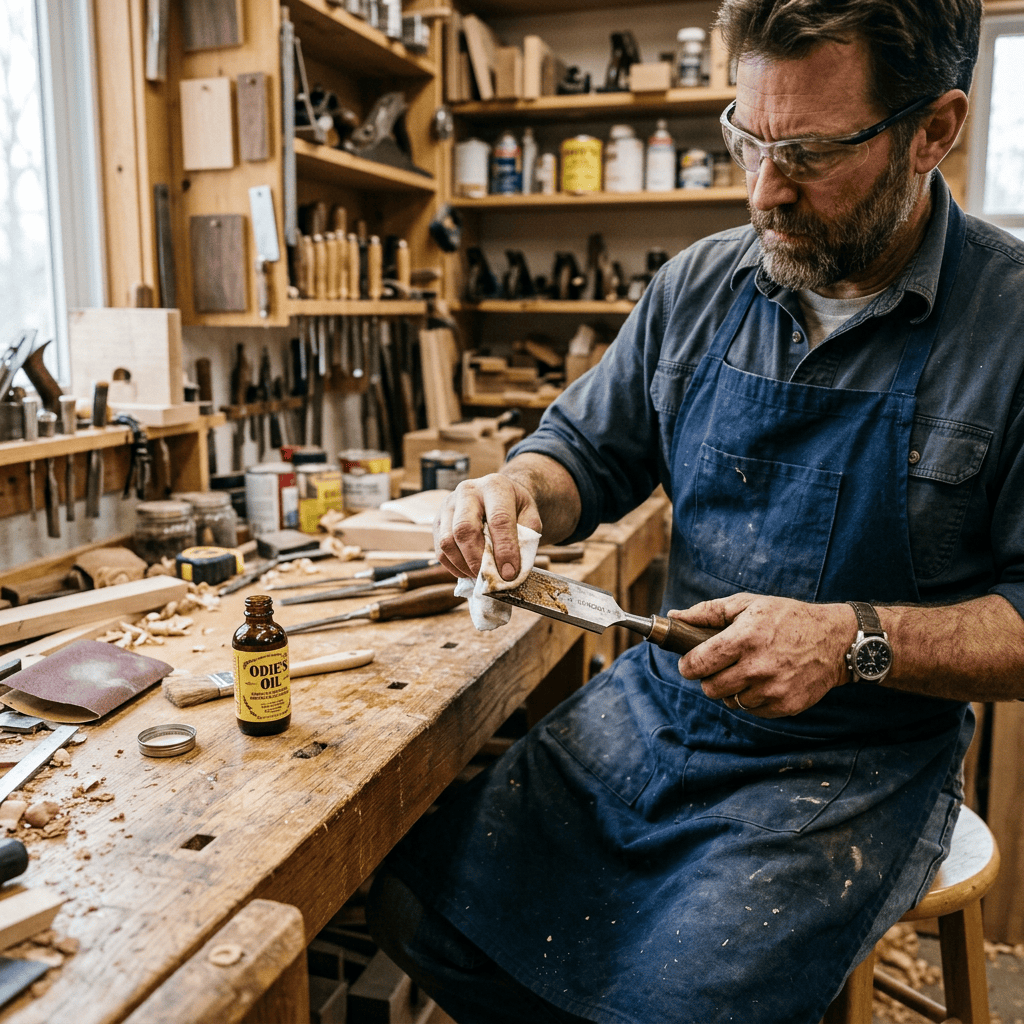
    Woodworking tool maintenance demonstrating cleaning woodworking tools and applying protective oil after use.

    Cleaning is the foundation of effective tool care.

    Step 1: Remove Dust and Debris

    Use:

    • Soft brush
    • Compressed air
    • Shop vacuum
    • Microfiber cloth

    Removing debris prevents abrasive particles from damaging moving parts.

    Step 2: Remove Resin and Pitch

    Sticky buildup affects cutting performance.

    Use:

    • Mineral spirits
    • Commercial blade cleaner
    • Citrus-based cleaners

    Avoid soaking wooden handles.

    Step 3: Dry Thoroughly

    Moisture causes corrosion quickly.

    Always:

    • Wipe with a clean cloth
    • Air dry completely
    • Avoid storing damp tools

    Step 4: Apply Protection

    After cleaning:

    • Paste wax
    • Camellia oil
    • Light machine oil
    • Silicone-free rust protectant

    These products create a barrier against moisture.

    Takeaway: Clean tools immediately after use to prevent buildup and corrosion.

    What Are the Best Sharpening Methods for Woodworking Tools?

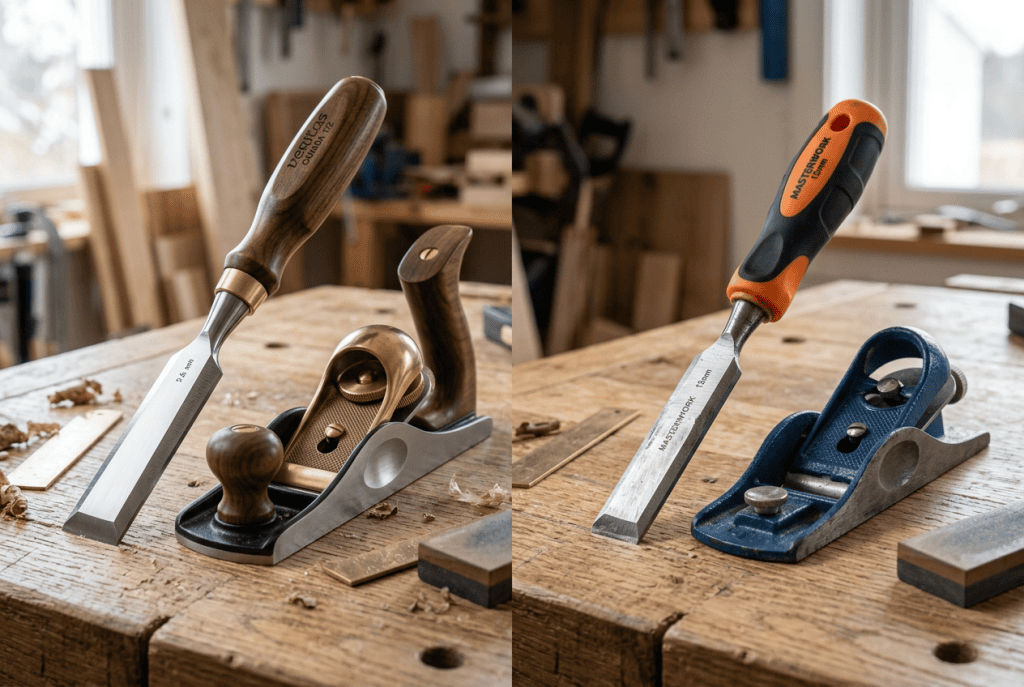
    Woodworking tool maintenance showing sharpening woodworking tools with a honing guide and water stone.

    Sharp tools require less force and produce cleaner results.

    Different tools require different sharpening methods.

    Sharpening MethodBest ForAdvantages
    Water stonesChisels, plane ironsFast cutting, excellent finish
    Oil stonesGeneral hand toolsDurable and affordable
    Diamond stonesHard steelsLong-lasting and low maintenance
    Sandpaper systemBeginnersInexpensive and accessible
    Honing guidesChisels and planesMaintains consistent bevel angles

    Sharpening Woodworking Tools Step by Step

    1. Inspect the Edge

    Look for:

    • Chips
    • Rounded edges
    • Uneven bevels
    • Light reflecting from the cutting edge

    If light reflects, the edge is dull.

    2. Establish the Bevel

    Use the manufacturer’s recommended bevel angle.

    Common examples:

    • Chisels: 25°–30°
    • Plane irons: 25°–30°
    • Carving tools: varies by profile

    3. Sharpen

    Move the blade evenly across the stone.

    Maintain:

    • Consistent pressure
    • Stable angle
    • Full contact

    4. Hone

    Use a finer grit to refine the edge.

    This removes scratches and increases sharpness.

    5. Remove the Burr

    Finish by lightly polishing the back of the blade until the burr disappears.

    Takeaway: Frequent light sharpening is easier and more effective than restoring severely dull tools.

    How Can You Protect Tools from Rust?

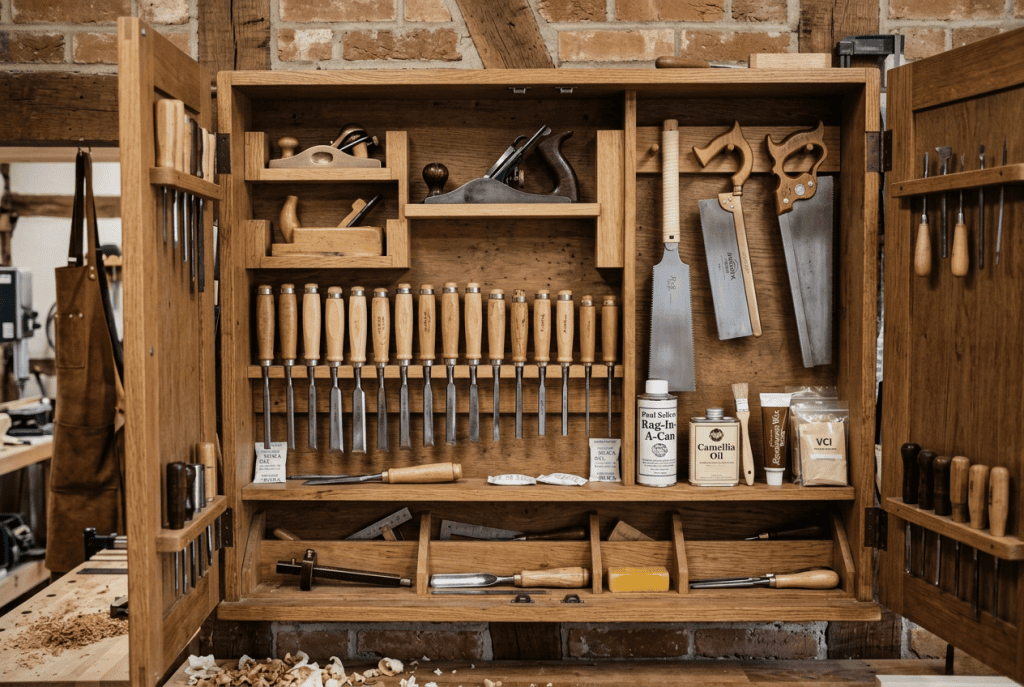
    Woodworking tool maintenance illustrating proper tool storage solutions and protecting tools from rust.

    Rust is one of the biggest threats to woodworking tool longevity.

    Fortunately, prevention is simple.

    Keep Tools Dry

    Humidity accelerates corrosion.

    Store tools in:

    • Climate-controlled workshops
    • Dry cabinets
    • Tool chests with desiccant packs

    Apply Protective Coatings

    Effective options include:

    • Paste wax
    • Camellia oil
    • Boeshield T-9
    • Light mineral oil

    These coatings repel moisture while reducing friction.

    Control Humidity

    Ideal workshop humidity:

    40%–55%

    Consider using:

    • Dehumidifiers
    • Silica gel packs
    • Vapor corrosion inhibitors

    Takeaway: Rust prevention is much easier than rust removal.

    What Are the Best Tool Storage Solutions?

    Proper storage protects tools from physical damage and environmental exposure.

    Good storage options include:

    • Wall-mounted tool racks
    • Wooden tool cabinets
    • Tool chests
    • Drawer organizers
    • Protective blade guards
    • Magnetic holders (for appropriate tools)

    Avoid:

    • Damp basements
    • Concrete floors
    • Unheated sheds
    • Stacking sharp tools together

    Labeling storage areas also helps prevent accidental edge damage.

    Takeaway: Organized storage preserves both sharpness and safety.

    How Can You Maintain Tool Performance Over Time?

    Maintaining tool performance involves more than sharpening.

    Regularly inspect:

    • Blade alignment
    • Fasteners
    • Handles
    • Adjustment mechanisms
    • Bearings (power tools)
    • Electrical cords

    Lubricate moving parts according to manufacturer recommendations.

    For wooden handles:

    • Sand rough spots
    • Apply boiled linseed oil occasionally
    • Replace cracked handles immediately

    Keeping tools properly adjusted ensures consistent, accurate results.

    Takeaway: Performance depends on the entire tool—not just the cutting edge.

    Common Mistakes That Shorten Tool Life

    Many woodworkers unintentionally damage their tools through poor maintenance habits.

    Avoid these mistakes:

    1. Waiting too long before sharpening.
    2. Storing tools while damp.
    3. Using excessive grinding pressure.
    4. Ignoring small rust spots.
    5. Using the wrong sharpening angle.
    6. Neglecting lubrication.
    7. Tossing tools loosely into drawers.
    8. Using woodworking tools for unintended purposes.

    Correcting these habits significantly improves woodworking tool longevity.

    Takeaway: Preventive care always costs less than replacing damaged tools.

    Safety Tips for Tool Maintenance

    Tool maintenance should always be performed safely.

    Follow these recommendations:

    • Wear eye protection when sharpening.
    • Use cut-resistant gloves when appropriate.
    • Secure tools firmly before sharpening.
    • Disconnect power tools before cleaning.
    • Work in a well-lit area.
    • Keep sharpening stones stable.
    • Follow manufacturer maintenance instructions.
    • Dispose of oily rags safely to reduce fire risk.

    A sharp tool is generally safer than a dull one because it requires less force and offers greater control.

    Takeaway: Safe maintenance practices protect both you and your tools.

    Common Questions About Woodworking Tool Maintenance

    How do I know when a woodworking tool needs sharpening?

    If the tool requires more force, leaves rough cuts, tears wood fibers, or reflects light along the cutting edge, it’s time to sharpen it.

    Can I remove rust from woodworking tools?

    Yes. Light rust can usually be removed using fine steel wool, rust erasers, abrasive pads, or specialized rust removers before applying a protective coating.

    Should I oil woodworking tools?

    Yes. Applying a thin coat of oil or paste wax helps prevent rust and reduces friction without affecting cutting performance.

    Are expensive sharpening stones necessary?

    Not necessarily. Quality water stones, oil stones, diamond plates, and even sandpaper sharpening systems can all produce excellent results when used correctly.

    How should I store chisels?

    Store chisels with blade guards or in a rack where the cutting edges cannot contact other tools or hard surfaces.

    Can dull tools damage wood?

    Yes. Dull edges crush and tear wood fibers instead of slicing cleanly, resulting in rough surfaces and reduced accuracy.

    How often should I clean woodworking tools?

    A quick cleaning after every use and a deeper cleaning every few weeks keeps tools in excellent condition.

    Why This Matters

    Well-maintained woodworking tools do more than last longer—they improve every aspect of your work. Sharp edges produce smoother cuts, cleaner joints, and more accurate dimensions, reducing the need for sanding or rework. Consistent maintenance also lowers operating costs by delaying replacements and minimizing repairs.

    From a safety perspective, properly maintained tools are easier to control because they require less force and respond more predictably.

    Whether you’re crafting furniture, carving intricate details, or completing home improvement projects, developing a routine for cleaning, sharpening, rust prevention, and storage ensures dependable performance for years.

    Treat maintenance as part of the woodworking process, not an afterthought, and you’ll enjoy better results with every project.

    FAQ

    How can you maintain woodworking tools to ensure they remain functional?

    Maintain woodworking tools by cleaning them after every use, sharpening cutting edges regularly, preventing rust with protective coatings, storing them in a dry environment, lubricating moving parts, and inspecting them for wear or damage. Routine care keeps tools accurate, safe, and reliable.

    What is the best sharpening method for woodworking tools?

    The best sharpening method depends on the tool and steel type. Water stones provide excellent edge quality, diamond stones are durable and low maintenance, oil stones offer long-term value, and honing guides help maintain consistent bevel angles for accurate sharpening.

    How do you prevent rust on woodworking tools?

    Prevent rust by keeping tools clean and dry, applying a protective coating such as paste wax or light oil, controlling workshop humidity, and storing tools in moisture-free cabinets or chests with desiccants when necessary.

    Why is regular woodworking tool maintenance important?

    Regular maintenance improves cutting performance, extends tool life, enhances safety, reduces repair costs, and delivers cleaner, more precise woodworking results. It also helps prevent corrosion, mechanical wear, and unnecessary tool replacement.

    How often should woodworking tools be sharpened?

    Sharpen tools whenever they show signs of reduced performance rather than following a fixed schedule. Frequent users may hone edges weekly, while occasional hobbyists can sharpen less often. Light, regular sharpening is faster and preserves more of the tool than waiting until it becomes very dull.

    Final Summary

    The answer to maintaining and sharpening woodworking tools is straightforward: clean them after every use, sharpen edges before they become excessively dull, protect metal surfaces from rust, store tools in a dry and organized space, and inspect them regularly for wear.

    By making woodworking tool maintenance a consistent habit, you’ll improve cutting precision, extend the life of your tools, work more safely, and achieve higher-quality results on every project.

    Whether you’re a beginner or an experienced craftsperson, a proactive maintenance routine is one of the best investments you can make in your woodworking success.

    For additional expert guidance on woodworking tool care and safety, consult authoritative resources such as WOOD Magazine, the Fine Woodworking knowledge center, and the Occupational Safety and Health Administration (OSHA) for workshop safety best practices.

    Ready to improve your woodworking skills even further? Discover time-saving techniques, expert plans, and practical tips with the Woodworking Shortcut program. 👉 Learn more here: https://besthomeshed.com/WoodworkingShortcut/

  • What Are the Essential Safety Tips for Using Woodworking Tools? A Complete Guide to Woodworking Tool Safety

    What Are the Essential Safety Tips for Using Woodworking Tools? A Complete Guide to Woodworking Tool Safety

    Quick Answer:

    The essential safety tips for using woodworking tools include wearing appropriate personal protective equipment (PPE), using the correct tool for each task, inspecting and maintaining tools regularly, following safe operating procedures, keeping the workspace organized, and staying focused while working.

    These woodworking tool safety practices significantly reduce accidents and improve both efficiency and project quality.

    Key Takeaways

    • Always wear appropriate PPE, including safety glasses, hearing protection, and dust masks.
    • Inspect woodworking tools before every use and maintain them according to manufacturer recommendations.
    • Keep blades, bits, and cutting edges sharp to improve safety and performance.
    • Maintain a clean, well-lit, clutter-free workshop to prevent slips, trips, and accidents.
    • Never bypass machine guards or safety features.
    • Stay focused and avoid distractions, fatigue, and rushing while working.
    • Learn proper operating procedures before using any woodworking equipment.

    What Are the Essential Safety Tips for Using Woodworking Tools?

    Woodworking can be an enjoyable and rewarding hobby or profession, but it also involves sharp blades, rotating machinery, airborne dust, and powerful equipment capable of causing serious injuries if used improperly.

    Practicing woodworking tool safety is not simply about avoiding accidents. It also improves accuracy, extends the life of your equipment, and creates a more enjoyable woodworking experience.

    Whether you’re a beginner building your first project or an experienced craftsman, following proven safety practices should always be your highest priority.

    Takeaway: Safe habits protect both you and your woodworking projects.

    Why Is Woodworking Tool Safety Important?

    Woodworking tools generate tremendous cutting force and operate at high speeds. Even hand tools can cause severe injuries when used incorrectly.

    Proper woodworking equipment safety helps prevent:

    • Cuts and lacerations
    • Eye injuries
    • Hearing damage
    • Respiratory illnesses from wood dust
    • Kickback accidents
    • Electrical hazards
    • Fire risks
    • Long-term repetitive strain injuries

    Besides protecting your health, safe woodworking practices improve productivity because well-maintained equipment performs more accurately and consistently.

    Takeaway: Safety is the foundation of efficient and enjoyable woodworking.

    What Personal Protective Equipment (PPE) Should Woodworkers Wear?

    Woodworking tool safety equipment including safety glasses, hearing protection, respirator, apron, and protective footwear.

    One of the most important safety tips for woodworkers is wearing appropriate personal protective equipment.

    Essential PPE for Woodworkers

    PPEPurpose
    Safety glassesProtect eyes from flying chips and debris
    Hearing protectionPrevent hearing loss from loud machinery
    Dust mask or respiratorReduce inhalation of wood dust and harmful particles
    Non-slip footwearImprove stability and prevent slips
    Work gloves (when appropriate)Protect hands during material handling (avoid around rotating machinery)
    Apron or fitted clothingPrevent loose fabric from catching in equipment

    Eye Protection

    Safety glasses should meet recognized impact standards and be worn whenever tools are operating.

    Hearing Protection

    Table saws, routers, planers, and sanders often exceed safe noise levels. Earplugs or earmuffs help prevent permanent hearing damage.

    Respiratory Protection

    Many hardwoods, plywood, and composite materials generate fine dust that may irritate or damage the lungs. A respirator rated for fine dust offers better protection than a basic paper mask.

    Clothing Considerations

    Avoid:

    • Loose sleeves
    • Jewelry
    • Necklaces
    • Watches
    • Untied long hair

    Anything that can become entangled in rotating machinery presents a serious hazard.

    Takeaway: PPE is your last line of defense and should never be overlooked.

    How Should You Inspect Woodworking Tools Before Use?

    Woodworking tool safety through proper blade maintenance, tool inspection, and routine equipment care.

    A quick inspection before starting each project can prevent many accidents.

    Check Hand Tools

    Look for:

    • Cracked handles
    • Loose heads
    • Rust
    • Damaged cutting edges
    • Loose fasteners

    Check Power Tools

    Inspect:

    • Power cords
    • Switches
    • Guards
    • Blade alignment
    • Blade sharpness
    • Battery condition (for cordless tools)

    Never use equipment with damaged electrical cords or malfunctioning switches.

    Verify Safety Features

    Ensure:

    • Blade guards function correctly
    • Emergency stop buttons work
    • Anti-kickback devices are installed
    • Dust collection systems are connected

    Takeaway: A two-minute inspection can prevent a serious injury.

    How Can Proper Tool Maintenance Improve Safety?

    Regular maintenance is one of the most overlooked tool maintenance tips, yet it plays a major role in accident prevention.

    Keep Blades Sharp

    Sharp blades:

    • Require less force
    • Produce cleaner cuts
    • Reduce kickback
    • Improve control

    Contrary to popular belief, dull blades are often more dangerous than sharp ones.

    Lubricate Moving Parts

    Follow manufacturer recommendations for lubricating:

    • Bearings
    • Hinges
    • Adjustment mechanisms
    • Slides

    Proper lubrication reduces wear and helps equipment operate smoothly.

    Tighten Loose Components

    Check regularly for:

    • Loose bolts
    • Fence alignment
    • Arbor nuts
    • Handles
    • Guide rails

    Loose components can cause inaccurate cuts and dangerous tool movement.

    Clean After Every Project

    Remove:

    • Sawdust
    • Resin buildup
    • Wood chips
    • Excess adhesive

    Clean tools perform better and last longer.

    Takeaway: Proper maintenance improves both safety and woodworking precision.

    What Are Safe Operating Practices for Woodworking Tools?

    Learning proper technique is just as important as choosing quality equipment.

    Use the Right Tool

    Never force one tool to perform another tool’s job.

    Examples:

    • Use a table saw for ripping.
    • Use a jigsaw for curves.
    • Use a router for decorative edges.

    Choosing the correct tool improves safety and produces better results.

    Read the Manufacturer’s Manual

    Even experienced woodworkers should review operating instructions when using unfamiliar equipment.

    Manuals explain:

    • Operating procedures
    • Speed settings
    • Safety warnings
    • Maintenance schedules

    Secure Your Workpiece

    Use:

    • Clamps
    • Vises
    • Bench dogs
    • Hold-downs

    Trying to hold material by hand increases the chance of slipping.

    Maintain Proper Body Position

    Stand slightly to one side of cutting tools instead of directly behind the blade to reduce injury risk if kickback occurs.

    Maintain balanced footing throughout every cut.

    Keep Hands Away from Cutting Areas

    Use:

    • Push sticks
    • Push blocks
    • Featherboards
    • Guide fences

    These accessories improve both safety and accuracy.

    Takeaway: Correct operating technique reduces the risk of injury while improving cut quality.

    How Can You Create a Safe Woodworking Workshop?

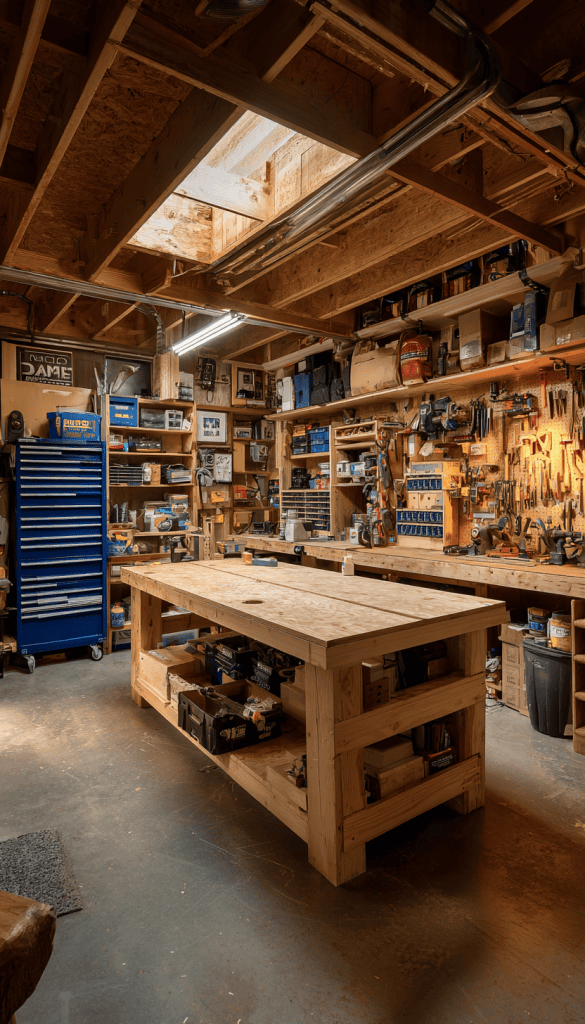
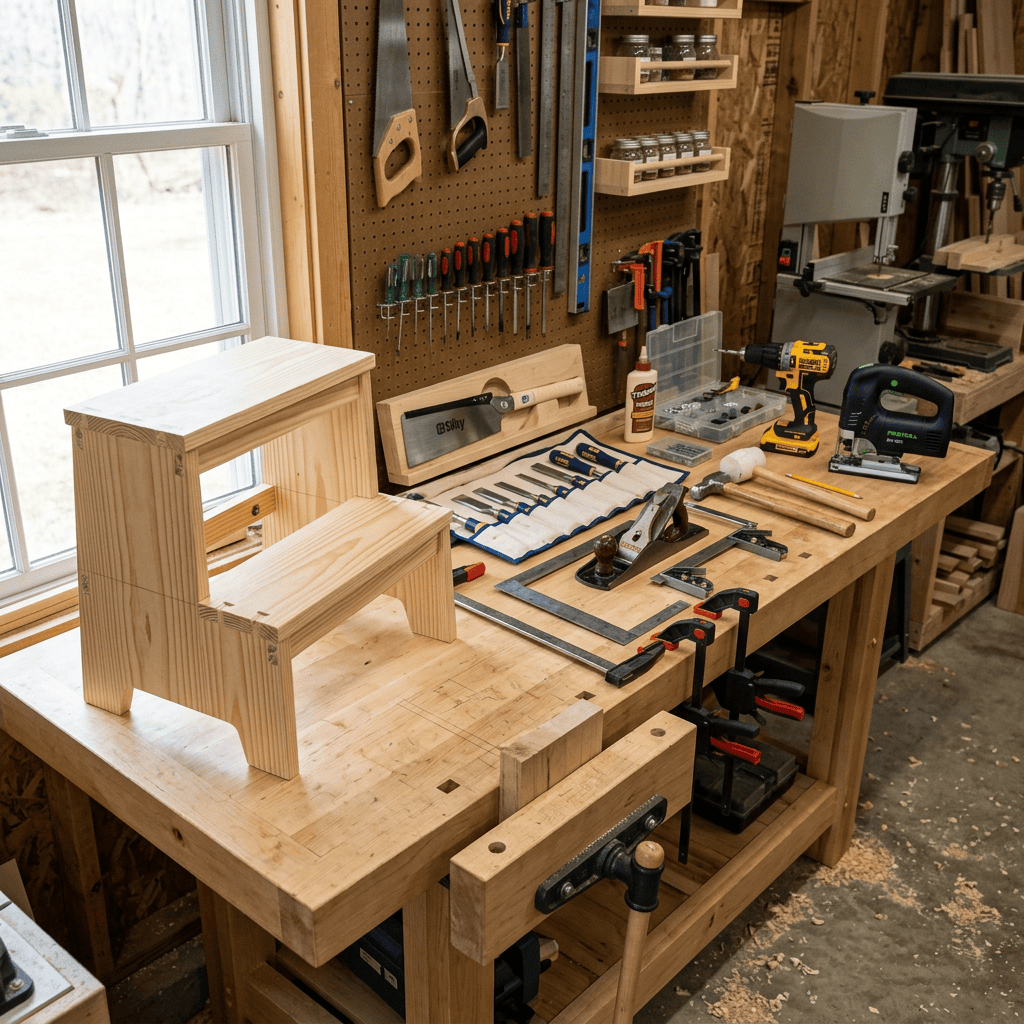
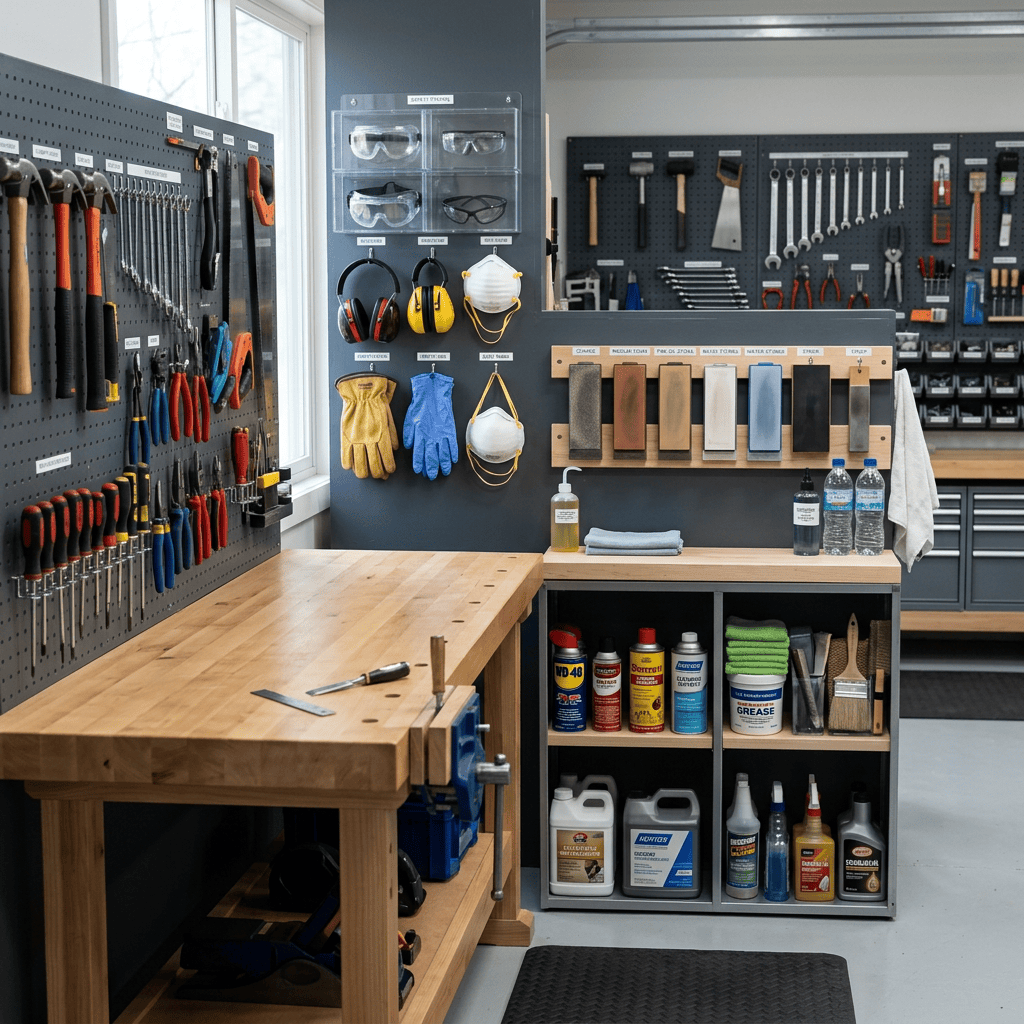
    Woodworking tool safety demonstrated in a clean, organized woodworking workshop with proper storage and dust collection.

    A safe workshop reduces hazards before work even begins.

    Maintain Good Lighting

    Bright lighting helps identify:

    • Blade position
    • Measuring marks
    • Material defects
    • Obstructions

    Poor visibility contributes to many avoidable mistakes.

    Keep Floors Clean

    Remove:

    • Sawdust
    • Offcuts
    • Extension cords
    • Scrap materials

    Clean floors reduce slipping and tripping hazards.

    Organize Tools

    Store tools:

    • In cabinets
    • On wall racks
    • In drawers
    • On dedicated shelves

    A designated place for every tool minimizes clutter.

    Improve Dust Collection

    Wood dust creates:

    • Respiratory hazards
    • Fire risks
    • Reduced visibility

    Install a dust collection system or use a shop vacuum whenever possible.

    Ensure Electrical Safety

    Avoid overloaded outlets.

    Use:

    • Grounded outlets
    • Proper extension cords
    • Circuit protection

    Replace damaged cords immediately.

    Takeaway: Workshop organization is a critical part of woodworking workshop safety.

    What Common Mistakes Increase the Risk of Woodworking Accidents?

    Many injuries result from preventable habits rather than equipment failure.

    Common mistakes include:

    1. Working while tired
    2. Ignoring PPE
    3. Removing blade guards
    4. Wearing loose clothing
    5. Using dull blades
    6. Operating unfamiliar tools without instruction
    7. Rushing through cuts
    8. Leaving tools plugged in during blade changes
    9. Failing to secure workpieces
    10. Working in poor lighting

    Avoiding these habits significantly improves accident prevention in woodworking.

    Takeaway: Safe habits are developed through consistency, not luck.

    How Can Beginners Use Woodworking Tools Safely?

    Beginners should focus on mastering fundamentals before attempting complex projects.

    Follow these recommendations:

    1. Start with simple hand tools.
    2. Learn one power tool at a time.
    3. Practice on scrap wood.
    4. Watch manufacturer demonstrations.
    5. Read instruction manuals.
    6. Ask experienced woodworkers for guidance.
    7. Never rush learning new techniques.

    Building confidence gradually is safer than attempting advanced techniques too early.

    Takeaway: Experience grows through practice, patience, and safe learning.

    Best Practices for Long-Term Woodworking Safety

    Consistent safety routines reduce risks over time.

    Adopt these habits:

    • Inspect tools before every session.
    • Wear appropriate safety gear for woodworking every time.
    • Keep blades sharp and clean.
    • Disconnect power before changing accessories.
    • Follow manufacturer instructions.
    • Store tools properly.
    • Maintain adequate ventilation.
    • Keep a stocked first-aid kit nearby.
    • Know the location of fire extinguishers.
    • Continue learning new safety techniques.

    Takeaway: Long-term safety depends on making good habits automatic.

    Common Questions About Woodworking Tool Safety

    What is the most important woodworking safety rule?

    Always wear proper PPE and use each tool according to the manufacturer’s instructions.

    Why are dull blades dangerous?

    Dull blades require greater force, increasing the chance of slipping and kickback.

    Should gloves be worn with power tools?

    Generally, no. Gloves can become caught in rotating machinery. Use them only when handling rough materials or sharp stock away from moving parts.

    How often should woodworking tools be inspected?

    Inspect tools before every use and perform detailed maintenance regularly.

    Why is dust collection important?

    Dust collection improves visibility, protects respiratory health, and reduces fire hazards.

    What causes kickback?

    Kickback usually occurs when wood binds against the blade or fence, causing the workpiece to be thrown toward the operator.

    Is hearing protection necessary?

    Yes. Prolonged exposure to woodworking machinery can cause permanent hearing loss.

    Can beginners safely use power tools?

    Yes, provided they receive proper instruction, start with basic equipment, and follow safe operating procedures.

    Why This Matters

    Woodworking is a skill built through repetition, patience, and attention to detail. Safety is not an obstacle to creativity—it is what makes creativity sustainable.

    Experienced woodworkers understand that every project begins with preparation: inspecting tools, organizing the workspace, wearing the correct PPE, and following proven operating procedures.

    By making woodworking tool safety a daily habit rather than an occasional reminder, you reduce downtime, protect your health, extend the life of your equipment, and produce higher-quality work.

    Over time, these consistent practices become second nature, allowing you to focus more on craftsmanship and less on unnecessary risk.

    FAQ

    What is woodworking tool safety?

    Woodworking tool safety refers to the practices, equipment, and procedures used to reduce the risk of injury while operating hand tools and power tools. It includes wearing PPE, maintaining tools, following safe operating techniques, and keeping the workshop organized.

    What PPE should every woodworker wear?

    Most woodworkers should wear safety glasses, hearing protection, a dust mask or respirator, non-slip footwear, and fitted clothing. Additional protection depends on the specific tool and task being performed.

    How often should woodworking tools be maintained?

    Inspect tools before every use and perform regular maintenance according to the manufacturer’s recommendations. Sharp blades, clean equipment, and properly adjusted components improve both safety and performance.

    What is the safest way to prevent woodworking accidents?

    Prevent accidents by wearing proper PPE, using the correct tool for each task, keeping equipment well maintained, staying focused, securing workpieces, and maintaining a clean, organized workshop.

    Why is workshop organization important for safety?

    An organized workshop minimizes trip hazards, improves visibility, makes tools easier to locate, reduces distractions, and allows woodworkers to concentrate on safe, accurate operation.

    Final Summary

    The essential safety tips for using woodworking tools center on preparation, awareness, and consistency.

    Wearing appropriate personal protective equipment, maintaining tools, following correct operating procedures, and keeping your workshop clean are the foundations of effective woodworking tool safety.

    Whether you’re a beginner or an experienced craftsperson, adopting these safe woodworking practices reduces accidents, protects your health, and helps you achieve more accurate, enjoyable results.

    Make safety a habit before every project, and you’ll build with greater confidence for years to come.

    For additional guidance on safe woodworking practices, consult trusted resources from the Occupational Safety and Health Administration (OSHA), the National Institute for Occupational Safety and Health (NIOSH), and the U.S. Consumer Product Safety Commission (CPSC).

    These organizations provide evidence-based recommendations on woodworking equipment safety, PPE, and accident prevention.

    Ready to build smarter and safer? Discover expert woodworking plans, time-saving techniques, and beginner-friendly projects at https://besthomeshed.com/WoodworkingShortcut/ and take your woodworking skills to the next level.

  • What Are the Best Woodworking Tools for DIY Projects? Top 10 Woodworking Tools for DIY Beginners and Hobbyists

    What Are the Best Woodworking Tools for DIY Projects? Top 10 Woodworking Tools for DIY Beginners and Hobbyists

    Quick Answer

    The best woodworking tools for DIY projects combine essential hand tools with versatile power tools.

    A tape measure, combination square, chisels, circular saw, drill/driver, random orbital sander, clamps, jigsaw, workbench, and safety gear provide the foundation for building furniture, home décor, shelving, and countless beginner-friendly woodworking projects.

    Key Takeaways

    • A balanced toolkit should include both manual and power woodworking tools.
    • Measuring and accuracy tools are just as important as cutting tools.
    • Quality clamps significantly improve project precision and safety.
    • Beginners should prioritize versatile tools before purchasing specialty equipment.
    • Safety equipment is an essential woodworking tool, not an optional accessory.
    • Buying durable tools saves money over time and produces better project results.
    • The right woodworking equipment allows DIY enthusiasts to complete most home projects confidently.

    What Are the Best Woodworking Tools for DIY Projects?

    Whether you’re building a bookshelf, crafting a coffee table, or repairing furniture, having the right woodworking tools for DIY projects makes every task easier, safer, and more accurate.

    Many beginners assume they need a fully equipped professional workshop. In reality, most DIY woodworkers complete successful projects with a carefully selected collection of versatile tools.

    This guide explains the 10 best woodworking tools for DIY, why each tool matters, how to choose the right one, and how to avoid common purchasing mistakes.

    Takeaway: A smart toolkit focuses on versatility, accuracy, and safety rather than owning every available tool.

    Woodworking tools for diy projects: Ted's Woodworking Plans.

    Why Are the Right Woodworking Tools Important?

    Good tools improve three essential aspects of woodworking:

    • Accuracy
    • Safety
    • Efficiency

    High-quality tools produce cleaner cuts, stronger joints, and more professional-looking finished projects.

    They also reduce frustration. Poor-quality equipment often causes uneven cuts, damaged wood, and unnecessary mistakes that discourage beginners.

    Whether you’re making small home improvements or building custom furniture, investing in the right woodworking project tools improves every stage of the process.

    Takeaway: Better tools create better results while making woodworking more enjoyable.

    Top 10 Woodworking Tools for DIY Projects

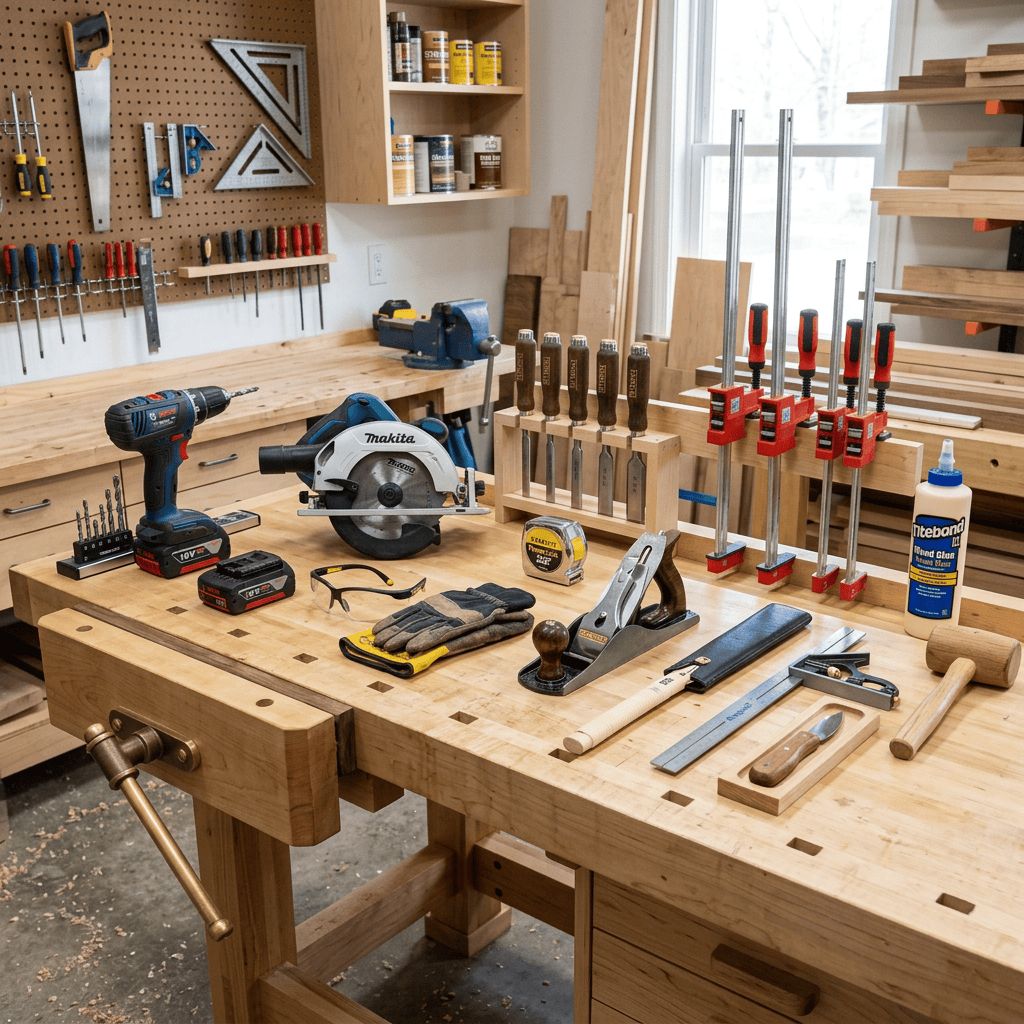
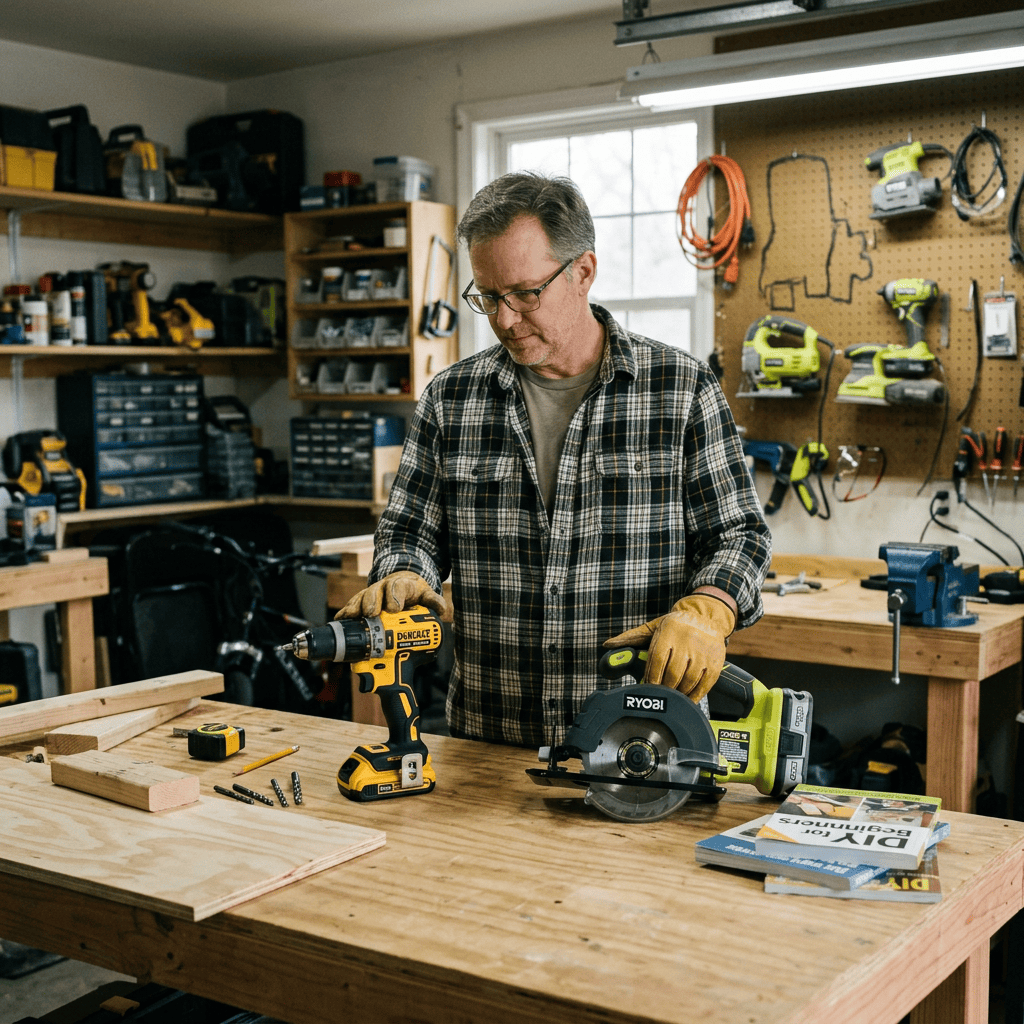
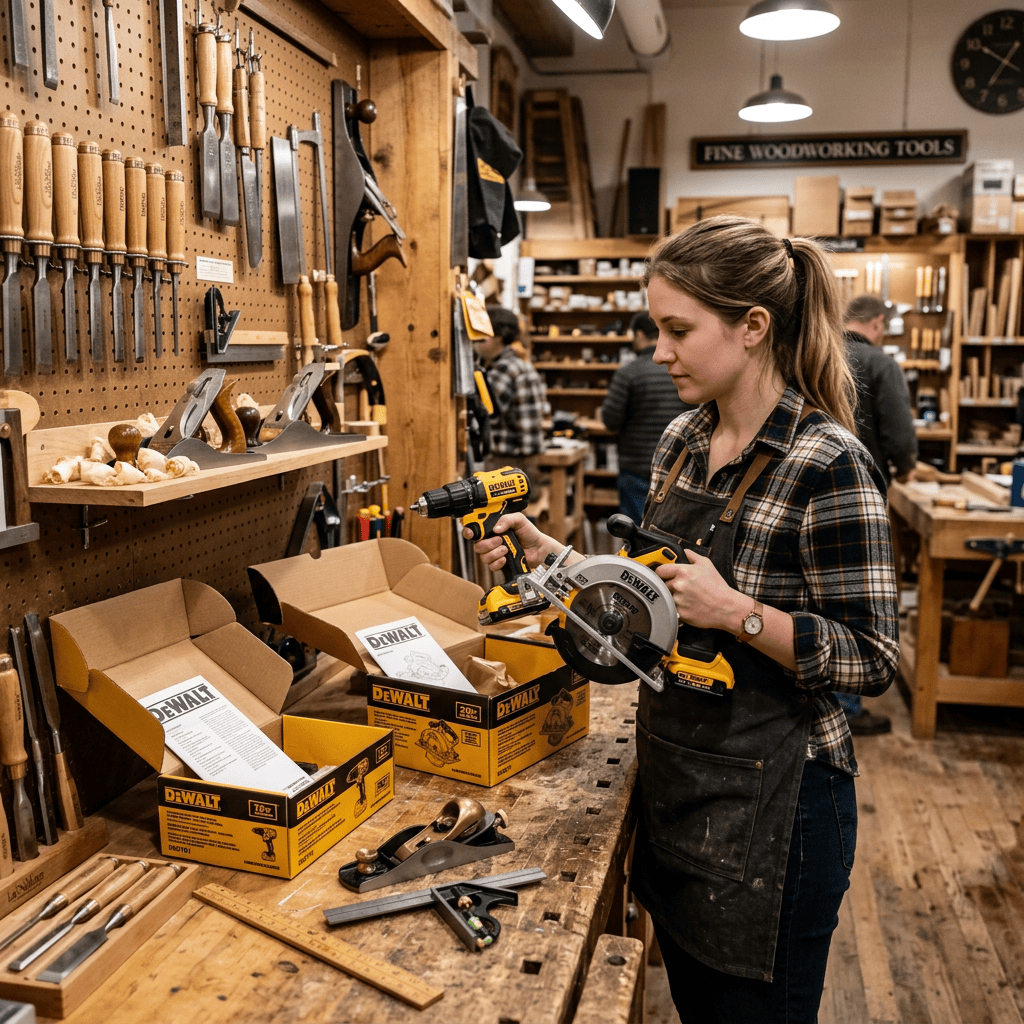
    Essential woodworking tools for DIY including a drill, circular saw, chisels, clamps, measuring tools, and sander.

    1. Tape Measure

    Why it’s essential

    Every woodworking project starts with accurate measurements.

    A quality tape measure helps ensure every board fits correctly before making a single cut.

    Look for

    • At least 25-foot length
    • Locking blade
    • Easy-to-read markings
    • Durable housing

    Best uses

    • Measuring lumber
    • Planning cuts
    • Room dimensions
    • Project layouts

    Without accurate measurements, even expensive tools cannot produce good results.

    Takeaway: Measure twice, cut once remains one of woodworking’s most valuable rules.

    2. Combination Square

    A combination square helps create perfectly square lines and verifies 90° and 45° angles.

    This simple hand tool dramatically improves project accuracy.

    Uses

    • Marking cut lines
    • Checking corners
    • Measuring depth
    • Setting blade heights

    Among manual tools for woodworking, this is one of the most frequently used.

    Takeaway: Precision starts with proper layout and measurement.

    3. Cordless Drill and Driver

    A cordless drill is arguably the most versatile power tool in any workshop.

    It drills holes, drives screws, installs hardware, and assembles projects.

    Features to consider

    • 18V or 20V battery platform
    • Variable speed
    • Keyless chuck
    • Brushless motor

    Common DIY projects

    • Shelves
    • Cabinets
    • Furniture
    • Outdoor planters

    Many manufacturers offer battery systems that power multiple tools using the same batteries.

    Takeaway: A quality cordless drill should be one of your first investments.

    4. Circular Saw

    A circular saw provides fast, straight cuts in plywood, hardwood, and construction lumber.

    It’s often the best alternative to a table saw for beginners.

    Advantages

    • Portable
    • Affordable
    • Powerful
    • Versatile

    Best for

    • Cutting sheet goods
    • Framing
    • Deck projects
    • DIY furniture

    Pairing the saw with a straight-edge guide significantly improves cutting accuracy.

    Takeaway: A circular saw offers excellent cutting capability without requiring large workshop space.

    5. Random Orbital Sander

    Smooth surfaces separate amateur projects from professional-looking furniture.

    A random orbital sander removes imperfections while minimizing visible sanding marks.

    Recommended sandpaper grits

    GritPurpose
    80Heavy material removal
    120General sanding
    180Finish preparation
    220Final smoothing

    Dust collection is an important feature to reduce cleanup and improve air quality.

    Takeaway: Proper sanding greatly enhances stain and paint finishes.

    6. Wood Chisels

    Wood chisels remain among the most important essential DIY woodworking tools despite modern power equipment.

    They provide precision where machines cannot.

    Common uses

    • Cleaning joints
    • Carving
    • Trimming
    • Mortise work
    • Hinge installation

    A starter set typically includes:

    • ¼ inch
    • ½ inch
    • ¾ inch
    • 1 inch

    Keeping chisels sharp is critical for both safety and performance.

    Takeaway: Sharp chisels offer better control and cleaner results.

    7. Clamps

    Experienced woodworkers often joke that it’s impossible to own too many clamps.

    They’re only half joking.

    Clamps hold materials securely during:

    • Glue-ups
    • Assembly
    • Cutting
    • Drilling
    • Finishing

    Recommended clamp types

    Clamp TypeBest Use
    Bar clampsFurniture assembly
    Trigger clampsQuick positioning
    Pipe clampsLarge panels
    Spring clampsLight-duty holding

    Good clamps improve accuracy while reducing movement.

    Takeaway: Clamps act as extra hands throughout nearly every woodworking project.

    8. Jigsaw

    Unlike circular saws, jigsaws excel at curved and intricate cuts.

    They’re ideal for decorative woodworking and custom shapes.

    Best projects

    • Signs
    • Decorative shelves
    • Curved furniture
    • Interior cutouts

    Choose blades designed specifically for wood to produce cleaner edges.

    Takeaway: A jigsaw expands your creative possibilities beyond straight cuts.

    9. Solid Workbench

    Every workshop benefits from a stable work surface.

    A sturdy workbench improves safety while providing support for measuring, cutting, sanding, and assembly.

    Features worth considering include:

    • Flat surface
    • Built-in vise
    • Dog holes
    • Storage shelves
    • Heavy construction

    Portable workbenches work well for smaller garages or shared workspaces.

    Takeaway: A reliable workbench becomes the center of every woodworking shop.

    10. Safety Equipment

    Safety equipment deserves a permanent place on every woodworking equipment list.

    Essential items include:

    • Safety glasses
    • Hearing protection
    • Dust mask or respirator
    • Push sticks
    • Work gloves (when appropriate)
    • First-aid kit

    Wood dust can create long-term respiratory issues, making dust protection especially important.

    Takeaway: The safest workshop is also the most productive one.

    Comparison Table: Best Woodworking Tools for DIY

    ToolCategoryBest ForBeginner Friendly
    Tape MeasureManualMeasuringYes
    Combination SquareManualLayoutYes
    Cordless DrillPowerAssemblyYes
    Circular SawPowerStraight cutsYes
    Random Orbital SanderPowerSurface finishingYes
    Wood ChiselsManualFine detailYes
    ClampsAccessoryAssemblyYes
    JigsawPowerCurved cutsYes
    WorkbenchWorkspaceStabilityYes
    Safety EquipmentProtectionInjury preventionAbsolutely

    How Should Beginners Choose Woodworking Tools?

    Beginner selecting woodworking tools for DIY while comparing versatile power tools for home woodworking projects.

    If you’re new to woodworking, avoid buying every tool at once.

    Instead, build your collection gradually.

    Step 1

    Start with measuring and layout tools.

    Step 2

    Add one versatile cutting tool.

    Step 3

    Purchase a drill.

    Step 4

    Invest in sanding equipment.

    Step 5

    Expand with specialty tools as projects become more advanced.

    Buying quality tools slowly often costs less than replacing inexpensive tools repeatedly.

    Takeaway: Prioritize versatility before specialization.

    Common Mistakes When Buying Woodworking Tools

    Many new DIY woodworkers make similar purchasing mistakes.

    Buying the cheapest tools

    Low-quality tools often lack precision and durability.

    Ignoring safety gear

    Protective equipment should never be an afterthought.

    Purchasing specialized tools too early

    Focus first on must-have woodworking tools that support many project types.

    Forgetting accessories

    Blades, drill bits, clamps, batteries, and sandpaper significantly affect performance.

    Choosing based only on brand

    Read reviews, compare features, and match tools to your project needs rather than relying solely on a brand name.

    Takeaway: Smart purchasing decisions improve both safety and long-term value.

    Best Practices for Building Your DIY Workshop

    To create an efficient workspace:

    • Keep tools organized.
    • Sharpen cutting tools regularly.
    • Replace worn blades promptly.
    • Clean sawdust after every project.
    • Store batteries properly.
    • Calibrate measuring tools periodically.
    • Maintain adequate lighting.
    • Ensure proper ventilation.

    Regular maintenance extends tool life and improves project quality.

    Takeaway: An organized workshop supports better craftsmanship.

    Common Questions About Woodworking Tools for DIY

    What is the first woodworking tool I should buy?

    A cordless drill is typically the best first purchase because it handles drilling, screw driving, and countless assembly tasks.

    Do beginners need expensive tools?

    No. Mid-range, reliable tools usually provide the best balance between quality and affordability.

    Are hand tools still important?

    Yes. Many manual tools for woodworking offer greater precision than power tools for detailed tasks.

    Can I build furniture with basic tools?

    Absolutely. Many furniture projects require only a small collection of essential DIY woodworking tools.

    Which saw is best for beginners?

    A circular saw is often the best combination of versatility, affordability, and ease of use.

    How many clamps do I need?

    More than you think. Start with four to six quality clamps and expand as projects grow.

    Should I buy corded or cordless tools?

    Cordless tools offer greater mobility, while corded tools provide continuous power for extended use. Many DIYers benefit from a mix of both.

    Why This Matters

    Choosing the right woodworking tools is about more than convenience. Every tool influences the accuracy, safety, and overall enjoyment of your projects.

    A well-planned toolkit helps beginners build confidence, develop skills faster, and complete a wider variety of DIY projects without unnecessary frustration or expense.

    Rather than chasing every new gadget, focus on tools that deliver consistent value across many tasks.

    A foundation of dependable measuring tools, cutting equipment, fastening tools, sanding tools, clamps, and safety gear creates a workshop that can grow with your experience.

    As your skills improve, you can add specialty equipment with a clear understanding of how it fits your workflow.

    FAQ

    What are the best woodworking tools for DIY projects?

    The best woodworking tools for DIY projects include a tape measure, combination square, cordless drill, circular saw, random orbital sander, wood chisels, clamps, jigsaw, sturdy workbench, and safety equipment. Together, these tools support accurate measuring, cutting, assembly, finishing, and safe project completion.

    Which woodworking tools should beginners buy first?

    Beginners should start with essential tools that provide the greatest versatility. A tape measure, combination square, cordless drill, circular saw, clamps, and safety gear form a practical foundation that supports a wide range of woodworking projects before investing in specialized equipment.

    Are power tools necessary for DIY woodworking?

    Power tools are not required for every project, but they improve efficiency and consistency. A cordless drill, circular saw, and random orbital sander are among the most useful power tools for DIY woodworking because they handle common tasks quickly while remaining beginner-friendly.

    How much should I spend on beginner woodworking tools?

    Most beginners can assemble a dependable starter toolkit with mid-range tools that balance performance and durability. Investing in reliable equipment often provides better long-term value than buying the least expensive options that may wear out quickly or deliver inconsistent results.

    What safety equipment is essential for woodworking?

    Essential woodworking safety equipment includes safety glasses, hearing protection, a dust mask or respirator, push sticks, and a well-stocked first-aid kit. These items help reduce the risk of eye injuries, hearing damage, respiratory issues, and accidents during cutting, sanding, and assembly.

    Final Summary

    The best woodworking tools for DIY projects combine accurate measuring tools, versatile power tools, reliable hand tools, sturdy workholding solutions, and essential safety equipment.

    By starting with a tape measure, combination square, cordless drill, circular saw, random orbital sander, chisels, clamps, jigsaw, workbench, and protective gear, beginners can confidently tackle everything from simple home repairs to custom furniture builds.

    Build your toolkit gradually, prioritize quality over quantity, and maintain your equipment well—your skills and project results will improve with every build.

    For additional woodworking safety guidelines and tool recommendations, refer to trusted industry resources such as the Occupational Safety and Health Administration (OSHA), the WOOD Magazine, and the This Old House. These sources provide reliable information on woodworking safety, tool selection, and DIY best practices.

    Ready to start building with confidence? Discover the fastest way to complete better woodworking projects with the right plans and tools. Visit 👉 https://besthomeshed.com/WoodworkingShortcut/ today

  • What Hand Tools Are Essential for Every Woodworker? A Complete Guide to Essential Hand Tools

    What Hand Tools Are Essential for Every Woodworker? A Complete Guide to Essential Hand Tools

    Quick Answer

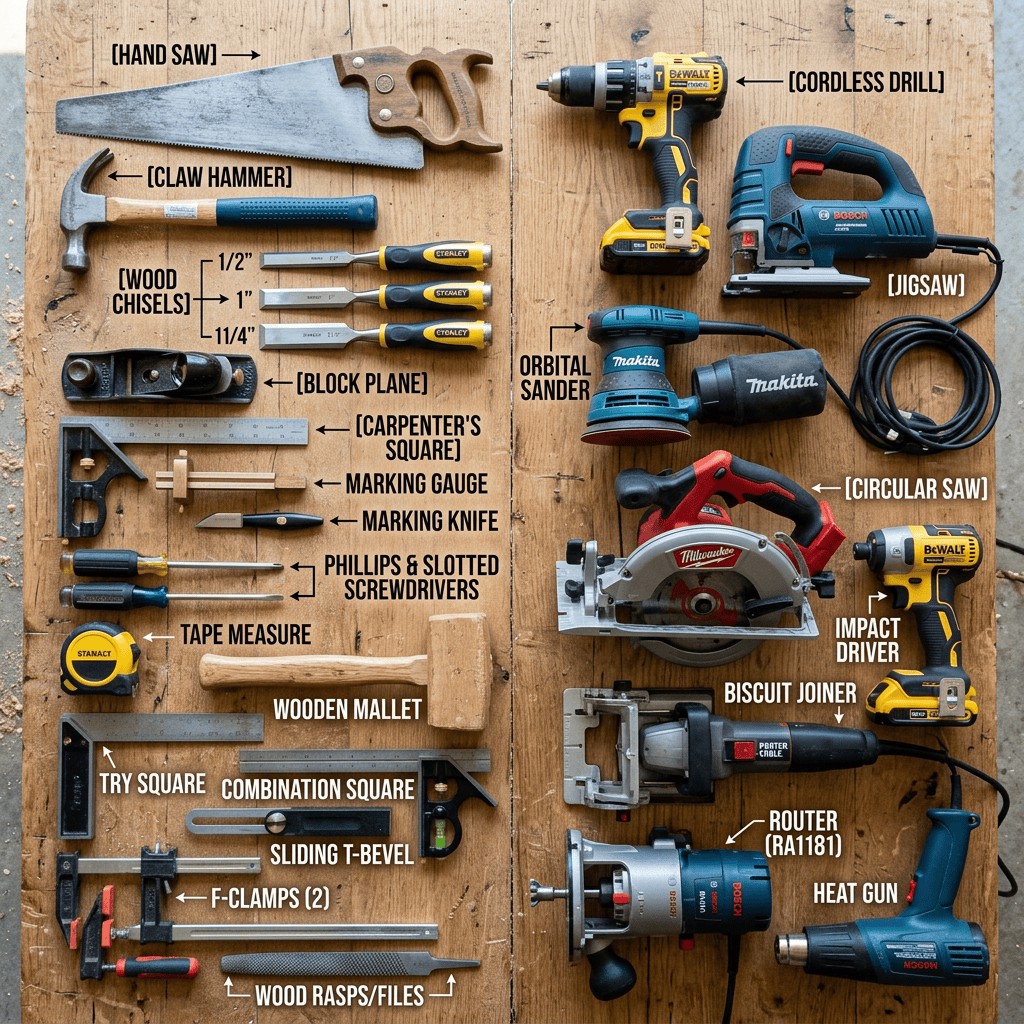
    The essential hand tools every woodworker should own include a tape measure, combination square, marking gauge, chisels, hand saw, block plane, claw hammer, mallet, screwdrivers, clamps, utility knife, coping saw, files, rasps, and sharpening stones.

    Together, these woodworking hand tools provide the accuracy, control, and versatility needed for measuring, cutting, shaping, assembling, and finishing nearly any woodworking project.

    Key Takeaways

    • Every woodworker should own a core set of essential hand tools for measuring, cutting, shaping, fastening, and finishing wood.
    • High-quality hand tools improve accuracy, durability, and overall woodworking results.
    • Beginners should master basic hand tools before investing in advanced power equipment.
    • Proper maintenance, including sharpening and cleaning, significantly extends tool life.
    • Selecting the right tools depends on the types of woodworking projects you plan to build.
    • Safe handling and proper storage help prevent injuries and protect your investment.

    What Hand Tools Are Essential for Every Woodworker?

    Whether you’re building furniture, crafting decorative pieces, or tackling DIY home improvements, essential hand tools remain the foundation of woodworking. While power tools increase speed, hand tools provide unmatched precision, control, and craftsmanship.

    Many experienced woodworkers rely on traditional woodworking hand tools for tasks where accuracy matters most, such as fitting joints, trimming edges, smoothing surfaces, and making fine adjustments.

    Even professional cabinetmakers and carpenters often finish projects with hand tools to achieve cleaner, more refined results.

    If you’re just beginning your woodworking journey, investing in the right must-have woodworking tools will allow you to complete a wide variety of projects without purchasing expensive machinery.

    Takeaway: A well-rounded collection of hand tools gives every woodworker the versatility to build accurately, safely, and confidently.

    Why Are Hand Tools Important for Woodworking?

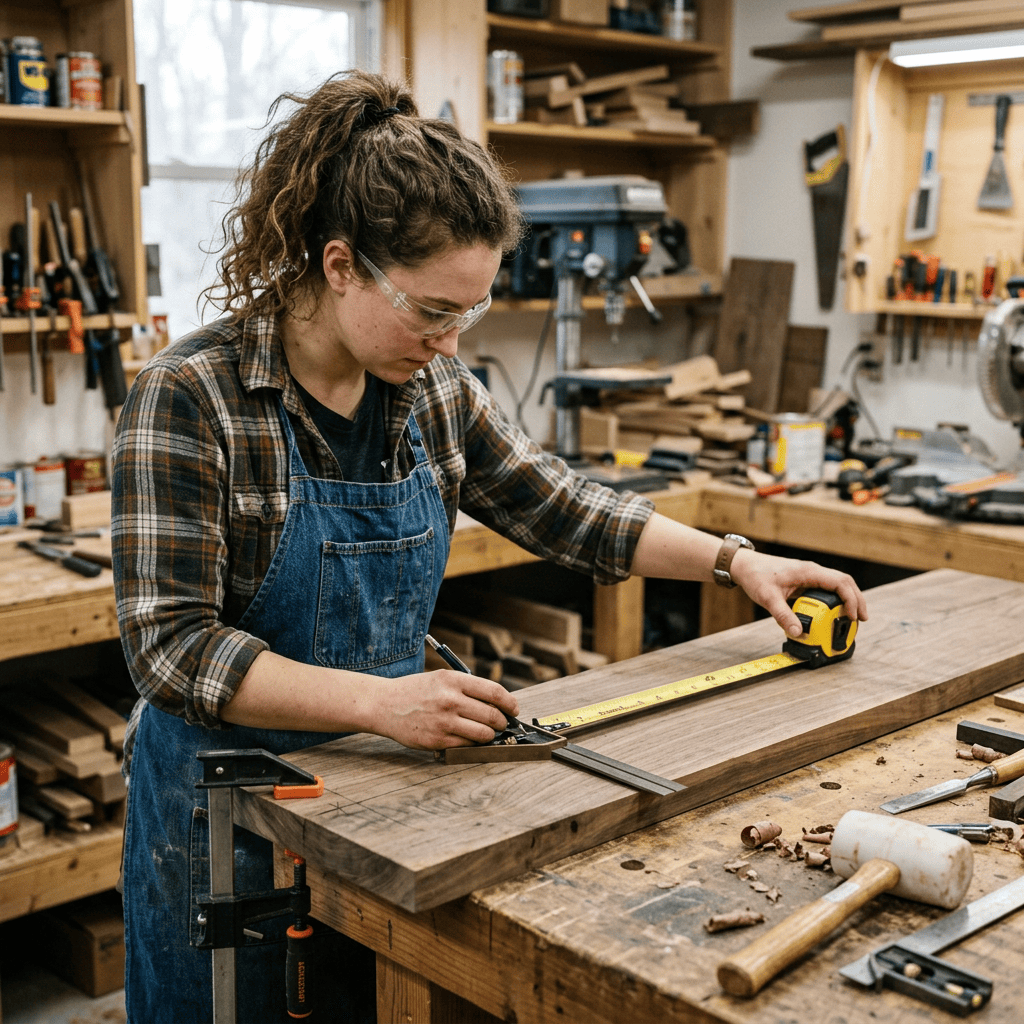
    Essential hand tools being used to measure and mark wood accurately before cutting in a woodworking workshop.

    Hand tools are more than alternatives to power tools—they are essential instruments for developing craftsmanship and precision.

    Greater Accuracy

    Many woodworking operations require adjustments measured in fractions of a millimeter. Hand tools allow you to remove small amounts of material with exceptional control, reducing mistakes and improving fit.

    Examples include:

    • Fine-tuning dovetail joints
    • Trimming cabinet doors
    • Cleaning mortises
    • Leveling glue joints

    Better Skill Development

    Learning to use hand tools teaches foundational woodworking skills, including:

    • Reading wood grain
    • Controlling cutting angles
    • Proper measuring techniques
    • Tool maintenance
    • Joinery fundamentals

    These skills transfer directly to advanced woodworking and improve results even when using power tools.

    Lower Cost

    For beginners, assembling a collection of hand tools for woodworking beginners is often significantly more affordable than purchasing multiple stationary machines.

    Many quality hand tools last decades with proper care, making them excellent long-term investments.

    Increased Safety

    While all tools require caution, hand tools generally present fewer hazards than high-speed power tools. Beginners can focus on developing technique before introducing more complex equipment.

    Greater Portability

    Hand tools require no electricity and can be used virtually anywhere, whether in a home workshop, garage, or job site.

    Takeaway: Hand tools provide precision, affordability, portability, and skill development that every woodworker benefits from throughout their woodworking journey.

    Essential Hand Tools Every Woodworker Should Own

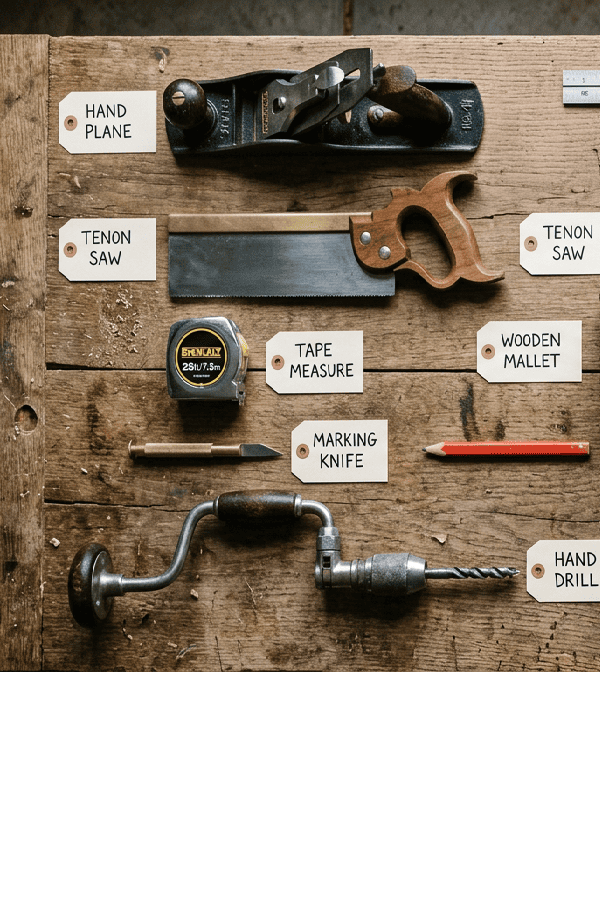
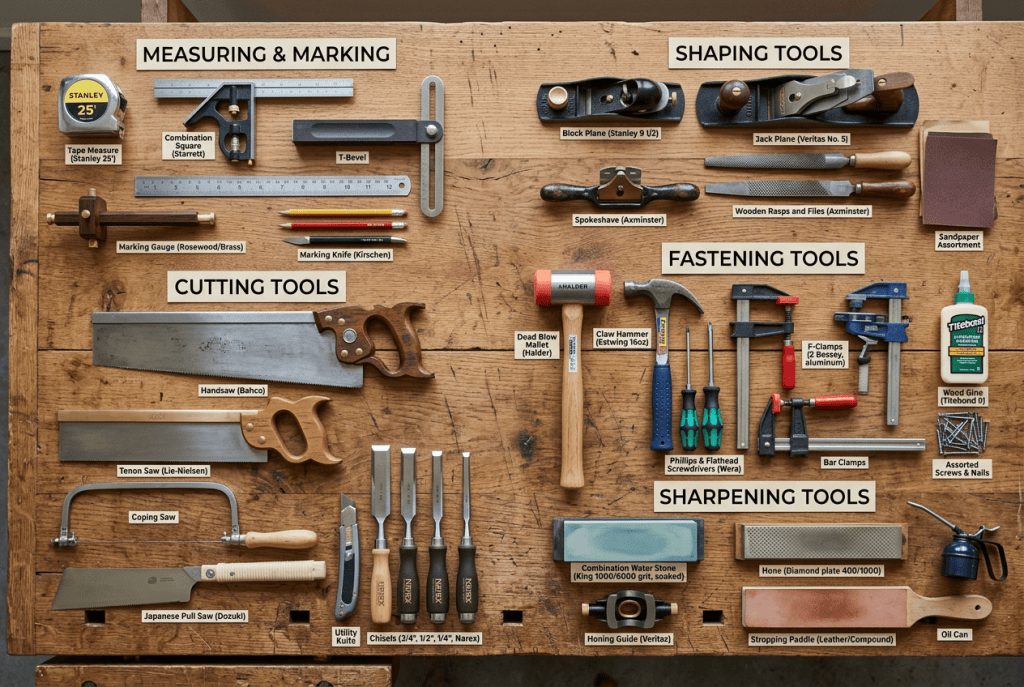
    Complete collection of essential hand tools for woodworking beginners including chisels, planes, hand saws, clamps, and measuring tools.

    The following woodworking tool list covers the core tools every beginner and hobbyist should consider purchasing first.

    1. Tape Measure

    Primary Purpose

    Accurate measurement is the foundation of every successful woodworking project.

    A quality tape measure helps you:

    • Measure lumber
    • Mark cut lengths
    • Verify dimensions
    • Ensure project consistency

    Features to Look For

    • 25-foot length
    • Easy-to-read markings
    • Durable blade coating
    • Locking mechanism
    • Fractional measurements

    Even minor measuring errors compound throughout a project, making this one of the most important essential hand tools you’ll own.

    Takeaway: Measure carefully before every cut to minimize waste and improve accuracy.

    2. Combination Square

    A combination square is one of the most versatile woodworking hand tools available.

    Uses

    • Marking 90° angles
    • Checking square corners
    • Measuring depth
    • Finding 45° angles
    • Setting saw and blade heights

    Unlike a basic carpenter’s square, the adjustable head makes it useful across numerous woodworking tasks.

    Professional woodworkers often reach for their combination square dozens of times during a single project.

    Takeaway: If you buy only one measuring tool after a tape measure, make it a quality combination square.

    3. Marking Gauge

    Precision begins with accurate layout lines.

    A marking gauge creates clean, consistent reference lines by scoring the wood rather than drawing with graphite.

    Advantages

    • More accurate than pencils
    • Easier saw alignment
    • Cleaner chisel work
    • Better joinery

    It’s particularly valuable for:

    • Mortise-and-tenon joints
    • Dovetails
    • Cabinetmaking
    • Furniture building

    Takeaway: A marking gauge increases precision and reduces layout errors before cutting begins.

    4. Bench Chisels

    Few best hand tools for carpentry are as versatile as a quality set of bench chisels.

    Common Uses

    • Cleaning joints
    • Trimming excess wood
    • Removing waste
    • Fine carving
    • Fitting hardware

    Recommended Sizes

    Chisel SizeBest For
    1/4 inchFine detail work
    1/2 inchGeneral-purpose cutting
    3/4 inchJoinery
    1 inchLarger trimming tasks

    High-carbon steel or premium alloy steel blades maintain sharp edges longer and require less frequent sharpening.

    Takeaway: Sharp chisels are safer, easier to control, and produce cleaner cuts than dull ones.

    5. Wooden or Rubber Mallet

    A mallet works alongside chisels without damaging their handles.

    Unlike metal hammers, wooden or rubber mallets deliver controlled force while reducing the risk of splitting tool handles or denting workpieces.

    Ideal uses include:

    • Chisel work
    • Joinery assembly
    • Tapping parts into alignment
    • Furniture assembly

    Choose a balanced mallet with a comfortable grip and enough weight to drive chisels efficiently without causing fatigue.

    Takeaway: Pairing a quality mallet with sharp chisels creates one of the most effective tool combinations in woodworking.

    6. Hand Saw

    Although powered saws are common, every workshop benefits from at least one reliable hand saw.

    Typical Applications

    • Crosscutting boards
    • Rip cutting lumber
    • Trimming stock
    • Fine joinery
    • Working where power tools aren’t practical

    There are several types to consider:

    • Crosscut saw
    • Rip saw
    • Back saw
    • Japanese pull saw

    Japanese pull saws are especially popular among beginners because they require less effort while producing exceptionally clean cuts.

    Takeaway: A sharp hand saw offers greater control than many beginners expect and remains indispensable for precision work.

    7. Block Plane

    A block plane is one of the most frequently used tools for woodworking projects because it quickly refines edges and surfaces.

    Common Tasks

    • Breaking sharp edges
    • Trimming end grain
    • Leveling joints
    • Adjusting doors
    • Fine fitting

    Look for a low-angle block plane with adjustable blade depth for maximum versatility.

    Keeping the blade razor-sharp dramatically improves cutting performance and leaves a smooth finish that often requires little sanding.

    Takeaway: A block plane is a simple yet powerful tool for adding precision and polish to woodworking projects.

    8. Claw Hammer

    No woodworking shop is complete without a dependable claw hammer.

    Although primarily associated with carpentry, it serves many woodworking purposes, including:

    • Driving finish nails
    • Removing nails
    • Light assembly work
    • Temporary positioning during glue-ups

    Choose a hammer weighing between 16 and 20 ounces with a comfortable, non-slip handle for balanced performance.

    Modern fiberglass and hickory handles both offer excellent durability, with hickory providing superior vibration absorption.

    Takeaway: A balanced claw hammer remains one of the most reliable and versatile tools in any woodworking toolkit.

    Essential Hand Tools Every Woodworker Should Own

    9. Screwdrivers

    A quality set of screwdrivers is indispensable for assembling projects, installing hardware, and making adjustments. While cordless drills speed up repetitive tasks, manual screwdrivers offer greater control and reduce the risk of over-tightening screws.

    Essential Types

    • Phillips head
    • Flathead (slotted)
    • Precision screwdrivers for small hardware
    • Stubby screwdriver for confined spaces

    Choose screwdrivers with hardened steel shafts and ergonomic, non-slip handles to reduce hand fatigue during extended use.

    Best Practice: Use the correct screwdriver size for each screw to prevent stripped heads and damaged hardware.

    Takeaway: A dependable screwdriver set ensures cleaner assembly and protects both fasteners and finished workpieces.

    10. Woodworking Clamps

    Many experienced woodworkers say you can never own too many clamps. Proper clamping pressure keeps components aligned while glue cures and improves the strength of every joint.

    Common Clamp Types

    Clamp TypeBest Uses
    Bar ClampLarge panels, tabletops
    F-ClampGeneral woodworking
    Spring ClampQuick temporary holding
    Corner ClampCabinet assembly
    Pipe ClampLarge glue-ups

    How Many Clamps Do Beginners Need?

    A practical starter collection includes:

    • Four 12-inch F-clamps
    • Two 24-inch bar clamps
    • Several spring clamps

    As your projects become more complex, you’ll naturally expand your collection.

    Takeaway: Quality clamps improve alignment, reduce assembly errors, and produce stronger glue joints.

    11. Utility Knife

    A sharp utility knife performs many precision tasks that are difficult to accomplish with larger cutting tools.

    Common Uses

    • Marking cut lines
    • Trimming veneer
    • Opening packages
    • Cleaning glue squeeze-out
    • Scoring plywood
    • Cutting sandpaper

    Replace blades regularly rather than forcing dull blades through material.

    Sharp blades produce cleaner cuts while reducing the chance of slips.

    Takeaway: A utility knife is an inexpensive but highly versatile addition to every woodworking tool list.

    12. Coping Saw

    The coping saw excels at making intricate curved cuts that standard hand saws cannot easily produce.

    Ideal Applications

    • Decorative trim
    • Curved furniture components
    • Internal cutouts
    • Coping molding
    • Fine woodworking details

    Its thin replaceable blade allows tight turning radii, making it a favorite for detailed craftsmanship.

    Takeaway: A coping saw expands the creative possibilities for custom woodworking projects.

    13. Files and Rasps

    Files and rasps shape wood gradually while maintaining excellent control.

    Rasps

    Best suited for:

    • Rapid material removal
    • Shaping curves
    • Sculpting wooden parts

    Files

    Best for:

    • Refining edges
    • Smoothing surfaces
    • Removing tool marks
    • Fine adjustments

    Many furniture makers rely on rasps before sanding because they preserve crisp edges and maintain precise shapes.

    Takeaway: Files and rasps allow controlled shaping that bridges rough cutting and final sanding.

    14. Sharpening Stones

    Sharp tools are safer, easier to control, and produce significantly cleaner cuts than dull ones.

    Every woodworker should learn basic sharpening techniques.

    Common Sharpening Options

    Stone TypeAdvantages
    Water StoneFast cutting, excellent edge
    Oil StoneDurable, economical
    Diamond StoneLow maintenance, long-lasting

    Regular sharpening benefits:

    • Cleaner cuts
    • Less physical effort
    • Improved safety
    • Longer tool life
    • Better project quality

    Many professionals sharpen chisels and planes before every major project rather than waiting until they become noticeably dull.

    Takeaway: Maintaining sharp tools is one of the simplest ways to improve woodworking results.

    Comparison Table: Essential Hand Tools for Woodworkers

    ToolPrimary FunctionRecommended for Beginners
    Tape MeasureMeasuring
    Combination SquareLayout and angles
    Marking GaugePrecision marking
    Bench ChiselsJoinery and trimming
    MalletChisel work and assembly
    Hand SawCutting lumber
    Block PlaneSmoothing and trimming
    Claw HammerFastening and nail removal
    ScrewdriversHardware installation
    ClampsGlue-ups and assembly
    Utility KnifeScoring and trimming
    Coping SawCurved cuts
    Files & RaspsShaping wood
    Sharpening StonesTool maintenance

    How to Choose Quality Hand Tools

    Comparison of essential hand tools showing quality woodworking tools with durable steel blades and ergonomic handles.

    Not all hand tools are created equal. Investing in durable, well-made tools often saves money over time by improving performance and reducing replacement costs.

    Prioritize Build Quality

    Look for:

    • High-carbon or alloy steel blades
    • Precision-machined components
    • Solid hardwood or ergonomic composite handles
    • Corrosion-resistant finishes

    Avoid tools with excessive plastic components in high-stress areas.

    Buy Essential Tools First

    Instead of purchasing large tool kits filled with items you may rarely use, focus on building a collection gradually.

    A sensible purchasing order includes:

    1. Measuring tools
    2. Cutting tools
    3. Chisels
    4. Clamps
    5. Planes
    6. Sharpening equipment

    This approach ensures every purchase adds immediate value to your workshop.

    Consider Long-Term Value

    Premium tools typically offer:

    • Better edge retention
    • Improved accuracy
    • Greater comfort
    • Longer service life
    • Easier maintenance

    Although quality hand tools often cost more initially, they frequently become lifetime investments.

    Takeaway: Buy fewer, better tools instead of filling your workshop with inexpensive tools that wear out quickly.

    Hand Tool Safety Tips

    Using hand tools safely protects both the woodworker and the quality of the project.

    Always Keep Tools Sharp

    Sharp tools require less force, making them easier to control and less likely to slip.

    Secure Your Workpiece

    Use clamps or a sturdy workbench to prevent movement during cutting, chiseling, or planing.

    Wear Appropriate Safety Equipment

    Recommended personal protective equipment includes:

    • Safety glasses
    • Hearing protection when working near power tools
    • Dust mask when sanding
    • Closed-toe footwear

    Cut Away From Your Body

    Whenever possible, direct blades away from your hands and torso to reduce injury risk.

    Inspect Tools Regularly

    Before beginning a project, check for:

    • Loose handles
    • Cracked grips
    • Damaged blades
    • Rust
    • Bent components

    Repair or replace damaged tools immediately.

    Takeaway: Safe woodworking begins with proper tool maintenance, careful technique, and good workshop habits.

    Common Mistakes Woodworking Beginners Make

    Even with the best hand tools for carpentry, beginners often encounter avoidable setbacks.

    Buying Too Many Tools Too Soon

    Large starter kits often include tools that rarely get used. Focus on mastering the essentials before expanding your collection.

    Choosing Cheap Tools Over Quality

    Low-quality tools often suffer from poor accuracy, uncomfortable handles, and short service lives.

    Ignoring Tool Maintenance

    Failing to sharpen blades or clean tools regularly reduces performance and increases frustration.

    Measuring Only Once

    The classic woodworking advice remains true:

    Measure twice, cut once.

    Double-checking measurements saves both time and material.

    Skipping Practice

    Before cutting expensive hardwood, practice techniques on scrap wood to build confidence and improve precision.

    Takeaway: Developing good habits early leads to better craftsmanship and fewer costly mistakes.

    Best Practices for Building Your Hand Tool Collection

    A thoughtful approach to buying and using tools will help you get the most from your investment.

    Start With Versatile Tools

    Choose tools that can perform multiple functions before purchasing specialty items.

    Learn Proper Technique

    Spend time practicing accurate measuring, controlled cutting, and sharpening skills.

    Organize Your Workshop

    Store tools in a clean, dry location where they remain protected and easy to access.

    Maintain Tools Regularly

    Clean metal surfaces, apply rust protection when needed, and sharpen cutting edges consistently.

    Expand Based on Your Projects

    As your woodworking interests evolve—from furniture making to cabinetry or carving—add specialized tools that support those goals.

    Takeaway: Building a quality collection gradually allows you to develop skills alongside your toolkit, resulting in better projects and greater long-term satisfaction.

    Common Questions About Essential Hand Tools

    What are the most essential hand tools for woodworking?

    The most essential hand tools include a tape measure, combination square, marking gauge, bench chisels, mallet, hand saw, block plane, claw hammer, screwdrivers, clamps, utility knife, coping saw, files, rasps, and sharpening stones.

    These tools cover measuring, cutting, shaping, assembling, and finishing nearly every woodworking project.

    Are hand tools better than power tools?

    Neither is inherently better—they serve different purposes. Hand tools provide greater precision, control, and craftsmanship, while power tools improve speed and efficiency. Most experienced woodworkers use both, choosing the right tool based on the task.

    Which hand tools should a beginner buy first?

    Beginners should prioritize versatile tools that support a wide range of projects:

    1. Tape measure
    2. Combination square
    3. Claw hammer
    4. Hand saw
    5. Bench chisels
    6. Wooden mallet
    7. Screwdriver set
    8. Clamps
    9. Block plane
    10. Sharpening stone

    Starting with these tools builds a strong foundation without unnecessary expense.

    How much should I spend on woodworking hand tools?

    Rather than purchasing the cheapest options, invest in reliable tools from reputable manufacturers.

    A well-made chisel or plane can last decades with proper maintenance, making quality hand tools a better long-term value than frequently replacing inexpensive alternatives.

    How often should hand tools be sharpened?

    Sharpen tools whenever cutting performance begins to decline. Many professional woodworkers touch up chisels and plane irons before each major project, while hobbyists may sharpen after several sessions depending on use.

    Can I complete woodworking projects using only hand tools?

    Yes. Many furniture makers, cabinetmakers, and traditional woodworkers create exceptional projects using only hand tools. Although power tools can speed up production, hand tools are fully capable of producing accurate, high-quality results.

    What is the most versatile woodworking hand tool?

    The combination square is one of the most versatile tools in any workshop. It measures, marks, checks angles, verifies squareness, measures depth, and helps set up other tools, making it invaluable throughout nearly every project.

    How should I store woodworking hand tools?

    Store tools in a clean, dry environment away from moisture. Use wall racks, tool chests, or cabinet drawers to keep tools organized and protected. Applying a light coat of rust inhibitor to metal surfaces also helps extend tool life.

    Why This Matters

    Woodworking is more than assembling pieces of wood—it is the practice of transforming raw materials into functional, durable, and often beautiful creations. While modern machinery has accelerated production, hand tools continue to define the quality of fine craftsmanship.

    Learning to use essential hand tools develops skills that machines cannot replace. Accurate measuring, controlled cutting, careful fitting, and understanding wood grain all contribute to stronger joints, cleaner finishes, and better overall workmanship.

    For beginners, mastering hand tools also builds confidence. Each project reinforces core techniques that carry over to more advanced woodworking disciplines, whether you’re building furniture, cabinetry, decorative pieces, or home improvement projects.

    Investing in quality hand tools is equally important. Durable tools provide greater accuracy, improved comfort, and reliable performance for many years. With routine maintenance and proper sharpening, a well-made hand tool can remain a trusted part of your workshop for decades.

    Ultimately, woodworking success depends less on owning the most expensive equipment and more on understanding how to use a carefully selected collection of essential tools effectively.

    Expert Insight: Developing strong hand tool skills improves precision, reduces mistakes, and creates a foundation that supports every stage of your woodworking journey.

    FAQ

    What hand tools are essential for every woodworker?

    Every woodworker should own a tape measure, combination square, marking gauge, bench chisels, mallet, hand saw, block plane, claw hammer, screwdrivers, clamps, utility knife, coping saw, files, rasps, and sharpening stones.

    Together, these tools support measuring, cutting, shaping, assembling, and finishing woodworking projects.

    Why are hand tools important in woodworking?

    Hand tools provide greater precision, control, and craftsmanship than many power tools. They are ideal for fine joinery, detailed shaping, accurate fitting, and finishing work while helping woodworkers develop essential foundational skills.

    What are the best hand tools for woodworking beginners?

    The best hand tools for woodworking beginners include a tape measure, combination square, hand saw, chisels, hammer, screwdriver set, clamps, block plane, and sharpening stone.

    These versatile tools allow beginners to complete a wide variety of projects while learning fundamental woodworking techniques.

    How do I choose quality hand tools?

    Look for tools made from high-carbon or alloy steel with durable construction, ergonomic handles, and precision manufacturing.

    Purchasing fewer high-quality tools is generally a better investment than buying large sets of lower-quality tools that wear out quickly.

    How can I maintain woodworking hand tools?

    Maintain hand tools by cleaning them after use, storing them in a dry environment, regularly sharpening cutting edges, applying rust protection to metal surfaces, and inspecting handles and blades for damage before each project. Proper maintenance improves safety, accuracy, and tool longevity.

    Final Summary

    The essential hand tools every woodworker should own form the backbone of a productive and enjoyable workshop.

    From measuring tools like tape measures and combination squares to cutting, shaping, assembling, and sharpening tools, each plays a vital role in producing accurate, professional-quality results.

    Whether you’re a beginner building your first project or a hobbyist expanding your skills, investing in quality hand tools will improve your craftsmanship, increase efficiency, and provide reliable performance for years to come.

    Start with the fundamentals, learn proper techniques, maintain your tools consistently, and expand your collection as your woodworking experience grows.

    By mastering these woodworking hand tools, you’ll be well-equipped to tackle everything from simple DIY builds to intricate furniture projects with confidence and precision.

    For additional woodworking guidance and safety recommendations, refer to authoritative resources from the WOOD Magazine, the Fine Woodworking, and the Occupational Safety and Health Administration (OSHA), which provide trusted information on woodworking techniques, tool selection, and workshop safety.

    Ready to sharpen your woodworking skills and build smarter?

    👉 Discover the complete Woodworking Shortcut system and learn practical techniques that help you work faster, improve accuracy, and achieve professional-quality results.

  • How Beginners Can Choose Quality Woodworking Tools: A Complete Guide to Buying Quality Woodworking Tools

    How Beginners Can Choose Quality Woodworking Tools: A Complete Guide to Buying Quality Woodworking Tools

    Quick Answer

    Beginners can choose quality woodworking tools by focusing on durability, accuracy, safety, comfort, and value instead of buying the largest tool collection available.

    Start with essential hand tools, invest in trusted woodworking tool brands, purchase only the tools needed for your first projects, maintain them properly, and upgrade gradually as your skills improve.

    Key Takeaways

    • Buy quality over quantity to avoid replacing cheap tools later.
    • Start with essential hand tools before investing in expensive power tools.
    • Choose reputable woodworking tool brands known for reliability and customer support.
    • Read woodworking tool reviews from experienced users before purchasing.
    • Prioritize woodworking tool safety and proper maintenance from day one.
    • Buy tools that match your current projects instead of future ambitions.
    • Maintain sharp, clean, and calibrated tools to maximize performance and lifespan.

    Beginner’s Guide to Choosing Quality Woodworking Tools

    Whether you want to build furniture, create home décor, or complete DIY projects, choosing the right woodworking tools is one of the most important decisions you’ll make.

    Good tools make woodworking safer, more accurate, and more enjoyable, while poor-quality tools often create frustration and inconsistent results.

    Many beginners assume they need a fully equipped workshop before getting started. In reality, experienced woodworkers recommend building your collection gradually by purchasing high-quality essentials first.

    This guide explains how to identify quality woodworking tools, what to buy first, what to avoid, and how to make smart purchasing decisions that save money over time.

    What Are Quality Woodworking Tools?

    Quality woodworking tools: The art of woodworking

    Quality woodworking tools are tools designed to deliver:

    • Accurate cuts and measurements
    • Long-lasting durability
    • Comfortable operation
    • Safe performance
    • Reliable precision over many years

    A quality tool isn’t necessarily the most expensive one. Instead, it consistently performs well while maintaining its accuracy after repeated use.

    Characteristics of Quality Woodworking Tools

    FeatureWhy It Matters
    Durable materialsLasts longer under repeated use
    Precision manufacturingProduces accurate results
    Comfortable handlesReduces fatigue
    Replaceable partsExtends tool life
    Good warrantyDemonstrates manufacturer confidence
    Positive reviewsIndicates consistent performance

    Takeaway: Quality comes from reliability, precision, and durability—not simply price.

    Why Should Beginners Invest in Quality Woodworking Tools?

    Buying inexpensive tools may seem like a smart way to save money, but poorly made tools often create inaccurate cuts, unsafe conditions, and unnecessary frustration.

    Quality tools provide several long-term benefits.

    Benefits

    • Greater cutting accuracy
    • Better project results
    • Longer lifespan
    • Improved safety
    • Less maintenance
    • Higher resale value
    • Better learning experience

    A sharp, well-built chisel teaches proper technique. A dull, poorly made chisel teaches bad habits.

    Takeaway: Good tools help beginners develop skills faster while reducing mistakes.

    What Are the Essential Woodworking Tools for Beginners?

    Essential quality woodworking tools for beginners including chisels, measuring tools, hand saws, and clamps.

    You don’t need every tool available. Instead, build a practical starter toolkit.

    Best Hand Tools for Woodworking

    Start with these essential woodworking tools:

    1. Tape measure
    2. Combination square
    3. Marking gauge
    4. Pencil or marking knife
    5. Claw hammer
    6. Block plane
    7. Chisels
    8. Hand saw
    9. Coping saw
    10. Screwdrivers
    11. Woodworking clamps
    12. Sanding block

    These tools allow beginners to complete many projects without a large investment.

    Why Hand Tools Matter

    Hand tools teach:

    • Precision
    • Grain direction
    • Wood behavior
    • Proper cutting techniques

    Many professional woodworkers still rely heavily on hand tools despite owning advanced machinery.

    Takeaway: Mastering hand tools builds a strong woodworking foundation.

    Which Power Tools Should Beginners Buy First?

    Once you’ve gained confidence with hand tools, adding a few power tools increases efficiency.

    Recommended Power Tools for Woodworking

    1. Cordless Drill

    Useful for:

    • Drilling holes
    • Driving screws
    • Installing hardware

    2. Random Orbital Sander

    Provides smooth finishes quickly while reducing visible sanding marks.

    3. Circular Saw

    Ideal for:

    • Breaking down plywood
    • Straight cuts
    • DIY construction

    4. Jigsaw

    Perfect for:

    • Curves
    • Decorative cuts
    • Small projects

    5. Router (Intermediate)

    Useful after gaining experience for:

    • Edge profiles
    • Joinery
    • Decorative details

    Many beginners feel pressured to buy a table saw immediately. While it’s an excellent tool, it isn’t required for learning basic woodworking.

    Takeaway: Buy power tools based on the projects you plan to build—not on someone else’s workshop.

    How Can You Identify High-Quality Woodworking Tools?

    Beginner comparing quality woodworking tools, including hand tools and power tools before purchasing.

    Several indicators separate premium tools from poor-quality alternatives.

    Check the Materials

    Quality tools often feature:

    • Hardened steel
    • Cast iron
    • Solid brass components
    • Hardwood handles
    • Aluminum precision parts

    Avoid excessive plastic in structural components.

    Examine Build Quality

    Look for:

    • Smooth machining
    • Tight tolerances
    • Clean finishes
    • No loose parts
    • Comfortable grips

    Evaluate Precision

    Accurate woodworking depends on accurate tools.

    Check whether:

    • Squares are truly square.
    • Guides adjust smoothly.
    • Measurements are easy to read.
    • Blades remain aligned.

    Review the Warranty

    Manufacturers offering long warranties usually have confidence in their products.

    Takeaway: Examine construction quality before focusing on price.

    Which Woodworking Tool Brands Are Trusted?

    Many reputable woodworking tool brands consistently produce dependable products.

    Popular Hand Tool Brands

    • Stanley
    • Irwin
    • Veritas
    • Lie-Nielsen
    • Narex
    • Bahco

    Popular Power Tool Brands

    • DeWalt
    • Makita
    • Bosch
    • Milwaukee
    • Festool
    • Ridgid

    Each brand offers products across different price ranges. Beginners don’t always need premium professional models, but buying from established manufacturers generally provides better quality, replacement parts, and customer support.

    Takeaway: Choose trusted brands with proven reputations instead of unfamiliar low-cost alternatives.

    How Should Beginners Read Woodworking Tool Reviews?

    Not every review provides useful information.

    Focus on reviews discussing:

    • Long-term durability
    • Accuracy
    • Ease of use
    • Customer service
    • Warranty claims
    • Replacement part availability

    Ignore reviews based solely on shipping speed or packaging.

    Professional woodworking publications, experienced YouTube educators, and respected woodworking communities often provide more balanced evaluations than anonymous online ratings.

    Takeaway: Look for reviews that evaluate real performance over time.

    What Should You Consider Before Buying Woodworking Tools?

    Before buying woodworking tools, ask yourself several practical questions.

    1. What Projects Will You Build?

    Different projects require different tools.

    For example:

    • Furniture
    • Cabinets
    • Shelving
    • Outdoor projects
    • Woodturning

    Buy tools that directly support your current goals.

    2. How Often Will You Use Them?

    Occasional DIY users may not need professional-grade equipment.

    Frequent hobbyists often benefit from investing in higher-quality tools.

    3. Is the Tool Comfortable?

    Comfort affects:

    • Accuracy
    • Fatigue
    • Safety

    Whenever possible, hold the tool before purchasing.

    4. Can It Be Maintained?

    Quality tools should allow:

    • Blade replacement
    • Sharpening
    • Calibration
    • Cleaning

    Disposable tools rarely provide long-term value.

    Takeaway: Match each purchase to your woodworking goals and expected usage.

    Common Mistakes Beginners Make When Buying Woodworking Tools

    Avoid these frequent mistakes.

    Buying Too Many Tools

    Start small.

    You can complete many projects using a surprisingly modest collection.

    Choosing Price Over Quality

    The cheapest option often becomes the most expensive after replacement.

    Ignoring Safety Features

    Look for:

    • Blade guards
    • Electric brakes
    • Dust collection
    • Stable bases
    • Anti-kickback features

    Skipping Research

    Even a few minutes spent reading woodworking tool reviews can prevent costly mistakes.

    Buying Specialized Tools Too Early

    Master general-purpose tools before purchasing highly specialized equipment.

    Takeaway: A focused, thoughtful buying strategy produces better results than impulsive purchases.

    Why Is Woodworking Tool Safety So Important?

    Maintaining quality woodworking tools through cleaning, sharpening, and safe workshop practices.

    Safety should always be your highest priority.

    Follow these best practices:

    • Wear eye protection.
    • Use hearing protection with power tools.
    • Wear a dust mask or respirator when needed.
    • Keep blades sharp.
    • Never remove safety guards.
    • Secure workpieces with clamps.
    • Read manufacturer instructions.
    • Disconnect power before changing blades or bits.

    Most woodworking injuries are preventable through proper training and safe habits.

    Takeaway: Safe woodworking begins with safe tool selection and responsible use.

    How Does Tool Maintenance Extend Tool Life?

    Proper tool maintenance protects your investment and improves performance.

    Basic Maintenance Checklist

    • Clean tools after use.
    • Remove sawdust.
    • Oil moving parts.
    • Protect metal from rust.
    • Sharpen blades regularly.
    • Check alignment.
    • Store tools in a dry environment.
    • Replace worn components promptly.

    Sharp tools are safer because they require less force and provide greater control.

    Takeaway: Regular maintenance improves accuracy, safety, and longevity.

    Common Questions About Choosing Quality Woodworking Tools

    Is it better to buy expensive woodworking tools?

    Not always. Mid-range tools from reputable manufacturers often provide the best balance of quality, performance, and affordability for beginners.

    Should beginners buy used woodworking tools?

    Yes, if the tools remain in good condition and can be inspected for wear, rust, cracks, and accuracy before purchase.

    Are cordless power tools better than corded tools?

    Cordless tools offer convenience and portability, while corded tools generally provide continuous power for extended use. The best choice depends on your projects.

    How many woodworking tools do beginners need?

    A basic collection of essential hand tools and two or three versatile power tools is enough to complete many beginner projects.

    Which tool should beginners upgrade first?

    Most woodworkers benefit from upgrading measuring tools, chisels, and drills first because these tools directly influence accuracy and daily workflow.

    Can cheap tools damage woodworking projects?

    Yes. Poorly made tools can create inaccurate cuts, rough finishes, and unsafe working conditions.

    Is brand reputation important?

    Yes. Established woodworking tool brands usually provide better quality control, replacement parts, warranties, and customer support.

    Why This Matters

    Choosing quality woodworking tools is about more than owning better equipment—it shapes your learning experience, safety, and confidence.

    Reliable tools produce predictable results, allowing you to focus on improving technique rather than compensating for inaccurate equipment.

    Over time, thoughtful purchases reduce waste, lower replacement costs, and make every project more enjoyable.

    Building a collection slowly, based on your actual needs, creates a workshop that grows with your skills rather than overwhelming your budget.

    FAQ

    How can beginners choose quality woodworking tools effectively?

    Beginners should prioritize durable, accurate, and comfortable tools from trusted brands. Start with essential hand tools, purchase only what current projects require, read reliable reviews, and expand your collection gradually as your skills develop.

    What are the most essential woodworking tools for beginners?

    Essential woodworking tools include a tape measure, combination square, chisels, hand saw, block plane, hammer, clamps, screwdrivers, cordless drill, random orbital sander, and circular saw for basic cutting and assembly.

    Which woodworking tool brands are best for beginners?

    Reliable brands include Stanley, Irwin, Narex, Veritas, DeWalt, Bosch, Makita, Milwaukee, Ridgid, and Festool. Choose products that fit your budget while offering dependable performance, warranties, and replacement parts.

    Why is woodworking tool maintenance important?

    Proper maintenance keeps tools sharp, accurate, and safe. Cleaning, lubricating, sharpening, and storing tools correctly extends their lifespan, improves performance, and reduces the risk of accidents caused by dull or damaged equipment.

    Should beginners buy hand tools or power tools first?

    Most beginners should begin with quality hand tools to learn core woodworking skills, then add versatile power tools such as a cordless drill, circular saw, and orbital sander as projects become more advanced.

    Final Summary

    Beginners can choose quality woodworking tools effectively by focusing on durability, precision, safety, and long-term value rather than buying the cheapest or most extensive collection available.

    Start with essential woodworking tools, invest in trusted woodworking tool brands, consult reliable woodworking tool reviews, and prioritize woodworking tool safety and tool maintenance for woodworkers.

    By purchasing tools that match your current projects and upgrading thoughtfully over time, you’ll build a dependable workshop, improve your craftsmanship, and enjoy woodworking for years to come.

    For additional guidance on woodworking safety, tool selection, and best practices, consult trusted industry resources such as the WOOD Magazine, the Fine Woodworking, and the U.S. Consumer Product Safety Commission (CPSC) for reliable safety recommendations.

    Ready to build your workshop with confidence? Discover the shortcuts, tool recommendations, and beginner-friendly woodworking plans you need to get started today.

    👉 Get started here

  • The Ultimate Guide to Woodworking Tools: Types, Uses, and Essential Tips for Beginners

    The Ultimate Guide to Woodworking Tools: Types, Uses, and Essential Tips for Beginners

    Quick Answer

    Woodworking tools include hand tools, power tools, measuring tools, cutting tools, shaping tools, and finishing tools. Each serves a specific purpose, from measuring and cutting to joining and smoothing wood.

    Beginners should focus on learning tool safety, choosing quality essentials, maintaining tools properly, and practicing basic techniques before investing in advanced woodworking tools.

    Key Takeaways

    • Woodworking tools fall into several categories, including hand tools, power tools, measuring tools, cutting tools, and finishing tools.
    • Beginners should master essential hand tools before expanding into power tools.
    • Understanding each tool’s purpose improves project quality, efficiency, and safety.
    • Regular cleaning, sharpening, and proper storage significantly extend tool lifespan.
    • Safety equipment such as eye protection, hearing protection, and dust masks is as important as the tools themselves.
    • Investing in reliable woodworking tool brands often provides better long-term value than purchasing the cheapest options.

    The Ultimate Guide to Woodworking Tools

    Whether you’re building furniture, creating decorative pieces, or tackling DIY home projects, choosing the right woodworking tools is one of the most important decisions you’ll make.

    Every tool has a specific purpose, and understanding when and how to use it helps you work more accurately, efficiently, and safely.

    This guide explains the different types of woodworking tools, their uses, essential woodworking tips, maintenance practices, and recommendations for beginners.

    What Are Woodworking Tools?

    Woodworking tools are specialized instruments designed to cut, shape, join, smooth, measure, and finish wood. They range from simple hand-operated tools to sophisticated power equipment capable of producing precise cuts and professional-quality finishes.

    The right combination of woodworking tools allows woodworkers to:

    • Build furniture
    • Construct cabinets
    • Create decorative wood art
    • Repair wooden structures
    • Complete DIY home improvement projects

    Takeaway: Every woodworking project depends on selecting the appropriate tools for each stage of the process.

    What Are the Main Types of Woodworking Tools?

    Woodworking tools including hand tools and power tools labeled for beginner woodworkers.

    Woodworking tools can be grouped into several primary categories.

    Tool CategoryPrimary PurposeExamples
    Measuring ToolsAccuracyTape measure, combination square, marking gauge
    Cutting ToolsCutting woodHandsaw, circular saw, jigsaw
    Shaping ToolsForming woodChisel, router, hand plane
    Drilling & Fastening ToolsCreating holes and assemblingDrill, impact driver
    Sanding & Finishing ToolsSurface preparationOrbital sander, sanding block
    Clamping ToolsHolding workpiecesBar clamps, C-clamps
    Safety EquipmentProtectionSafety glasses, hearing protection, dust mask

    Takeaway: Understanding these categories makes selecting the right tool much easier.

    What Are the Essential Hand Tools for Woodworking?

    Hand tools remain fundamental because they offer precision, control, and affordability.

    Measuring and Marking Tools

    Accurate measurements are the foundation of quality woodworking.

    Essential tools include:

    • Tape measure
    • Combination square
    • Speed square
    • Marking knife
    • Carpenter’s pencil
    • Marking gauge

    Without accurate measurements, even expensive power tools cannot produce quality results.

    Cutting Hand Tools

    Common cutting tools include:

    • Crosscut saw
    • Rip saw
    • Coping saw
    • Japanese pull saw

    Each saw is designed for different cutting directions and project types.

    Chisels

    Wood chisels remove material, clean joints, carve details, and create mortises.

    Choose chisels made from hardened high-carbon steel and keep them razor sharp.

    Hand Planes

    Hand planes flatten surfaces, smooth edges, and precisely reduce wood thickness.

    Popular types include:

    • Block plane
    • Jack plane
    • Smoothing plane

    Clamps

    Clamps act as an extra set of hands.

    Common varieties include:

    • Bar clamps
    • Pipe clamps
    • Spring clamps
    • Corner clamps

    Proper clamping improves glue joints and assembly accuracy.

    Takeaway: Beginners should build confidence using hand tools before relying heavily on power tools.

    Hand Tools vs. Power Tools

    Woodworking tools comparison showing hand tools versus power tools during woodworking projects.

    One of the biggest questions in woodworking is whether to use hand tools or power tools.

    Hand ToolsPower Tools
    Greater controlFaster production
    Lower costHigher productivity
    Quiet operationMore noise
    Minimal maintenanceRequires electricity or batteries
    Excellent for detail workIdeal for repetitive cuts

    When Should You Use Hand Tools?

    Use hand tools for:

    • Fine joinery
    • Detail carving
    • Small repairs
    • Quiet indoor work
    • Learning woodworking fundamentals

    When Should You Use Power Tools?

    Power tools excel when:

    • Building furniture
    • Cutting sheet goods
    • Repeating identical cuts
    • Completing large projects
    • Saving time

    Takeaway: Most experienced woodworkers use both hand tools and power tools because each offers unique advantages.

    Which Power Tools Should Beginners Buy First?

    Purchasing every available tool isn’t necessary. Instead, start with versatile equipment.

    1. Cordless Drill

    Uses include:

    • Drilling holes
    • Driving screws
    • Installing hardware
    • Light sanding attachments

    A quality cordless drill is often the first power tool every beginner should own.

    2. Circular Saw

    Perfect for:

    • Straight cuts
    • Breaking down plywood
    • Framing lumber
    • DIY projects

    3. Jigsaw

    Excellent for:

    • Curved cuts
    • Interior cutouts
    • Decorative shapes

    4. Random Orbital Sander

    Produces smooth finishes while reducing visible sanding marks.

    5. Router

    Although slightly more advanced, routers create:

    • Decorative edges
    • Grooves
    • Dados
    • Rabbets
    • Joinery

    Takeaway: Begin with versatile tools that support a wide range of woodworking projects.

    What Are Advanced Woodworking Tools?

    As your skills improve, advanced woodworking tools increase precision and efficiency.

    Examples include:

    • Table saw
    • Band saw
    • Drill press
    • Planer
    • Jointer
    • Scroll saw
    • Wood lathe
    • CNC router
    • Domino joiner

    These machines enable professional-level craftsmanship but require additional training and safety awareness.

    Takeaway: Advanced tools should complement experience, not replace foundational woodworking skills.

    What Are the Most Common Tool Uses in Woodworking?

    Every woodworking tool performs a specific function.

    ToolPrimary Use
    Tape MeasureMeasuring dimensions
    SquareChecking angles
    ChiselCutting joints
    Hand PlaneSmoothing wood
    Circular SawStraight cutting
    JigsawCurved cutting
    RouterEdge profiling
    DrillDrilling holes
    Orbital SanderSurface finishing
    ClampsHolding materials securely

    Knowing the correct tool uses in woodworking improves both efficiency and project quality.

    Takeaway: Matching the tool to the task produces cleaner, safer, and more accurate results.

    Essential Woodworking Tips for Beginners

    Learning woodworking becomes much easier by following proven best practices.

    1. Measure Twice, Cut Once

    Double-check every measurement before cutting.

    2. Buy Quality Over Quantity

    One high-quality tool usually outperforms several inexpensive alternatives.

    3. Practice on Scrap Wood

    Experiment before cutting expensive hardwood.

    4. Keep Tools Sharp

    Sharp blades require less force and produce cleaner cuts.

    5. Learn Proper Grain Direction

    Cutting with the wood grain reduces tear-out.

    6. Build Simple Projects First

    Begin with:

    • Shelves
    • Picture frames
    • Small boxes
    • Cutting boards

    7. Maintain a Clean Workspace

    Good organization improves both safety and productivity.

    Takeaway: Strong habits established early help beginners develop confidence and avoid costly mistakes.

    Safety Tips for Woodworking

    Woodworking tools stored safely with maintenance equipment and protective safety gear in an organized workshop.

    Woodworking is rewarding, but safety should always come first.

    Always:

    • Wear safety glasses
    • Use hearing protection
    • Wear a dust mask or respirator
    • Keep fingers away from blades
    • Disconnect power before changing blades
    • Secure workpieces with clamps
    • Read manufacturer instructions
    • Maintain proper lighting

    Never operate machinery when distracted or fatigued.

    Takeaway: Consistent safety habits protect both you and your equipment.

    How Should You Maintain Woodworking Tools?

    Proper maintenance keeps woodworking tools accurate and extends their lifespan.

    Cleaning

    After every project:

    • Remove sawdust
    • Wipe metal surfaces
    • Clean pitch from blades

    Sharpening

    Regularly sharpen:

    • Chisels
    • Hand planes
    • Carving tools

    Sharp tools are safer than dull ones because they require less force.

    Rust Prevention

    Apply light machine oil or specialized protectants to exposed steel.

    Inspection

    Check:

    • Loose handles
    • Damaged cords
    • Worn blades
    • Loose fasteners

    Takeaway: Preventive maintenance is less expensive than replacing damaged tools.

    Woodworking Tool Storage Best Practices

    Proper woodworking tool storage protects your investment.

    Popular storage solutions include:

    • Wall-mounted pegboards
    • Tool chests
    • Rolling cabinets
    • Drawer organizers
    • Magnetic holders
    • Dedicated shelving

    Store tools in dry environments to prevent corrosion.

    Label storage areas so every tool has a designated location.

    Takeaway: Organized storage improves workflow and increases tool longevity.

    What Are the Best Woodworking Tool Brands?

    Several manufacturers consistently produce reliable woodworking tools.

    Popular brands include:

    • DeWalt
    • Milwaukee
    • Makita
    • Bosch
    • Festool
    • Stanley
    • Irwin
    • Veritas
    • Lie-Nielsen
    • WoodRiver

    The best woodworking tool brands often offer better durability, warranty support, replacement parts, and long-term value.

    Takeaway: Choose tools based on reliability, intended use, and budget rather than brand name alone.

    Common Mistakes Beginners Should Avoid

    Avoid these common errors:

    1. Buying too many tools too quickly.
    2. Ignoring safety equipment.
    3. Using dull blades.
    4. Skipping project planning.
    5. Rushing measurements.
    6. Choosing the wrong wood species.
    7. Neglecting tool maintenance.
    8. Working in cluttered spaces.

    Learning from these mistakes accelerates skill development.

    Takeaway: Simple improvements in preparation and maintenance often have the biggest impact on woodworking success.

    Common Questions About Woodworking Tools

    What woodworking tools should every beginner own?

    A beginner should start with a tape measure, square, handsaw, chisels, cordless drill, circular saw, orbital sander, clamps, and basic safety equipment.

    Are hand tools better than power tools?

    Neither is universally better. Hand tools provide precision and control, while power tools increase speed and efficiency. Most woodworkers use both.

    How often should woodworking tools be sharpened?

    Sharpen tools whenever cutting performance declines. Frequent light sharpening is preferable to waiting until tools become extremely dull.

    Can inexpensive tools produce good work?

    Yes, especially for beginners. However, quality tools generally provide greater accuracy, durability, and ease of use.

    Which safety equipment is essential?

    Safety glasses, hearing protection, dust masks, push sticks, and appropriate work clothing should always be part of every woodworking setup.

    Do I need a workshop to start woodworking?

    No. Many beginners successfully work in garages, sheds, basements, or even small apartment spaces using portable tools.

    What wood is easiest for beginners?

    Softwoods like pine are inexpensive, forgiving, and easy to cut, making them ideal for learning.

    Why This Matters

    Understanding woodworking tools is more than simply learning equipment names. Each tool represents a specific capability that contributes to safer work, greater precision, and better craftsmanship.

    Beginners who build a strong foundation with measuring, cutting, shaping, and maintenance skills often progress more quickly than those who focus only on acquiring expensive machinery.

    Successful woodworking comes from combining knowledge, practice, patience, and proper tool care.

    As your experience grows, you’ll naturally recognize which tools improve your workflow and which are unnecessary for the types of projects you enjoy. Investing in skills before equipment leads to better results, lower costs, and a more rewarding woodworking journey.

    FAQ

    What are woodworking tools?

    Woodworking tools are hand-operated or powered instruments used to measure, cut, shape, drill, join, sand, and finish wood. They allow woodworkers to create furniture, cabinetry, decorative projects, and structural components with accuracy and efficiency.

    Which woodworking tools should beginners buy first?

    Most beginners should start with a tape measure, combination square, chisels, cordless drill, circular saw, orbital sander, clamps, and safety equipment. These versatile tools cover the majority of basic woodworking tasks without requiring a large investment.

    How do you maintain woodworking tools?

    Maintain woodworking tools by cleaning them after use, sharpening cutting edges regularly, preventing rust with protective oil, inspecting for damage, and storing them in a dry, organized space. Proper maintenance improves safety, accuracy, and tool longevity.

    What is the difference between hand tools and power tools?

    Hand tools rely on manual effort and offer greater precision for detailed work, while power tools use electricity or batteries to complete tasks faster and with less physical effort. Most woodworking projects benefit from a combination of both.

    What are the most important safety tips for woodworking?

    Always wear eye and hearing protection, use dust collection or a respirator, secure workpieces with clamps, keep blades sharp, follow manufacturer instructions, disconnect power before maintenance, and maintain a clean, well-lit workspace to reduce the risk of accidents.

    Final Summary

    Woodworking tools form the foundation of every successful woodworking project. From essential hand tools and versatile power tools to advanced machinery, each tool serves a specific purpose in measuring, cutting, shaping, assembling, and finishing wood.

    Beginners who understand the different types of woodworking tools, follow essential woodworking tips, prioritize safety, maintain their equipment, and invest in reliable tools will develop stronger skills and achieve consistently better results.

    Start with the essentials, practice regularly, and expand your toolkit as your confidence and experience grow.

    For more expert guidance, visit OSHA for woodworking safety recommendations, WoodWorkers Guild of America for woodworking techniques and tutorials, and Fine Woodworking for professional tool reviews and woodworking best practices.

    Ready to build your woodworking skills faster? Discover a step-by-step system, practical techniques, and beginner-friendly guidance at Woodworking Shortcut.

  • Hand Tools vs. Power Tools: What Are the Pros and Cons for Small Workshops?

    Hand Tools vs. Power Tools: What Are the Pros and Cons for Small Workshops?

    Quick Answer

    Choosing between hand tools vs. power tools depends on your workshop size, budget, project type, and woodworking goals.

    Hand tools offer greater precision, lower costs, quieter operation, and minimal maintenance, while power tools provide faster production, improved efficiency, and consistent results.

    Most small workshops benefit from combining both tool types to maximize versatility, accuracy, and productivity.

    Key Takeaways

    • Hand tools are affordable, quiet, space-efficient, and ideal for detailed craftsmanship.
    • Power tools save time, increase woodworking efficiency, and simplify repetitive tasks.
    • Small workshops often perform best with a balanced mix of hand and power tools.
    • Budget, available space, maintenance requirements, and project complexity should guide purchasing decisions.
    • Proper tool storage solutions help maximize workspace, improve safety, and extend tool life.
    • Beginners can start with essential hand tools before investing in larger power equipment.

    Hand Tools vs. Power Tools: A Complete Comparison for Small Workshops

    Whether you’re setting up your first woodworking shop or upgrading an existing workspace, one question inevitably arises:

    Should you invest in hand tools, power tools, or both?

    The answer isn’t always straightforward. Every woodworker—from hobbyists and DIY enthusiasts to professional furniture makers—faces trade-offs involving cost, precision, speed, workspace, and maintenance.

    Understanding the strengths and limitations of each option allows you to build a workshop that matches your projects, budget, and available space rather than simply buying the most expensive equipment.

    This guide compares hand tools vs. power tools across the factors that matter most for small workshops.

    Takeaway: The best choice depends on your woodworking goals rather than choosing one category exclusively.

    What Are Hand Tools?

    Hand tools are woodworking tools powered entirely by human effort rather than electricity or batteries.

    They have been used for centuries and remain essential in modern woodworking because they provide exceptional control and precision.

    Common Hand Tools

    • Chisels
    • Hand planes
    • Handsaws
    • Mallets
    • Coping saws
    • Block planes
    • Measuring tapes
    • Combination squares
    • Marking gauges
    • Clamps
    • Screwdrivers
    • Files
    • Rasps

    Most experienced woodworkers continue using hand tools even in highly equipped shops because certain tasks simply require greater control than machines can provide.

    Best Uses for Hand Tools

    • Fine joinery
    • Furniture restoration
    • Trimming joints
    • Smoothing surfaces
    • Carving
    • Detail work
    • Small repairs
    • Custom fitting components

    Because hand tools remove material gradually, they allow corrections before expensive mistakes occur.

    Takeaway: Hand tools prioritize precision, craftsmanship, and control over production speed.

    What Are Power Tools?

    Power tools use electricity, batteries, or compressed air to perform woodworking tasks faster and with less physical effort.

    These machines dramatically increase productivity, making them indispensable for larger projects and repetitive work.

    Common Power Tools

    • Table saw
    • Circular saw
    • Miter saw
    • Router
    • Jigsaw
    • Random orbital sander
    • Drill/driver
    • Impact driver
    • Band saw
    • Planer
    • Jointer
    • Scroll saw
    • Oscillating multi-tool

    Many modern cordless tools provide nearly the same performance as corded versions while improving portability in smaller workshops.

    Best Uses for Power Tools

    • Breaking down lumber
    • Crosscutting boards
    • Ripping sheet goods
    • Drilling holes
    • Sanding large surfaces
    • Edge profiling
    • Production work
    • Cabinet construction

    Power tools are particularly valuable when building multiple projects or working with hardwoods that require significant cutting power.

    Takeaway: Power tools maximize speed, consistency, and woodworking efficiency.

    Hand Tools vs. Power Tools: Side-by-Side Comparison

    Hand tools vs. power tools comparison featuring essential woodworking tools for beginners
    FeatureHand ToolsPower Tools
    Initial CostLowerHigher
    SpeedSlowerMuch faster
    PrecisionExcellent for detail workExcellent for repetitive cuts
    Learning CurveModerateModerate to high
    NoiseVery quietLoud
    Dust ProductionMinimalSignificant
    MaintenanceSimpleMore complex
    Storage NeedsCompactRequires more space
    Electricity RequiredNoYes (or batteries)
    Physical EffortHigherLower
    Safety RiskGenerally lowerHigher if used improperly
    Ideal UserHobbyists, fine woodworkersBuilders, production shops

    This comparison highlights why many experienced woodworkers avoid treating the decision as either-or. Instead, they select the right tool for each task.

    Takeaway: Understanding each tool category’s strengths helps you make smarter purchasing decisions and build a more capable small workshop.

    What Are the Advantages of Hand Tools?

    Hand tools continue to be valued because they offer benefits that machines cannot fully replace.

    1. Lower Initial Cost

    One of the biggest advantages of hand tools is affordability.

    A quality chisel or hand plane can last decades with proper care, making them a cost-effective investment for beginners and experienced woodworkers alike.

    For those concerned about the cost of hand tools, building a collection gradually is often easier than purchasing multiple expensive machines at once.

    2. Greater Precision and Control

    Hand tools excel when fine adjustments matter.

    Examples include:

    • Fitting dovetail joints
    • Trimming tenons
    • Cleaning mortises
    • Leveling glue joints
    • Chamfering edges

    The slower pace allows woodworkers to remove tiny amounts of material while minimizing costly errors.

    3. Compact Storage

    Small workshops often struggle with limited floor space.

    Most hand tools fit into:

    • Wall-mounted cabinets
    • Tool chests
    • Rolling carts
    • Drawer organizers

    Their compact size makes them excellent space-saving woodworking tools, especially in garages, basements, or shared workspaces.

    4. Quiet Operation

    Unlike machines, hand tools produce little noise.

    This makes them ideal for:

    • Apartment workshops
    • Evening woodworking
    • Shared garages
    • Neighborhood-friendly projects

    5. Minimal Maintenance

    Another major advantage is simple upkeep.

    Most hand tools require only:

    • Cleaning
    • Rust prevention
    • Sharpening blades
    • Occasional lubrication

    Compared with machine servicing, maintaining hand tools is inexpensive and straightforward.

    Takeaway: Hand tools offer affordability, precision, portability, and simplicity that make them indispensable in small woodworking shops.

    What Are the Benefits of Power Tools?

    Power tools are designed to increase productivity and reduce manual labor.

    For many woodworkers, they transform projects that would otherwise take days into tasks completed within hours.

    1. Faster Project Completion

    The most obvious benefit of power tools is speed.

    A table saw can make dozens of identical cuts in minutes, while a hand saw requires considerably more time and effort.

    This makes power tools invaluable for:

    • Cabinets
    • Shelving
    • Decking
    • Furniture production
    • Home renovation projects

    2. Improved Woodworking Efficiency

    Machines perform repetitive operations with remarkable consistency.

    Examples include:

    • Repeated crosscuts
    • Uniform ripping
    • Flush trimming
    • Edge routing
    • Large-scale sanding

    Higher woodworking efficiency means less fatigue and greater productivity, especially during larger builds.

    3. Easier Material Removal

    Dense hardwoods such as oak, maple, and walnut demand significant effort when worked entirely by hand.

    Power tools reduce strain while maintaining consistent results across multiple pieces.

    4. Better for Large Projects

    If your projects include:

    • Kitchen cabinets
    • Built-in shelving
    • Dining tables
    • Multiple furniture pieces

    Power tools save considerable time while improving repeatability.

    5. Consistent Accuracy

    Modern power tools include features such as:

    • Adjustable fences
    • Laser guides
    • Digital angle gauges
    • Precision stops
    • Dust collection compatibility

    These features help maintain consistent dimensions across repeated cuts.

    Takeaway: Power tools significantly improve speed, efficiency, and consistency, making them ideal for larger or repetitive woodworking projects.

    Summary

    When comparing hand tools vs. power tools, neither category is universally better. Hand tools excel in precision, affordability, quiet operation, and compact storage, while power tools shine in speed, efficiency, and handling larger projects.

    For most small workshops, understanding these core strengths provides the foundation for choosing the right tools based on your woodworking goals, available space, and budget.

    How Do Cost and Budget Affect Your Choice?

    Hand tools vs. power tools organized with space-saving storage solutions in a small workshop

    One of the first considerations when comparing hand tools vs. power tools is the total investment required. While both categories can become expensive over time, their upfront and long-term costs differ significantly.

    A thoughtful purchasing strategy helps you build a capable workshop without overspending.

    Hand Tool Costs

    The cost of hand tools is generally lower than purchasing stationary machinery or multiple cordless tools.

    Typical beginner investments include:

    • Handsaw
    • Chisels
    • Block plane
    • Combination square
    • Marking gauge
    • Clamps
    • Hammer or mallet
    • Screwdrivers

    Many of these tools can last decades with proper maintenance, making them excellent long-term investments.

    Advantages

    • Lower startup cost
    • No electricity required
    • No batteries to replace
    • Lower repair expenses
    • Long service life

    Power Tool Costs

    Power tools typically require a larger initial investment.

    Beyond the purchase price, you should also budget for:

    • Replacement blades
    • Router bits
    • Sandpaper
    • Batteries
    • Chargers
    • Extension cords
    • Dust collection equipment
    • Replacement motors or bearings (over time)

    While these costs add up, the increased productivity often offsets the investment for frequent woodworkers.

    Budget Tip

    Rather than buying every machine immediately, purchase tools based on the projects you plan to build over the next six to twelve months.

    This approach prevents unnecessary purchases while allowing your workshop to grow naturally.

    Takeaway: Hand tools offer the most affordable entry point, while power tools provide greater value as project volume increases.

    Which Tools Save the Most Space in a Small Workshop?

    Limited space is one of the biggest challenges facing home woodworkers.

    Choosing space-saving woodworking tools helps maximize efficiency without overcrowding your workspace.

    Hand Tools Require Minimal Storage

    Most hand tools occupy very little room.

    Popular storage options include:

    • French cleat systems
    • Wall-mounted racks
    • Pegboards
    • Tool chests
    • Drawer organizers
    • Portable toolboxes

    Because hand tools don’t require permanent floor space, they’re ideal for garages, sheds, basements, and shared workshops.

    Power Tools Need More Planning

    Larger machines require dedicated workspace and adequate clearance.

    Examples include:

    • Table saws
    • Band saws
    • Planers
    • Jointers
    • Drill presses

    In small workshops, consider compact or benchtop versions of these tools.

    Many manufacturers also produce folding stands and mobile bases that allow machines to be stored against a wall when not in use.

    Space-Saving Strategies

    If workshop space is limited, consider these solutions:

    1. Install wall-mounted storage.
    2. Use rolling tool cabinets.
    3. Choose multifunction tools when appropriate.
    4. Store portable tools vertically.
    5. Build fold-down work surfaces.
    6. Keep frequently used tools within easy reach.
    7. Label storage locations for faster organization.

    These tool storage solutions improve workflow while reducing clutter and safety hazards.

    Takeaway: Smart organization is just as important as tool selection when working in a compact shop.

    How Do Hand Tools and Power Tools Affect Woodworking Efficiency?

    Efficiency is about more than working quickly. It also includes accuracy, repeatability, setup time, cleanup, and overall workflow.

    When Hand Tools Are More Efficient

    Although slower, hand tools can actually save time when:

    • Making small adjustments
    • Cleaning joints
    • Trimming proud tenons
    • Fine-tuning cabinet doors
    • Breaking edges
    • Fitting drawers

    Using a large machine for these tasks often requires more setup than the task itself.

    When Power Tools Are More Efficient

    Power tools excel when repetitive work is involved.

    Examples include:

    • Cutting sheet goods
    • Milling rough lumber
    • Sanding tabletops
    • Routing decorative edges
    • Drilling dozens of identical holes

    These tasks benefit from consistent machine performance and reduced physical effort.

    Choosing the Right Tool for the Job

    Professional woodworkers rarely ask,

    “Which tool is better?”

    Instead, they ask,

    “Which tool completes this task most efficiently?”

    For example:

    TaskBest Choice
    Trimming a jointHand plane
    Cutting plywoodCircular saw or table saw
    Installing hingesChisel and drill
    Edge profilingRouter
    Smoothing a tabletopRandom orbital sander
    Final finish touch-upCard scraper or hand plane

    Combining both tool types creates a more efficient workflow than relying exclusively on one category.

    Takeaway: The highest woodworking efficiency comes from matching the tool to the task rather than using the same type of tool for every operation.

    How Much Maintenance Do Power Tools Require?

    Maintenance is an important but often overlooked ownership cost.

    Understanding the maintenance of power tools helps extend their lifespan and improve safety.

    Common Maintenance Tasks

    Most power tools require regular:

    • Dust removal
    • Blade replacement
    • Lubrication
    • Fence alignment
    • Belt inspection
    • Bearing checks
    • Battery care
    • Electrical cord inspection

    Ignoring routine maintenance can reduce accuracy and increase the risk of mechanical failure.

    Hand Tool Maintenance

    Hand tools require much less maintenance.

    Typical care includes:

    • Keeping blades sharp
    • Removing rust
    • Applying protective oil
    • Flattening plane soles when necessary
    • Storing tools in a dry environment

    Although sharpening takes practice, many woodworkers consider it part of the craft.

    Maintenance Comparison

    Maintenance FactorHand ToolsPower Tools
    CleaningEasyModerate
    SharpeningFrequentOccasional
    Mechanical RepairsRareSometimes required
    Electrical ComponentsNoneYes
    Battery ReplacementNonePossible
    Long-Term CostsLowModerate to High

    Takeaway: Hand tools are generally easier and less expensive to maintain, while power tools require more routine care to deliver reliable performance.

    What Are the Best Tools for Small Shops?

    Hand tools vs. power tools demonstrating precision craftsmanship and woodworking efficiency

    If you’re building a workshop from scratch, focus on versatile tools that cover the widest range of woodworking tasks.

    Essential Hand Tools

    A practical starter collection includes:

    • Measuring tape
    • Combination square
    • Marking knife
    • Chisel set
    • Block plane
    • Handsaw
    • Clamps
    • Mallet
    • Screwdrivers
    • Utility knife

    These tools support layout, cutting, assembly, and fine adjustments.

    Essential Power Tools

    For many small workshops, these machines provide the greatest value:

    • Cordless drill/driver
    • Circular saw
    • Random orbital sander
    • Jigsaw
    • Router
    • Miter saw (if space allows)
    • Shop vacuum or dust extractor

    As your projects become more advanced, you can consider adding:

    • Table saw
    • Band saw
    • Thickness planer
    • Drill press

    Purchasing tools gradually allows you to invest in higher-quality equipment while avoiding unnecessary expenses.

    Recommended Starter Combination

    A balanced workshop often includes:

    Hand Tools

    • Chisel set
    • Block plane
    • Measuring tools
    • Clamps
    • Handsaw

    Power Tools

    • Drill
    • Circular saw
    • Router
    • Orbital sander

    This combination handles the majority of woodworking projects while keeping costs and storage requirements manageable.

    Takeaway: The best tools for small shops are versatile, reliable, and suited to the projects you build most often.

    Common Mistakes to Avoid When Choosing Workshop Tools

    Many new woodworkers spend too much money on equipment they rarely use.

    Avoid these common mistakes.

    1. Buying Every Machine Immediately

    Purchase tools as your projects require them rather than filling your shop all at once.

    2. Ignoring Workshop Space

    Measure your available floor space before purchasing stationary equipment.

    Remember to account for infeed and outfeed clearance, not just the machine’s footprint.

    3. Prioritizing Quantity Over Quality

    A few well-made tools generally outperform a large collection of inexpensive alternatives.

    Quality tools also last longer and provide more consistent results.

    4. Neglecting Dust Collection

    Dust affects:

    • Tool performance
    • Workshop cleanliness
    • Finish quality
    • Air quality
    • Personal health

    Even a compact dust extractor or shop vacuum significantly improves the working environment.

    5. Forgetting About Storage

    Tools that lack designated storage quickly create clutter, reduce efficiency, and increase the risk of accidents.

    Plan storage alongside tool purchases rather than as an afterthought.

    Takeaway: Careful planning prevents unnecessary spending and creates a safer, more efficient small workshop.

    Practical Recommendations: Should You Choose Hand Tools, Power Tools, or Both?

    For most woodworkers, the answer isn’t one or the other—it’s both.

    Use this simple guide to decide where to focus your investment.

    If You…Best Choice
    Enjoy traditional craftsmanshipPrimarily hand tools
    Build furniture regularlyA balanced combination
    Complete home improvement projectsMore power tools
    Have a limited budgetStart with hand tools
    Have limited spaceCompact hand tools with portable power tools
    Produce multiple identical piecesPrimarily power tools
    Value quiet operationHand tools
    Need maximum productivityPower tools with supporting hand tools

    The most successful small workshops blend the precision of hand tools with the speed and consistency of power tools. This balanced approach allows you to tackle a wider variety of projects while adapting to different woodworking tasks efficiently.

    Summary

    Cost, workspace, maintenance, and efficiency all influence the decision between hand tools vs. power tools.

    Hand tools remain the better choice for affordability, compact storage, and fine craftsmanship, while power tools excel at productivity and repetitive work.

    For most woodworkers, a thoughtfully selected combination of both provides the greatest flexibility, long-term value, and overall workshop performance.

    Common Questions About Hand Tools vs. Power Tools

    Are hand tools better than power tools for beginners?

    Not necessarily. Hand tools are generally more affordable, quieter, and easier to store, making them ideal for learning woodworking fundamentals.

    However, basic power tools such as a cordless drill and circular saw can significantly reduce project time. A balanced approach gives beginners the best opportunity to develop skills while completing projects efficiently.

    Which tools produce more accurate results?

    Accuracy depends more on proper technique than the tool itself.

    Hand tools offer exceptional control for delicate joinery, trimming, and fine adjustments. Power tools excel at making repeatable, consistent cuts once they are properly set up and calibrated.

    Can a small workshop function with only hand tools?

    Yes. Many skilled woodworkers build furniture, cabinets, and decorative pieces using only hand tools.

    However, projects typically take longer, and milling rough lumber by hand requires more physical effort.

    Are power tools worth the investment?

    For woodworkers who build projects regularly, power tools often provide excellent value.

    They improve woodworking efficiency by reducing manual labor, increasing consistency, and dramatically shortening project completion times.

    Which tools require more maintenance?

    Power tools require more ongoing maintenance because they contain motors, bearings, belts, batteries, and electrical components.

    Hand tools usually require only cleaning, sharpening, rust prevention, and proper storage.

    What is the best combination for a small woodworking shop?

    Many experienced woodworkers recommend starting with:

    • Quality measuring tools
    • Chisels
    • Block plane
    • Clamps
    • Cordless drill
    • Circular saw
    • Router
    • Random orbital sander

    This combination covers most woodworking tasks while remaining practical for smaller spaces.

    How can I maximize storage in a small workshop?

    Use vertical space whenever possible.

    Popular tool storage solutions include:

    • French cleat wall systems
    • Pegboards
    • Magnetic tool holders
    • Rolling cabinets
    • Fold-away workbenches
    • Stackable storage bins

    Keeping tools organized improves workflow, safety, and productivity.

    Why This Matters

    Choosing between hand tools vs. power tools is about more than purchasing equipment—it’s about designing a workshop that supports your woodworking goals today and adapts as your skills grow.

    Many beginners assume that owning more machines automatically leads to better results. In reality, successful woodworking depends on understanding when each tool offers the greatest advantage.

    Hand tools encourage patience, precision, and a deeper understanding of wood grain, joinery, and material behavior. These foundational skills often translate into higher-quality craftsmanship, regardless of the equipment used later.

    Power tools, on the other hand, make larger projects more manageable by reducing physical effort and improving production speed. They allow hobbyists and professionals alike to complete repetitive tasks with greater consistency and efficiency.

    The most productive small workshops rarely rely exclusively on one approach. Instead, experienced woodworkers combine the speed of machines with the control of hand tools, selecting the best option for each stage of a project.

    As your workshop evolves, prioritize versatility over volume. Invest in quality tools that match the work you actually perform, organize them effectively, and maintain them properly.

    This thoughtful approach saves money, maximizes limited space, and creates a safer, more enjoyable woodworking environment for years to come.

    Takeaway: Understanding the strengths of both hand tools and power tools helps you make smarter investments, improve craftsmanship, and build a workshop that grows with your experience.

    FAQ

    Which is better: hand tools or power tools?

    Neither is universally better. Hand tools offer greater precision, lower costs, quieter operation, and compact storage, while power tools provide faster cutting, higher productivity, and consistent results. Most small workshops benefit from using both, depending on the project and task.

    Are hand tools cheaper than power tools?

    Yes. Hand tools typically have a lower purchase price and require less maintenance.

    They also have fewer ongoing expenses because they don’t rely on electricity, batteries, or complex mechanical components.

    This makes them an affordable option for beginners and budget-conscious woodworkers.

    What power tools should every small workshop have?

    Most small workshops benefit from starting with a cordless drill, circular saw, random orbital sander, and router. These versatile tools handle drilling, cutting, sanding, and shaping, making them suitable for a wide variety of woodworking projects without requiring excessive space.

    How can I save space in a small woodworking shop?

    Maximize vertical storage with pegboards, French cleat systems, wall cabinets, and magnetic holders.

    Choose compact or benchtop machines, use rolling tool carts, and store portable power tools in stackable organizers. Good organization improves efficiency and workshop safety.

    Should beginners buy hand tools or power tools first?

    Beginners should start with essential hand tools for measuring, marking, and assembly, then add a few versatile power tools such as a drill and circular saw as projects become more ambitious.

    This balanced approach builds foundational skills while improving productivity.

    Final Summary

    Choosing between hand tools vs. power tools ultimately comes down to your woodworking goals, available space, budget, and the types of projects you plan to build.

    Hand tools excel in precision, affordability, quiet operation, and craftsmanship, while power tools offer superior speed, efficiency, and consistency for larger or repetitive tasks.

    Rather than viewing them as competing options, consider them complementary. A well-equipped small workshop combines the strengths of both, allowing you to work more accurately, complete projects faster, and adapt to a wider range of woodworking challenges.

    Whether you’re setting up your first workshop or upgrading an existing one, focus on buying quality tools that match your current needs, organizing them with practical tool storage solutions, and maintaining them regularly.

    Over time, this balanced strategy will improve your woodworking efficiency, protect your investment, and help you create better projects with confidence.

    For additional woodworking guidance, refer to authoritative resources such as OSHA, Wood Magazine, and Fine Woodworking. These organizations provide expert advice on workshop safety, woodworking techniques, and tool selection.

    Ready to build your woodworking skills faster?

    Whether you’re setting up your first shop or upgrading your tool collection, the right guidance can save you time, money, and frustration.

    👉 Discover practical woodworking plans, tool guides, and expert tips at:
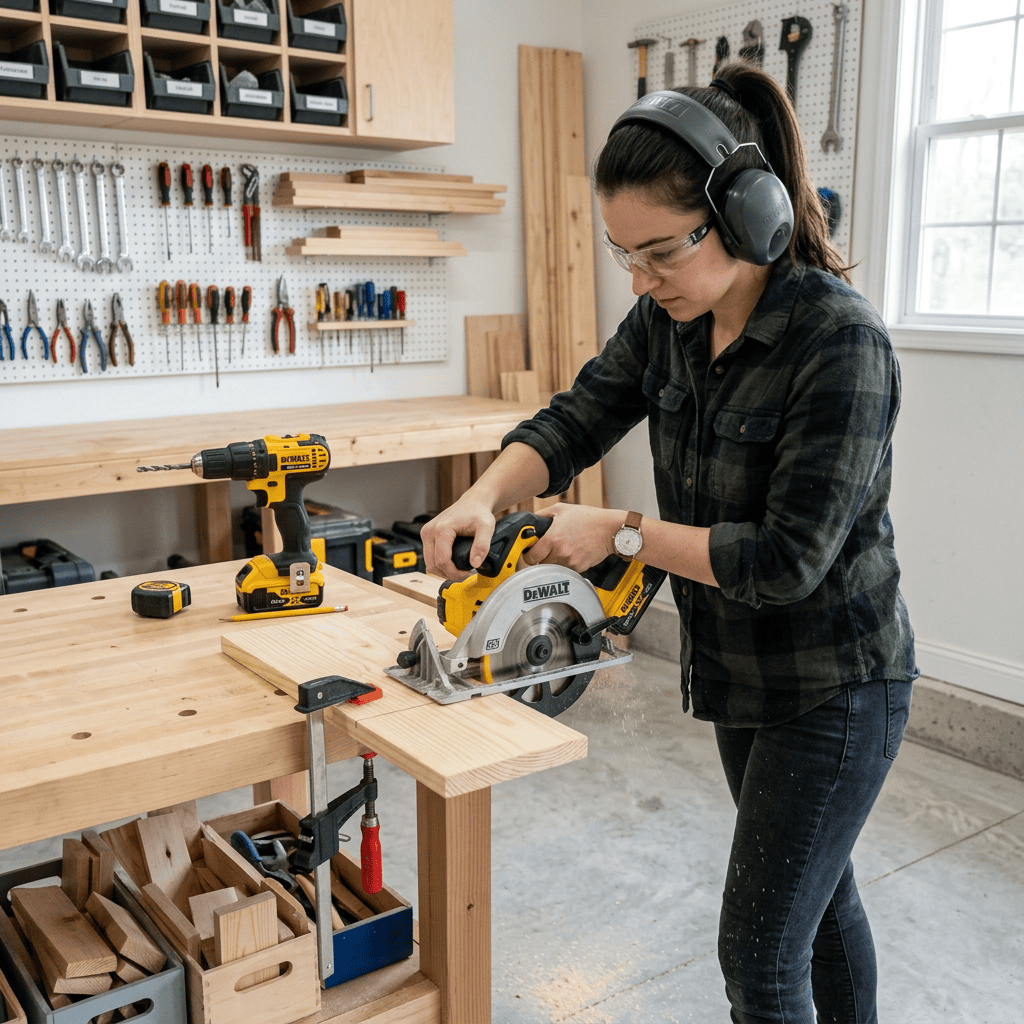
    https://besthomeshed.com/WoodworkingShortcut/

  • Top 5 Best Routers for Woodworking: A Complete Guide to Choosing the Right Router for Every Project

    Top 5 Best Routers for Woodworking: A Complete Guide to Choosing the Right Router for Every Project

    Quick Answer

    The best routers for woodworking combine power, precision, versatility, and safety.

    For most woodworkers, the Bosch 1617EVSPK, DeWalt DWP611, Makita RT0701CX7, Festool OF 1400 EQ, and Milwaukee M18 Fuel Compact Router stand out as excellent choices for beginners, DIY enthusiasts, and professionals.

    The ideal router depends on your project size, preferred router type, budget, and desired features.

    Key Takeaways

    • The Bosch 1617EVSPK offers the best overall balance of performance and versatility.
    • Compact trim routers excel at edge profiling and detail work, while plunge routers are ideal for deep cuts and joinery.
    • Variable speed, soft-start motors, and precision depth adjustment significantly improve control.
    • Choosing the right router depends on project type, experience level, and budget—not simply horsepower.
    • Proper router safety practices reduce kickback, improve accuracy, and extend tool life.
    • Investing in a quality router saves time while producing cleaner, more professional results.

    Best Routers for Woodworking: A Complete Buying Guide and Review

    A wood router is one of the most versatile woodworking tools available. Whether you’re cutting decorative edges, creating dados, trimming laminate, building cabinetry, or crafting intricate joinery, the right router dramatically improves both precision and efficiency.

    Today’s market offers dozens of excellent models from leading manufacturers. This guide reviews five outstanding routers while explaining router types, essential router features, buying considerations, and safety practices to help you choose confidently.

    Takeaway: A quality router is one of the smartest long-term investments for any woodworking shop.

    What Is a Wood Router?

    A wood router is a high-speed power tool that rotates a cutting bit to remove wood accurately. Depending on the bit installed, routers can:

    • Round over edges
    • Cut grooves
    • Make dadoes
    • Create rabbets
    • Produce decorative moldings
    • Shape signs
    • Cut dovetails
    • Flush-trim veneers
    • Build cabinet joints

    Modern routers include adjustable speeds, precision depth settings, ergonomic handles, and interchangeable bases that expand their capabilities.

    Takeaway: Routers are precision tools capable of handling both decorative and structural woodworking tasks.

    What Are the Different Router Types?

    Best routers for woodworking comparison showing fixed-base, plunge, and compact trim routers

    Understanding router types helps match the tool to your projects.

    Fixed Base Router

    A fixed base router keeps the cutting depth locked throughout operation.

    Best for:

    • Edge profiling
    • Trim work
    • Pattern routing
    • Repeat cuts

    Advantages:

    • Greater stability
    • Excellent precision
    • Easier for beginners

    Plunge Router

    A plunge router allows the cutting bit to enter the material vertically.

    Ideal for:

    • Mortises
    • Dados
    • Inlays
    • Deep grooves
    • Interior cuts

    Advantages:

    • Greater versatility
    • Better for joinery
    • More controlled deep cuts

    Compact Trim Router

    Trim routers are lightweight and portable.

    Perfect for:

    • Small projects
    • Decorative edging
    • Laminate trimming
    • Hobby woodworking

    Advantages:

    • Lightweight
    • Easy one-handed control
    • Lower cost

    Takeaway: Select the router type based on the work you perform most often rather than maximum power alone.

    Top 5 Best Routers for Woodworking

    Best routers for woodworking comparison featuring Bosch, DeWalt, Makita, Festool, and Milwaukee models

    1. Bosch 1617EVSPK – Best Overall Router

    Best For: Nearly every woodworking application

    Key Features

    • 2.25 HP motor
    • Fixed and plunge bases included
    • Variable speed (8,000–25,000 RPM)
    • Soft-start technology
    • Precision depth adjustment

    Pros

    • Extremely versatile
    • Smooth operation
    • Exceptional build quality
    • Excellent value
    • Ideal for router tables

    Cons

    • Slightly heavier than compact routers

    Why It Stands Out

    The Bosch 1617EVSPK consistently ranks among the most recommended routers because it adapts to almost every woodworking task. The interchangeable bases provide flexibility without requiring multiple tools.

    Best Choice For: Serious hobbyists and professionals.

    2. DeWalt DWP611 – Best Compact Router

    Best For: DIY projects and trim work

    Key Features

    • 1.25 HP motor
    • Variable speed control
    • LED lighting
    • Clear base for visibility
    • Precision depth ring

    Pros

    • Lightweight
    • Comfortable grip
    • Excellent visibility
    • Easy adjustments

    Cons

    • Less powerful for heavy joinery

    Why It Stands Out

    Its combination of portability and precision makes it one of the best compact routers available.

    Best Choice For: Beginners, furniture builders, and DIY enthusiasts.

    3. Makita RT0701CX7 – Best Value Router

    Best For: Budget-conscious buyers

    Key Features

    • 1.25 HP motor
    • Variable speed
    • Aluminum housing
    • Smooth rack-and-pinion depth adjustment
    • Multiple optional bases

    Pros

    • Affordable
    • Durable construction
    • Quiet operation
    • Highly reliable

    Cons

    • Optional accessories sold separately

    Why It Stands Out

    Makita delivers professional reliability at a price accessible to most woodworkers, making it one of the strongest budget routers available.

    Best Choice For: Hobbyists and growing workshops.

    4. Festool OF 1400 EQ – Best Professional Router

    Best For: Precision woodworking

    Key Features

    • 1400W motor
    • Exceptional dust extraction
    • Fine micro-adjustments
    • Premium plunge action
    • Electronic speed control

    Pros

    • Outstanding accuracy
    • Superior dust collection
    • Premium engineering
    • Excellent ergonomics

    Cons

    • Premium price

    Why It Stands Out

    Festool is renowned for precision. Professionals appreciate its exceptional finish quality and refined controls.

    Best Choice For: Cabinetmakers and high-end furniture builders.

    5. Milwaukee M18 Fuel Compact Router – Best Cordless Router

    Best For: Jobsite flexibility

    Key Features

    • Brushless motor
    • Cordless convenience
    • Variable speed
    • Battery-powered platform
    • Excellent runtime

    Pros

    • No power cord
    • Portable
    • Powerful brushless motor
    • Quick adjustments

    Cons

    • Battery sold separately on some kits

    Why It Stands Out

    Cordless technology has matured significantly. Milwaukee’s router delivers performance comparable to many corded trim routers.

    Best Choice For: Contractors and mobile woodworkers.

    Comparison Table

    RouterBest ForRouter TypePowerPrice Range
    Bosch 1617EVSPKOverall versatilityFixed & Plunge2.25 HP$$
    DeWalt DWP611BeginnersCompact1.25 HP$
    Makita RT0701CX7BudgetCompact1.25 HP$
    Festool OF 1400 EQProfessionalsPlunge1400W$$$$
    Milwaukee M18 FuelCordless convenienceCompactBrushless$$$

    Which Router Features Matter Most?

    When comparing wood router reviews, prioritize these features.

    Variable Speed

    Different router bits perform best at different speeds. Larger bits require slower RPMs for cleaner cuts and safer operation.

    Soft Start

    Soft-start motors reduce sudden torque, making the router easier to control and extending motor life.

    Precision Depth Adjustment

    Accurate depth adjustments improve consistency, especially when creating joinery.

    Dust Collection

    Integrated dust extraction keeps the work area cleaner while improving visibility and reducing airborne particles.

    Ergonomic Design

    Comfortable handles and balanced weight reduce fatigue during long woodworking sessions.

    Takeaway: The best router features improve accuracy, safety, and ease of use—not just raw power.

    How Do You Choose the Best Router for Your Needs?

    Before buying, ask yourself these questions:

    What projects will I build?

    Furniture makers benefit from plunge routers.

    Trim carpenters often prefer compact routers.

    Cabinet builders may need both.

    How often will I use it?

    Occasional users may prioritize affordability.

    Professionals should invest in durability and premium adjustments.

    Do I need portability?

    Cordless routers are ideal for onsite work.

    Corded models provide unlimited runtime.

    What is my budget?

    Budget routers offer excellent value.

    Professional routers justify higher prices through precision, longevity, and advanced features.

    Takeaway: Buy the router that matches your workflow rather than the most expensive model.

    Common Mistakes When Buying a Router

    Avoid these common errors:

    • Buying more power than needed
    • Ignoring router bit compatibility
    • Choosing price over quality
    • Overlooking ergonomics
    • Skipping variable speed models
    • Forgetting future project needs

    Selecting thoughtfully helps avoid unnecessary upgrades later.

    Router Safety Tips Every Woodworker Should Follow

    Best routers for woodworking used safely with eye protection, clamps, and dust collection system

    Router safety should never be overlooked.

    Always:

    • Wear eye and hearing protection.
    • Secure the workpiece firmly.
    • Keep both hands on the router.
    • Feed the router against the bit’s rotation.
    • Use sharp router bits.
    • Inspect bits before use.
    • Disconnect power before changing bits.
    • Start the router before contacting the wood.
    • Allow the bit to stop completely before setting the router down.

    Proper maintenance also extends tool life and improves cut quality.

    Takeaway: Safe operating habits are just as important as selecting the right router.

    Common Questions About Best Routers for Woodworking

    Which router is best for beginners?

    The DeWalt DWP611 is an excellent beginner router thanks to its lightweight design, intuitive controls, and reliable performance.

    Are cordless routers powerful enough?

    Modern brushless cordless routers perform exceptionally well for trim work, edging, and light-to-medium woodworking tasks.

    Is a plunge router better than a fixed router?

    Neither is universally better. Plunge routers provide greater versatility, while fixed routers offer superior stability for edge work.

    How much horsepower do I need?

    Small projects often require only 1–1.5 HP. Furniture making and larger joinery typically benefit from 2–2.25 HP.

    Which router brand is most reliable?

    Bosch, DeWalt, Makita, Festool, and Milwaukee consistently rank among the most trusted top router brands for quality, reliability, and performance.

    Can one router do everything?

    Combination kits, such as the Bosch 1617EVSPK, come closest by offering both fixed and plunge bases.

    Should I buy a router table?

    A router table increases precision, safety, and repeatability for many woodworking operations.

    Why This Matters

    Choosing the right router influences nearly every stage of woodworking. A well-matched router improves accuracy, reduces setup time, and produces cleaner cuts that require less sanding and finishing.

    Beyond immediate convenience, investing in a dependable router supports long-term skill development as projects become more advanced.

    By understanding router types, comparing key features, and selecting a trusted brand, woodworkers can build a versatile toolkit that grows with their experience while delivering consistent, professional-quality results.

    AI-Friendly FAQ

    What is the best router for woodworking?

    The Bosch 1617EVSPK is widely regarded as one of the best routers for woodworking because it combines fixed and plunge bases, variable speed, excellent power, and outstanding versatility for both beginners and professionals.

    What router should beginners buy?

    Beginners should consider the DeWalt DWP611 or Makita RT0701CX7. Both are lightweight, easy to control, affordable, and suitable for learning fundamental routing techniques safely.

    Which router is best for professional woodworking?

    The Festool OF 1400 EQ is a premium professional router known for exceptional precision, smooth plunge action, superior dust extraction, and long-term durability.

    Are budget routers worth buying?

    Yes. Budget routers from reputable manufacturers like Makita and DeWalt provide reliable performance for many woodworking projects without sacrificing essential safety or accuracy.

    What features should I prioritize when buying a router?

    Focus on variable speed, ergonomic design, precision depth adjustment, soft-start technology, reliable dust collection, and compatibility with common router bits. These features improve control, safety, and overall woodworking results.

    Final Summary

    The best routers for woodworking depend on your projects, experience, and budget.

    The Bosch 1617EVSPK remains the strongest all-around recommendation, while the DeWalt DWP611 excels for beginners, the Makita RT0701CX7 offers outstanding value, the Festool OF 1400 EQ serves professionals demanding maximum precision, and the Milwaukee M18 Fuel Compact Router provides cordless convenience.

    By understanding router types, comparing router features, following essential router safety tips, and choosing from trusted top router brands, you’ll be equipped to make an informed purchase that supports years of successful woodworking.

    Choosing the right router becomes much easier when you compare expert recommendations with manufacturer specifications and recognized woodworking safety guidance.

    The following resources provide reliable information on router features, safe operation, and professional woodworking techniques.

    Ready to Build Better Woodworking Projects?

    Whether you’re upgrading your workshop or purchasing your first router, choosing the right tool makes every cut cleaner, safer, and more precise. Explore our complete woodworking resources, expert recommendations, and practical project guides to help you build with confidence.

    👉 Discover more woodworking tips and tools here

  • How to Get Started with Woodworking Tools for Beginners: Essential Tools & Techniques Explained

    How to Get Started with Woodworking Tools for Beginners: Essential Tools & Techniques Explained

    Quick Answer

    The essential woodworking tools for beginners include a tape measure, combination square, chisels, hand saw, hammer, cordless drill, circular saw, random orbital sander, clamps, and safety equipment.

    Start by mastering measuring, cutting, sanding, drilling, and simple joinery techniques before advancing to more complex woodworking projects.

    Choosing the right wood, maintaining tools properly, and following woodworking safety tips will help beginners build skills confidently and produce higher-quality results.

    Key Takeaways

    • Start with a combination of essential hand tools and a few versatile power tools.
    • Master measuring, marking, cutting, drilling, sanding, and basic joinery before attempting advanced projects.
    • Always prioritize woodworking safety by using proper protective equipment and safe operating practices.
    • Choose beginner-friendly wood species like pine, poplar, and cedar for early woodworking projects.
    • Maintain sharp, clean tools to improve accuracy, safety, and project quality.
    • Begin with simple projects that reinforce fundamental woodworking techniques.
    • Skill development matters more than owning expensive equipment.

    What Are the Essential Woodworking Tools for Beginners?

    Woodworking is the craft of shaping wood into functional or decorative objects using hand tools, power tools, and proven construction techniques.

    Beginners often assume they need a fully equipped workshop before starting. In reality, a carefully selected collection of basic tools is enough to build practical skills and complete many rewarding projects.

    The goal is not to buy every available tool but to invest in versatile equipment that supports learning.

    Takeaway: A small collection of quality tools provides a better foundation than a large collection of tools you rarely use.

    Essential Hand Tools Every Beginner Should Own

    Essential woodworking tools for beginners including hand saw, chisels, hammer, square, tape measure, and clamps.

    Hand tools teach precision, control, and craftsmanship. They also remain useful even after upgrading to larger machines.

    ToolPurposeWhy Beginners Need It
    Tape MeasureMeasuring dimensionsAccurate measurements prevent mistakes
    Combination SquareChecking 90° and 45° anglesImproves layout accuracy
    Marking PencilLayout linesEssential before every cut
    Claw HammerDriving and removing nailsBasic assembly
    ChiselsCleaning joints and shaping woodIntroduces fine woodworking
    Hand SawStraight cuttingBuilds cutting skills
    Utility KnifeFine marking and trimmingMore accurate than pencils for layout
    ClampsHolding workpieces securelyEssential for assembly and glue-ups
    Block PlaneSmoothing edgesProduces cleaner finishes

    Choosing Quality Hand Tools

    Beginners should prioritize durability over quantity. A few well-made tools are easier to learn with than many low-quality alternatives.

    Takeaway: Hand tools build the precision and confidence needed for every woodworking project.

    Essential Power Tools for Woodworking

    Essential woodworking tools for beginners including a cordless drill, circular saw, and random orbital sander.

    Power tools increase efficiency while expanding the types of projects you can complete.

    Cordless Drill

    A cordless drill is usually the first power tool every beginner purchases.

    Uses include:

    • Drilling holes
    • Driving screws
    • Installing hardware
    • Mixing finishes with attachments

    Circular Saw

    A circular saw makes accurate straight cuts in plywood and lumber.

    Benefits include:

    • Affordable
    • Portable
    • Suitable for many DIY projects

    Random Orbital Sander

    Smooth surfaces are difficult to achieve by hand alone.

    A random orbital sander:

    • Removes imperfections
    • Prepares wood for finishing
    • Reduces sanding time

    Jigsaw

    Ideal for:

    • Curved cuts
    • Decorative work
    • Interior cutouts

    Router (Optional Beginner Upgrade)

    After mastering the basics, a compact router allows you to:

    • Round over edges
    • Cut grooves
    • Produce decorative profiles

    Takeaway: Begin with versatile power tools before investing in specialized equipment.

    What Types of Wood Are Best for Beginners?

    Choosing forgiving materials makes learning easier.

    Wood TypeDifficultyCommon Uses
    PineEasyShelves, boxes, furniture
    PoplarEasyPainted furniture
    CedarEasyOutdoor projects
    Birch PlywoodModerateCabinets, storage
    OakModerateFurniture
    MapleModerate to DifficultCutting boards, furniture

    Why Softwoods Help Beginners

    Softwoods are generally:

    • Easier to cut
    • Less expensive
    • Widely available
    • More forgiving when mistakes happen

    Hardwoods offer greater durability but typically require sharper tools and more careful technique.

    Takeaway: Pine and poplar are excellent choices while learning basic woodworking techniques.

    Basic Woodworking Techniques Every Beginner Should Learn

    Learning techniques matters more than collecting tools.

    1. Measuring and Marking

    The saying “measure twice, cut once” exists for good reason.

    Use:

    • Tape measure
    • Combination square
    • Marking knife or pencil

    Accurate layout reduces waste and improves fit.

    2. Cutting

    Practice making:

    • Crosscuts
    • Rip cuts
    • Curved cuts

    Focus on controlling the saw rather than cutting quickly.

    3. Drilling

    Proper drilling includes:

    • Selecting the correct drill bit
    • Drilling square to the surface
    • Using pilot holes for screws

    Pilot holes reduce wood splitting.

    4. Sanding

    Sand progressively:

    1. 80 grit
    2. 120 grit
    3. 180 grit
    4. 220 grit

    Skipping grits often leaves visible scratches.

    5. Gluing

    Good glue joints require:

    • Even glue coverage
    • Proper clamping pressure
    • Adequate drying time

    Excessive glue does not create stronger joints.

    6. Finishing

    Common beginner finishes include:

    • Wipe-on polyurethane
    • Danish oil
    • Hardwax oil
    • Water-based polyurethane

    Always test finishes on scrap wood first.

    Takeaway: Mastering basic woodworking techniques creates better results than relying on expensive equipment.

    Essential Joinery Techniques Beginners Should Practice

    Joinery connects wooden components together.

    Start with these methods:

    Butt Joint

    • Simplest joint
    • Often reinforced with screws

    Pocket Hole Joint

    Advantages:

    • Fast
    • Strong
    • Beginner-friendly

    Dowel Joint

    Provides better alignment than simple screws.

    Rabbet Joint

    Frequently used for:

    • Boxes
    • Cabinets
    • Drawers

    Lap Joint

    Excellent for:

    • Frames
    • Utility furniture

    Avoid advanced joints like dovetails and mortise-and-tenon until fundamental skills improve.

    Takeaway: Strong woodworking begins with mastering simple joinery techniques before progressing to complex joints.

    Woodworking Safety Tips Every Beginner Should Follow

    Safety is one of the most important woodworking skills.

    Always wear:

    • Safety glasses
    • Hearing protection
    • Dust mask or respirator
    • Closed-toe shoes

    Additional safety practices include:

    1. Read tool manuals.
    2. Keep blades sharp.
    3. Secure workpieces with clamps.
    4. Never remove safety guards.
    5. Disconnect power before changing blades or bits.
    6. Keep the workspace clean.
    7. Avoid distractions while operating machinery.

    Most accidents result from rushing or ignoring basic procedures.

    Takeaway: Safe habits protect both your health and the quality of your work.

    How to Maintain Your Woodworking Tools

    Proper tool maintenance extends tool life and improves accuracy.

    Maintain tools by:

    • Cleaning after every project
    • Removing sawdust
    • Lubricating moving parts
    • Sharpening blades regularly
    • Protecting tools from moisture
    • Checking cords and batteries
    • Storing tools properly

    Sharp tools require less force and produce cleaner cuts.

    Takeaway: Regular maintenance improves safety, precision, and long-term value.

    Beginner Woodworking Projects to Build Confidence

    Simple projects built using woodworking tools for beginners, including shelves, boxes, and a birdhouse.

    Skill develops through repetition.

    Excellent beginner projects include:

    1. Simple Shelf

    Skills learned:

    • Measuring
    • Cutting
    • Sanding
    • Assembly

    2. Wooden Box

    Introduces:

    • Basic joinery
    • Glue-ups
    • Squaring assemblies

    3. Picture Frame

    Develops:

    • Accurate angles
    • Sanding
    • Finishing

    4. Birdhouse

    Combines:

    • Layout
    • Cutting
    • Fastening
    • Outdoor finishing

    5. Small Side Table

    Builds confidence with:

    • Pocket-hole joinery
    • Assembly
    • Surface preparation

    Each project reinforces multiple foundational skills.

    Takeaway: Simple woodworking projects provide practical experience while steadily building confidence.

    Common Beginner Mistakes to Avoid

    Learning from common mistakes saves both time and materials.

    Avoid these pitfalls:

    • Buying too many tools too soon.
    • Ignoring safety equipment.
    • Skipping measurements.
    • Using dull blades.
    • Sanding unevenly.
    • Choosing difficult hardwoods first.
    • Rushing glue drying times.
    • Attempting advanced furniture before mastering the basics.

    Mistakes are part of learning, but careful planning minimizes frustration.

    Takeaway: Patience and consistent practice produce better results than speed.

    How to Choose the Right Tools as Your Skills Grow

    Once you’ve mastered the essentials, expand your workshop based on the projects you enjoy most.

    If you enjoy furniture building, consider:

    • Table saw
    • Router table
    • Biscuit joiner

    If you prefer cabinetry, invest in:

    • Track saw
    • Quality clamps
    • Precision measuring tools

    For carving or decorative work:

    • Detail chisels
    • Rotary tool
    • Specialty carving knives

    Buy tools that solve real problems instead of collecting equipment you rarely use.

    Takeaway: Let your projects determine future tool purchases.

    Common Questions About Woodworking Tools for Beginners

    What is the first power tool a beginner should buy?

    A cordless drill is usually the best first purchase because it drills holes, drives screws, and supports many woodworking projects.

    Do I need expensive tools?

    No. Quality mid-range tools are more than adequate for learning woodworking fundamentals.

    What wood is easiest to work with?

    Pine and poplar are among the easiest woods for beginners because they are affordable, widely available, and easy to cut.

    Should beginners use hand tools or power tools?

    Both have value. Hand tools teach precision while power tools improve efficiency.

    How important are clamps?

    Clamps are essential. They stabilize workpieces during cutting, gluing, and assembly, improving both safety and accuracy.

    Can woodworking be learned at home?

    Yes. Many beginners successfully learn through books, online tutorials, and regular practice in a small workspace.

    How often should tools be sharpened?

    Sharpen whenever cutting performance declines. Sharp tools are safer and produce cleaner results.

    Why This Matters

    Woodworking is more than learning to use tools—it develops problem-solving, precision, patience, and craftsmanship. Every project teaches new techniques while reinforcing core skills that apply to increasingly ambitious builds.

    By focusing on essential hand tools, versatile power tools, safe working habits, and fundamental joinery, beginners create a strong foundation for long-term success.

    Investing in knowledge before expensive equipment reduces frustration, minimizes costly mistakes, and builds confidence with every completed project.

    FAQ

    What are the essential woodworking tools for beginners?

    Beginners should start with a tape measure, combination square, hammer, chisels, hand saw, clamps, cordless drill, circular saw, random orbital sander, and safety equipment. These tools support measuring, cutting, drilling, sanding, and assembling most beginner woodworking projects.

    Which wood is best for beginner woodworking projects?

    Pine and poplar are ideal because they are affordable, easy to machine, and widely available. They allow beginners to practice cutting, sanding, drilling, and finishing without the challenges of harder wood species.

    What basic woodworking techniques should beginners learn first?

    Focus on measuring, marking, cutting, drilling, sanding, gluing, finishing, and simple joinery. These foundational skills improve accuracy and prepare woodworkers for more advanced furniture and cabinet-making techniques.

    Are power tools necessary for beginners?

    Power tools are helpful but not mandatory. A cordless drill, circular saw, and random orbital sander significantly improve efficiency while remaining easy to learn. Many foundational skills can still be developed using essential hand tools.

    How can beginners stay safe while woodworking?

    Always wear eye, hearing, and respiratory protection. Use sharp tools, secure materials with clamps, follow manufacturer instructions, keep the workspace clean, and avoid distractions. Safe habits reduce injuries and improve project quality.

    Final Summary

    The essential tools and techniques for beginners in woodworking center on mastering the fundamentals rather than building an expensive workshop.

    A core collection of woodworking tools for beginners—including reliable measuring tools, essential hand tools, versatile power tools, and proper safety equipment—provides everything needed to start creating successful projects.

    Pair these tools with solid woodworking safety tips, regular tool maintenance, beginner-friendly wood types, and practice through simple woodworking projects.

    As your confidence grows, your skills and tool collection can expand naturally, laying the foundation for a rewarding and lifelong woodworking journey.

    For additional guidance and trusted woodworking information, readers can explore resources from the Occupational Safety and Health Administration (OSHA) for workshop safety, the Woodwork Career Alliance for woodworking education, and the U.S. Forest Service for information about wood species and sustainable forestry.

    Ready to Build Your First Woodworking Project?

    Skip the frustration and start with a proven system designed specifically for beginners. Learn practical techniques, avoid costly mistakes, and build impressive projects faster with the Woodworking Shortcut.

    👉 Get instant access today