Quick Answer
Choosing between hand tools vs. power tools depends on your workshop size, budget, project type, and woodworking goals.
Hand tools offer greater precision, lower costs, quieter operation, and minimal maintenance, while power tools provide faster production, improved efficiency, and consistent results.
Most small workshops benefit from combining both tool types to maximize versatility, accuracy, and productivity.
Key Takeaways
- Hand tools are affordable, quiet, space-efficient, and ideal for detailed craftsmanship.
- Power tools save time, increase woodworking efficiency, and simplify repetitive tasks.
- Small workshops often perform best with a balanced mix of hand and power tools.
- Budget, available space, maintenance requirements, and project complexity should guide purchasing decisions.
- Proper tool storage solutions help maximize workspace, improve safety, and extend tool life.
- Beginners can start with essential hand tools before investing in larger power equipment.
Hand Tools vs. Power Tools: A Complete Comparison for Small Workshops
Whether you’re setting up your first woodworking shop or upgrading an existing workspace, one question inevitably arises:
Should you invest in hand tools, power tools, or both?
The answer isn’t always straightforward. Every woodworker—from hobbyists and DIY enthusiasts to professional furniture makers—faces trade-offs involving cost, precision, speed, workspace, and maintenance.
Understanding the strengths and limitations of each option allows you to build a workshop that matches your projects, budget, and available space rather than simply buying the most expensive equipment.
This guide compares hand tools vs. power tools across the factors that matter most for small workshops.
Takeaway: The best choice depends on your woodworking goals rather than choosing one category exclusively.
What Are Hand Tools?
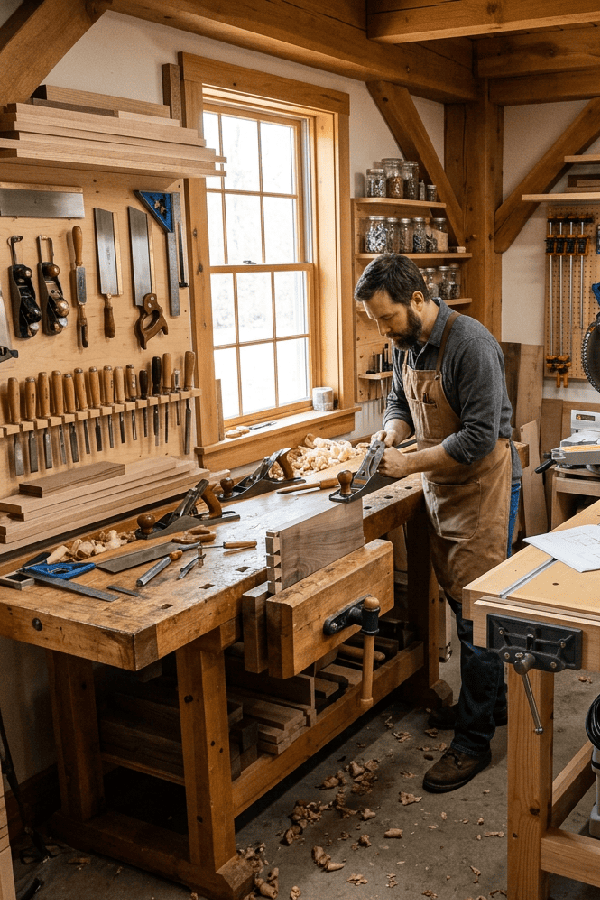
Hand tools are woodworking tools powered entirely by human effort rather than electricity or batteries.
They have been used for centuries and remain essential in modern woodworking because they provide exceptional control and precision.
Common Hand Tools
- Chisels
- Hand planes
- Handsaws
- Mallets
- Coping saws
- Block planes
- Measuring tapes
- Combination squares
- Marking gauges
- Clamps
- Screwdrivers
- Files
- Rasps
Most experienced woodworkers continue using hand tools even in highly equipped shops because certain tasks simply require greater control than machines can provide.
Best Uses for Hand Tools
- Fine joinery
- Furniture restoration
- Trimming joints
- Smoothing surfaces
- Carving
- Detail work
- Small repairs
- Custom fitting components
Because hand tools remove material gradually, they allow corrections before expensive mistakes occur.
Takeaway: Hand tools prioritize precision, craftsmanship, and control over production speed.
What Are Power Tools?
Power tools use electricity, batteries, or compressed air to perform woodworking tasks faster and with less physical effort.
These machines dramatically increase productivity, making them indispensable for larger projects and repetitive work.
Common Power Tools
- Table saw
- Circular saw
- Miter saw
- Router
- Jigsaw
- Random orbital sander
- Drill/driver
- Impact driver
- Band saw
- Planer
- Jointer
- Scroll saw
- Oscillating multi-tool
Many modern cordless tools provide nearly the same performance as corded versions while improving portability in smaller workshops.
Best Uses for Power Tools
- Breaking down lumber
- Crosscutting boards
- Ripping sheet goods
- Drilling holes
- Sanding large surfaces
- Edge profiling
- Production work
- Cabinet construction
Power tools are particularly valuable when building multiple projects or working with hardwoods that require significant cutting power.
Takeaway: Power tools maximize speed, consistency, and woodworking efficiency.
Hand Tools vs. Power Tools: Side-by-Side Comparison
| Feature | Hand Tools | Power Tools |
|---|---|---|
| Initial Cost | Lower | Higher |
| Speed | Slower | Much faster |
| Precision | Excellent for detail work | Excellent for repetitive cuts |
| Learning Curve | Moderate | Moderate to high |
| Noise | Very quiet | Loud |
| Dust Production | Minimal | Significant |
| Maintenance | Simple | More complex |
| Storage Needs | Compact | Requires more space |
| Electricity Required | No | Yes (or batteries) |
| Physical Effort | Higher | Lower |
| Safety Risk | Generally lower | Higher if used improperly |
| Ideal User | Hobbyists, fine woodworkers | Builders, production shops |
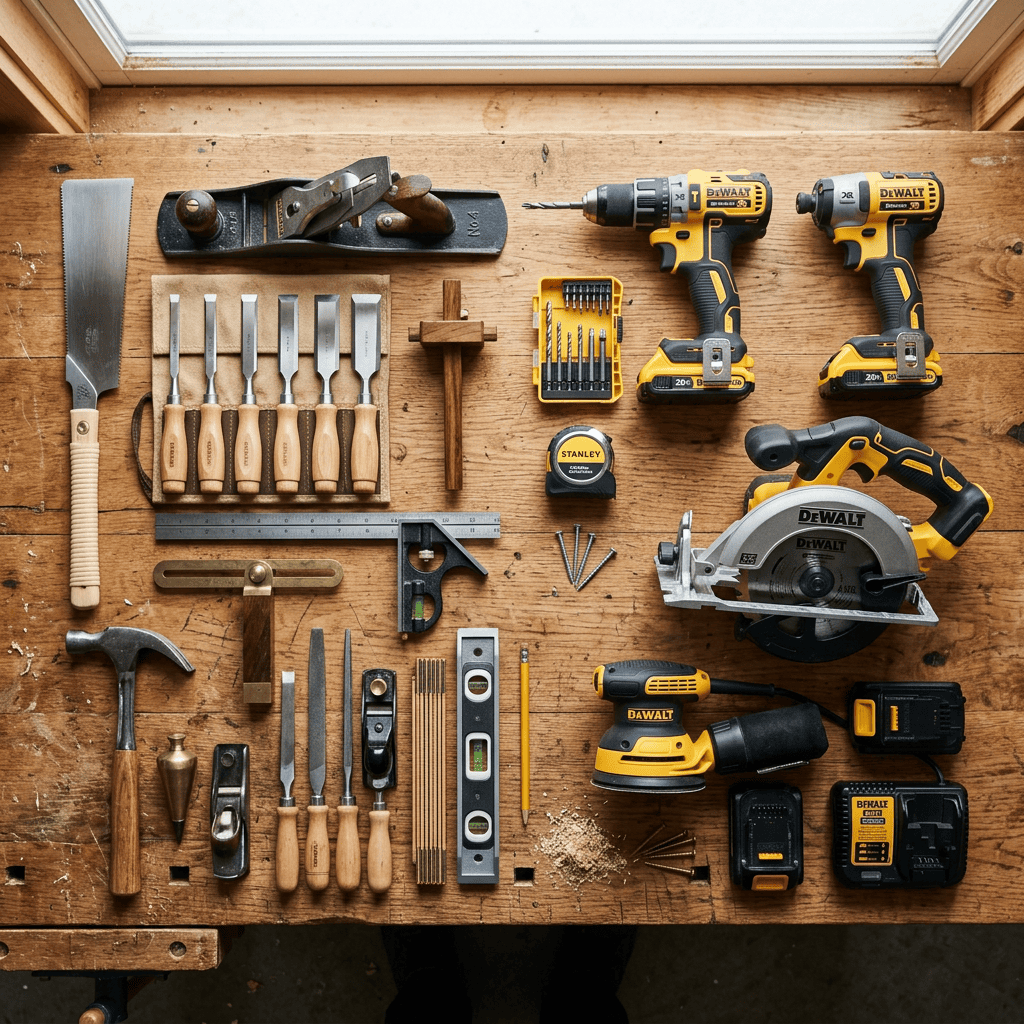
This comparison highlights why many experienced woodworkers avoid treating the decision as either-or. Instead, they select the right tool for each task.
Takeaway: Understanding each tool category’s strengths helps you make smarter purchasing decisions and build a more capable small workshop.
What Are the Advantages of Hand Tools?
Hand tools continue to be valued because they offer benefits that machines cannot fully replace.
1. Lower Initial Cost
One of the biggest advantages of hand tools is affordability.
A quality chisel or hand plane can last decades with proper care, making them a cost-effective investment for beginners and experienced woodworkers alike.
For those concerned about the cost of hand tools, building a collection gradually is often easier than purchasing multiple expensive machines at once.
2. Greater Precision and Control
Hand tools excel when fine adjustments matter.
Examples include:
- Fitting dovetail joints
- Trimming tenons
- Cleaning mortises
- Leveling glue joints
- Chamfering edges
The slower pace allows woodworkers to remove tiny amounts of material while minimizing costly errors.
3. Compact Storage
Small workshops often struggle with limited floor space.
Most hand tools fit into:
- Wall-mounted cabinets
- Tool chests
- Rolling carts
- Drawer organizers
Their compact size makes them excellent space-saving woodworking tools, especially in garages, basements, or shared workspaces.
4. Quiet Operation
Unlike machines, hand tools produce little noise.
This makes them ideal for:
- Apartment workshops
- Evening woodworking
- Shared garages
- Neighborhood-friendly projects
5. Minimal Maintenance
Another major advantage is simple upkeep.
Most hand tools require only:
- Cleaning
- Rust prevention
- Sharpening blades
- Occasional lubrication
Compared with machine servicing, maintaining hand tools is inexpensive and straightforward.
Takeaway: Hand tools offer affordability, precision, portability, and simplicity that make them indispensable in small woodworking shops.
What Are the Benefits of Power Tools?
Power tools are designed to increase productivity and reduce manual labor.
For many woodworkers, they transform projects that would otherwise take days into tasks completed within hours.
1. Faster Project Completion
The most obvious benefit of power tools is speed.
A table saw can make dozens of identical cuts in minutes, while a hand saw requires considerably more time and effort.
This makes power tools invaluable for:
- Cabinets
- Shelving
- Decking
- Furniture production
- Home renovation projects
2. Improved Woodworking Efficiency
Machines perform repetitive operations with remarkable consistency.
Examples include:
- Repeated crosscuts
- Uniform ripping
- Flush trimming
- Edge routing
- Large-scale sanding
Higher woodworking efficiency means less fatigue and greater productivity, especially during larger builds.
3. Easier Material Removal
Dense hardwoods such as oak, maple, and walnut demand significant effort when worked entirely by hand.
Power tools reduce strain while maintaining consistent results across multiple pieces.
4. Better for Large Projects
If your projects include:
- Kitchen cabinets
- Built-in shelving
- Dining tables
- Multiple furniture pieces
Power tools save considerable time while improving repeatability.
5. Consistent Accuracy
Modern power tools include features such as:
- Adjustable fences
- Laser guides
- Digital angle gauges
- Precision stops
- Dust collection compatibility
These features help maintain consistent dimensions across repeated cuts.
Takeaway: Power tools significantly improve speed, efficiency, and consistency, making them ideal for larger or repetitive woodworking projects.
Summary
When comparing hand tools vs. power tools, neither category is universally better. Hand tools excel in precision, affordability, quiet operation, and compact storage, while power tools shine in speed, efficiency, and handling larger projects.
For most small workshops, understanding these core strengths provides the foundation for choosing the right tools based on your woodworking goals, available space, and budget.
How Do Cost and Budget Affect Your Choice?
One of the first considerations when comparing hand tools vs. power tools is the total investment required. While both categories can become expensive over time, their upfront and long-term costs differ significantly.
A thoughtful purchasing strategy helps you build a capable workshop without overspending.
Hand Tool Costs
The cost of hand tools is generally lower than purchasing stationary machinery or multiple cordless tools.
Typical beginner investments include:
- Handsaw
- Chisels
- Block plane
- Combination square
- Marking gauge
- Clamps
- Hammer or mallet
- Screwdrivers
Many of these tools can last decades with proper maintenance, making them excellent long-term investments.
Advantages
- Lower startup cost
- No electricity required
- No batteries to replace
- Lower repair expenses
- Long service life
Power Tool Costs
Power tools typically require a larger initial investment.
Beyond the purchase price, you should also budget for:
- Replacement blades
- Router bits
- Sandpaper
- Batteries
- Chargers
- Extension cords
- Dust collection equipment
- Replacement motors or bearings (over time)
While these costs add up, the increased productivity often offsets the investment for frequent woodworkers.
Budget Tip
Rather than buying every machine immediately, purchase tools based on the projects you plan to build over the next six to twelve months.
This approach prevents unnecessary purchases while allowing your workshop to grow naturally.
Takeaway: Hand tools offer the most affordable entry point, while power tools provide greater value as project volume increases.
Which Tools Save the Most Space in a Small Workshop?
Limited space is one of the biggest challenges facing home woodworkers.
Choosing space-saving woodworking tools helps maximize efficiency without overcrowding your workspace.
Hand Tools Require Minimal Storage
Most hand tools occupy very little room.
Popular storage options include:
- French cleat systems
- Wall-mounted racks
- Pegboards
- Tool chests
- Drawer organizers
- Portable toolboxes
Because hand tools don’t require permanent floor space, they’re ideal for garages, sheds, basements, and shared workshops.
Power Tools Need More Planning
Larger machines require dedicated workspace and adequate clearance.
Examples include:
- Table saws
- Band saws
- Planers
- Jointers
- Drill presses
In small workshops, consider compact or benchtop versions of these tools.
Many manufacturers also produce folding stands and mobile bases that allow machines to be stored against a wall when not in use.
Space-Saving Strategies
If workshop space is limited, consider these solutions:
- Install wall-mounted storage.
- Use rolling tool cabinets.
- Choose multifunction tools when appropriate.
- Store portable tools vertically.
- Build fold-down work surfaces.
- Keep frequently used tools within easy reach.
- Label storage locations for faster organization.
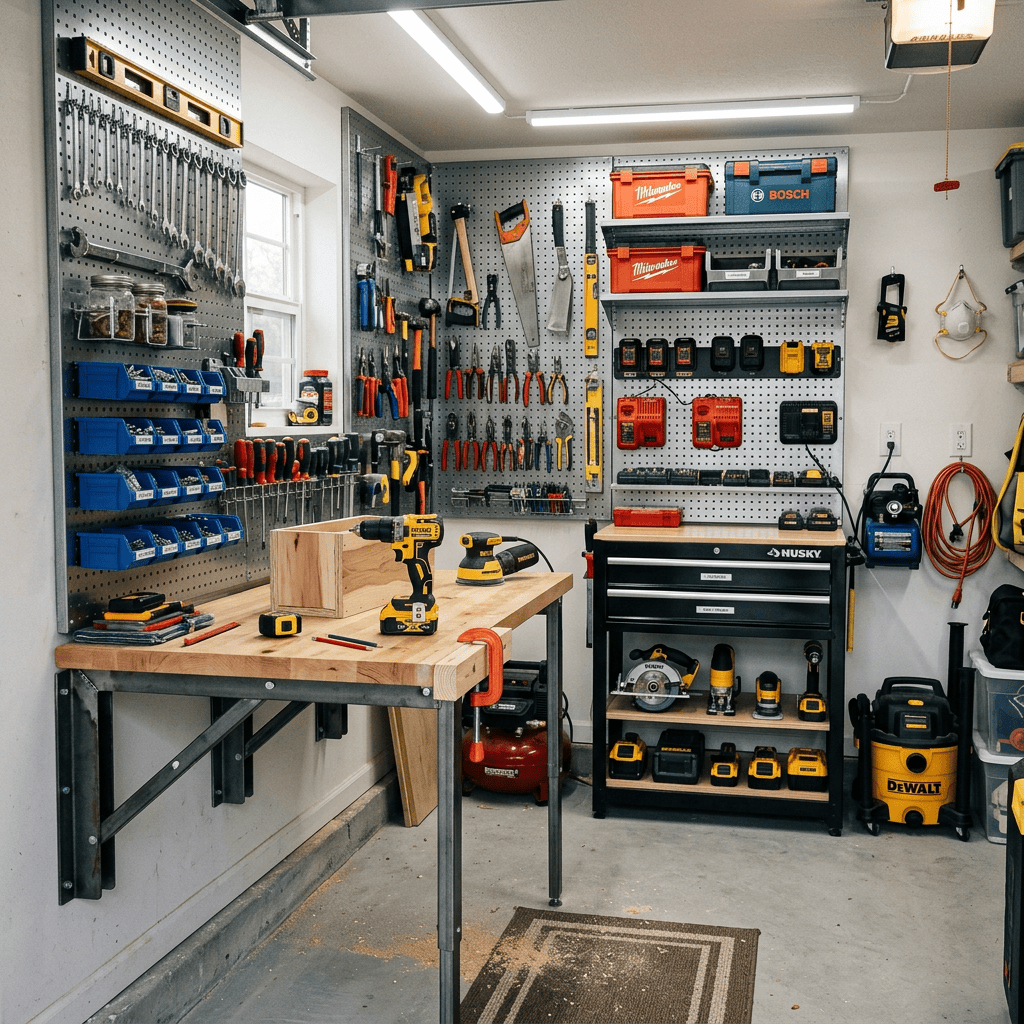
These tool storage solutions improve workflow while reducing clutter and safety hazards.
Takeaway: Smart organization is just as important as tool selection when working in a compact shop.
How Do Hand Tools and Power Tools Affect Woodworking Efficiency?
Efficiency is about more than working quickly. It also includes accuracy, repeatability, setup time, cleanup, and overall workflow.
When Hand Tools Are More Efficient
Although slower, hand tools can actually save time when:
- Making small adjustments
- Cleaning joints
- Trimming proud tenons
- Fine-tuning cabinet doors
- Breaking edges
- Fitting drawers
Using a large machine for these tasks often requires more setup than the task itself.
When Power Tools Are More Efficient
Power tools excel when repetitive work is involved.
Examples include:
- Cutting sheet goods
- Milling rough lumber
- Sanding tabletops
- Routing decorative edges
- Drilling dozens of identical holes
These tasks benefit from consistent machine performance and reduced physical effort.
Choosing the Right Tool for the Job
Professional woodworkers rarely ask,
“Which tool is better?”
Instead, they ask,
“Which tool completes this task most efficiently?”
For example:
| Task | Best Choice |
|---|---|
| Trimming a joint | Hand plane |
| Cutting plywood | Circular saw or table saw |
| Installing hinges | Chisel and drill |
| Edge profiling | Router |
| Smoothing a tabletop | Random orbital sander |
| Final finish touch-up | Card scraper or hand plane |
Combining both tool types creates a more efficient workflow than relying exclusively on one category.
Takeaway: The highest woodworking efficiency comes from matching the tool to the task rather than using the same type of tool for every operation.
How Much Maintenance Do Power Tools Require?
Maintenance is an important but often overlooked ownership cost.
Understanding the maintenance of power tools helps extend their lifespan and improve safety.
Common Maintenance Tasks
Most power tools require regular:
- Dust removal
- Blade replacement
- Lubrication
- Fence alignment
- Belt inspection
- Bearing checks
- Battery care
- Electrical cord inspection
Ignoring routine maintenance can reduce accuracy and increase the risk of mechanical failure.
Hand Tool Maintenance
Hand tools require much less maintenance.
Typical care includes:
- Keeping blades sharp
- Removing rust
- Applying protective oil
- Flattening plane soles when necessary
- Storing tools in a dry environment
Although sharpening takes practice, many woodworkers consider it part of the craft.
Maintenance Comparison
| Maintenance Factor | Hand Tools | Power Tools |
|---|---|---|
| Cleaning | Easy | Moderate |
| Sharpening | Frequent | Occasional |
| Mechanical Repairs | Rare | Sometimes required |
| Electrical Components | None | Yes |
| Battery Replacement | None | Possible |
| Long-Term Costs | Low | Moderate to High |
Takeaway: Hand tools are generally easier and less expensive to maintain, while power tools require more routine care to deliver reliable performance.
What Are the Best Tools for Small Shops?
If you’re building a workshop from scratch, focus on versatile tools that cover the widest range of woodworking tasks.
Essential Hand Tools
A practical starter collection includes:
- Measuring tape
- Combination square
- Marking knife
- Chisel set
- Block plane
- Handsaw
- Clamps
- Mallet
- Screwdrivers
- Utility knife
These tools support layout, cutting, assembly, and fine adjustments.
Essential Power Tools
For many small workshops, these machines provide the greatest value:
- Cordless drill/driver
- Circular saw
- Random orbital sander
- Jigsaw
- Router
- Miter saw (if space allows)
- Shop vacuum or dust extractor
As your projects become more advanced, you can consider adding:
- Table saw
- Band saw
- Thickness planer
- Drill press
Purchasing tools gradually allows you to invest in higher-quality equipment while avoiding unnecessary expenses.
Recommended Starter Combination
A balanced workshop often includes:
Hand Tools
- Chisel set
- Block plane
- Measuring tools
- Clamps
- Handsaw
Power Tools
- Drill
- Circular saw
- Router
- Orbital sander
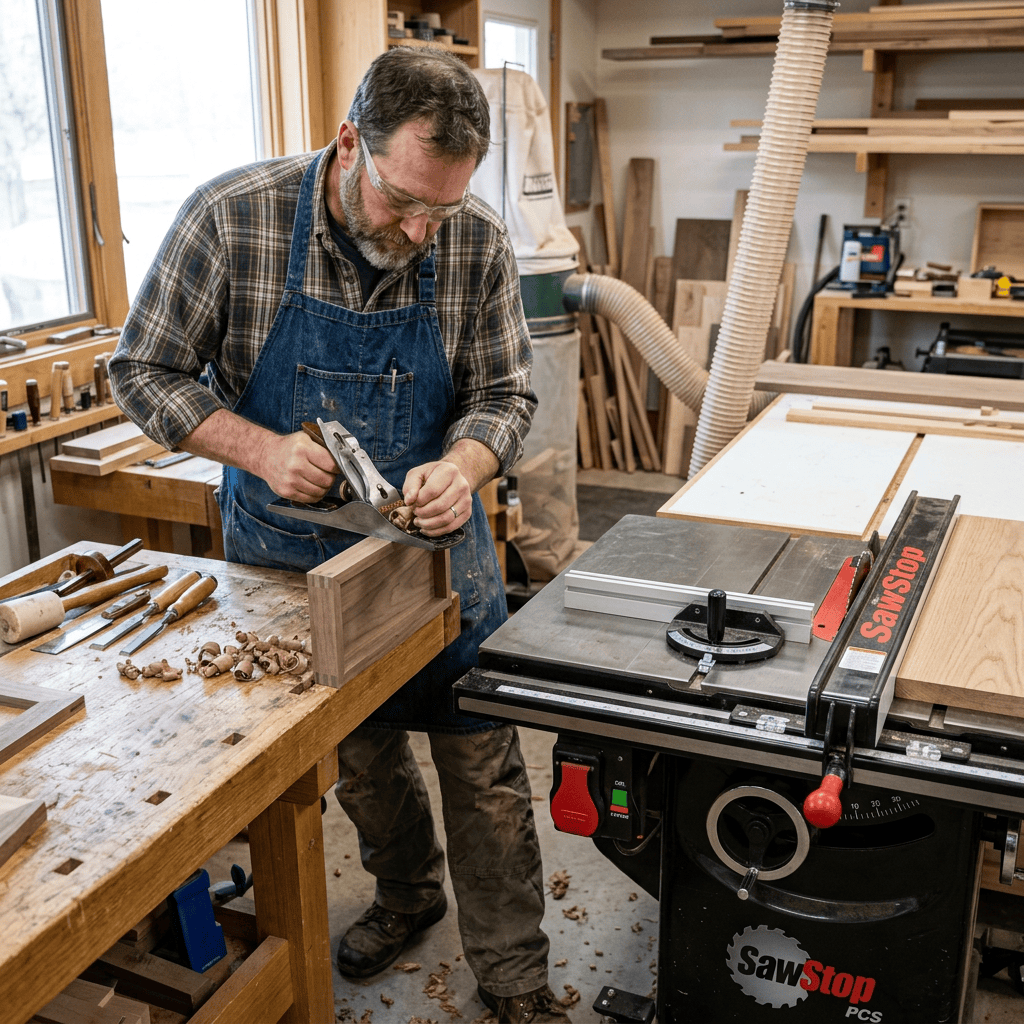
This combination handles the majority of woodworking projects while keeping costs and storage requirements manageable.
Takeaway: The best tools for small shops are versatile, reliable, and suited to the projects you build most often.
Common Mistakes to Avoid When Choosing Workshop Tools
Many new woodworkers spend too much money on equipment they rarely use.
Avoid these common mistakes.
1. Buying Every Machine Immediately
Purchase tools as your projects require them rather than filling your shop all at once.
2. Ignoring Workshop Space
Measure your available floor space before purchasing stationary equipment.
Remember to account for infeed and outfeed clearance, not just the machine’s footprint.
3. Prioritizing Quantity Over Quality
A few well-made tools generally outperform a large collection of inexpensive alternatives.
Quality tools also last longer and provide more consistent results.
4. Neglecting Dust Collection
Dust affects:
- Tool performance
- Workshop cleanliness
- Finish quality
- Air quality
- Personal health
Even a compact dust extractor or shop vacuum significantly improves the working environment.
5. Forgetting About Storage
Tools that lack designated storage quickly create clutter, reduce efficiency, and increase the risk of accidents.
Plan storage alongside tool purchases rather than as an afterthought.
Takeaway: Careful planning prevents unnecessary spending and creates a safer, more efficient small workshop.
Practical Recommendations: Should You Choose Hand Tools, Power Tools, or Both?
For most woodworkers, the answer isn’t one or the other—it’s both.
Use this simple guide to decide where to focus your investment.
| If You… | Best Choice |
|---|---|
| Enjoy traditional craftsmanship | Primarily hand tools |
| Build furniture regularly | A balanced combination |
| Complete home improvement projects | More power tools |
| Have a limited budget | Start with hand tools |
| Have limited space | Compact hand tools with portable power tools |
| Produce multiple identical pieces | Primarily power tools |
| Value quiet operation | Hand tools |
| Need maximum productivity | Power tools with supporting hand tools |
The most successful small workshops blend the precision of hand tools with the speed and consistency of power tools. This balanced approach allows you to tackle a wider variety of projects while adapting to different woodworking tasks efficiently.
Summary
Cost, workspace, maintenance, and efficiency all influence the decision between hand tools vs. power tools.
Hand tools remain the better choice for affordability, compact storage, and fine craftsmanship, while power tools excel at productivity and repetitive work.
For most woodworkers, a thoughtfully selected combination of both provides the greatest flexibility, long-term value, and overall workshop performance.
Common Questions About Hand Tools vs. Power Tools
Are hand tools better than power tools for beginners?
Not necessarily. Hand tools are generally more affordable, quieter, and easier to store, making them ideal for learning woodworking fundamentals.
However, basic power tools such as a cordless drill and circular saw can significantly reduce project time. A balanced approach gives beginners the best opportunity to develop skills while completing projects efficiently.
Which tools produce more accurate results?
Accuracy depends more on proper technique than the tool itself.
Hand tools offer exceptional control for delicate joinery, trimming, and fine adjustments. Power tools excel at making repeatable, consistent cuts once they are properly set up and calibrated.
Can a small workshop function with only hand tools?
Yes. Many skilled woodworkers build furniture, cabinets, and decorative pieces using only hand tools.
However, projects typically take longer, and milling rough lumber by hand requires more physical effort.
Are power tools worth the investment?
For woodworkers who build projects regularly, power tools often provide excellent value.
They improve woodworking efficiency by reducing manual labor, increasing consistency, and dramatically shortening project completion times.
Which tools require more maintenance?
Power tools require more ongoing maintenance because they contain motors, bearings, belts, batteries, and electrical components.
Hand tools usually require only cleaning, sharpening, rust prevention, and proper storage.
What is the best combination for a small woodworking shop?
Many experienced woodworkers recommend starting with:
- Quality measuring tools
- Chisels
- Block plane
- Clamps
- Cordless drill
- Circular saw
- Router
- Random orbital sander
This combination covers most woodworking tasks while remaining practical for smaller spaces.
How can I maximize storage in a small workshop?
Use vertical space whenever possible.
Popular tool storage solutions include:
- French cleat wall systems
- Pegboards
- Magnetic tool holders
- Rolling cabinets
- Fold-away workbenches
- Stackable storage bins
Keeping tools organized improves workflow, safety, and productivity.
Why This Matters
Choosing between hand tools vs. power tools is about more than purchasing equipment—it’s about designing a workshop that supports your woodworking goals today and adapts as your skills grow.
Many beginners assume that owning more machines automatically leads to better results. In reality, successful woodworking depends on understanding when each tool offers the greatest advantage.
Hand tools encourage patience, precision, and a deeper understanding of wood grain, joinery, and material behavior. These foundational skills often translate into higher-quality craftsmanship, regardless of the equipment used later.
Power tools, on the other hand, make larger projects more manageable by reducing physical effort and improving production speed. They allow hobbyists and professionals alike to complete repetitive tasks with greater consistency and efficiency.
The most productive small workshops rarely rely exclusively on one approach. Instead, experienced woodworkers combine the speed of machines with the control of hand tools, selecting the best option for each stage of a project.
As your workshop evolves, prioritize versatility over volume. Invest in quality tools that match the work you actually perform, organize them effectively, and maintain them properly.
This thoughtful approach saves money, maximizes limited space, and creates a safer, more enjoyable woodworking environment for years to come.
Takeaway: Understanding the strengths of both hand tools and power tools helps you make smarter investments, improve craftsmanship, and build a workshop that grows with your experience.
FAQ
Which is better: hand tools or power tools?
Neither is universally better. Hand tools offer greater precision, lower costs, quieter operation, and compact storage, while power tools provide faster cutting, higher productivity, and consistent results. Most small workshops benefit from using both, depending on the project and task.
Are hand tools cheaper than power tools?
Yes. Hand tools typically have a lower purchase price and require less maintenance.
They also have fewer ongoing expenses because they don’t rely on electricity, batteries, or complex mechanical components.
This makes them an affordable option for beginners and budget-conscious woodworkers.
What power tools should every small workshop have?
Most small workshops benefit from starting with a cordless drill, circular saw, random orbital sander, and router. These versatile tools handle drilling, cutting, sanding, and shaping, making them suitable for a wide variety of woodworking projects without requiring excessive space.
How can I save space in a small woodworking shop?
Maximize vertical storage with pegboards, French cleat systems, wall cabinets, and magnetic holders.
Choose compact or benchtop machines, use rolling tool carts, and store portable power tools in stackable organizers. Good organization improves efficiency and workshop safety.
Should beginners buy hand tools or power tools first?
Beginners should start with essential hand tools for measuring, marking, and assembly, then add a few versatile power tools such as a drill and circular saw as projects become more ambitious.
This balanced approach builds foundational skills while improving productivity.
Final Summary
Choosing between hand tools vs. power tools ultimately comes down to your woodworking goals, available space, budget, and the types of projects you plan to build.
Hand tools excel in precision, affordability, quiet operation, and craftsmanship, while power tools offer superior speed, efficiency, and consistency for larger or repetitive tasks.
Rather than viewing them as competing options, consider them complementary. A well-equipped small workshop combines the strengths of both, allowing you to work more accurately, complete projects faster, and adapt to a wider range of woodworking challenges.
Whether you’re setting up your first workshop or upgrading an existing one, focus on buying quality tools that match your current needs, organizing them with practical tool storage solutions, and maintaining them regularly.
Over time, this balanced strategy will improve your woodworking efficiency, protect your investment, and help you create better projects with confidence.
For additional woodworking guidance, refer to authoritative resources such as OSHA, Wood Magazine, and Fine Woodworking. These organizations provide expert advice on workshop safety, woodworking techniques, and tool selection.
Ready to build your woodworking skills faster?
Whether you’re setting up your first shop or upgrading your tool collection, the right guidance can save you time, money, and frustration.
👉 Discover practical woodworking plans, tool guides, and expert tips at:
https://besthomeshed.com/WoodworkingShortcut/