Quick Answer
The safest wood for cutting boards is generally hard maple because its closed-grain structure, moderate hardness, durability, and low porosity make it highly resistant to trapping moisture and bacteria when properly maintained.
Walnut is also a safe, food-friendly hardwood with slightly lower hardness. At the same time, bamboo is durable and sustainable but is technically a grass, often contains adhesive binders, and can be harder on knives depending on construction.
Key Takeaways
- Hard maple is widely considered the gold standard for food-safe wooden cutting boards due to its closed-grain structure.
- Walnut offers excellent safety, attractive appearance, and gentler knife impact, making it a premium alternative.
- Bamboo is sustainable and moisture-resistant but varies greatly in quality because manufacturing adhesives differ.
- Proper cleaning, drying, and regular application of food-grade mineral oil matter more for food safety than wood species alone.
- End-grain boards generally last longer and are gentler on knives than edge-grain boards.
- Closed-grain hardwoods are preferred over open-grain woods because they absorb less moisture and are easier to sanitize.
Safest Wood for Cutting Boards: Maple vs. Walnut vs. Bamboo
Choosing a cutting board is about more than appearance. The material affects food safety, knife performance, durability, maintenance, and long-term value.
Among the most common options—maple, walnut, and bamboo—each has strengths. However, when considering food safety, grain structure, hardness, longevity, and maintenance together, hard maple consistently ranks as the safest and most recommended wood for cutting boards.
Let’s examine why.
What Makes a Wood Safe for Cutting Boards?
A cutting board comes into direct contact with raw meat, vegetables, fruit, bread, and prepared foods. A safe material should minimize bacterial growth while resisting cracking and excessive wear.
Several factors determine whether a wood is suitable.
Closed-Grain Structure
The most important characteristic is grain structure.
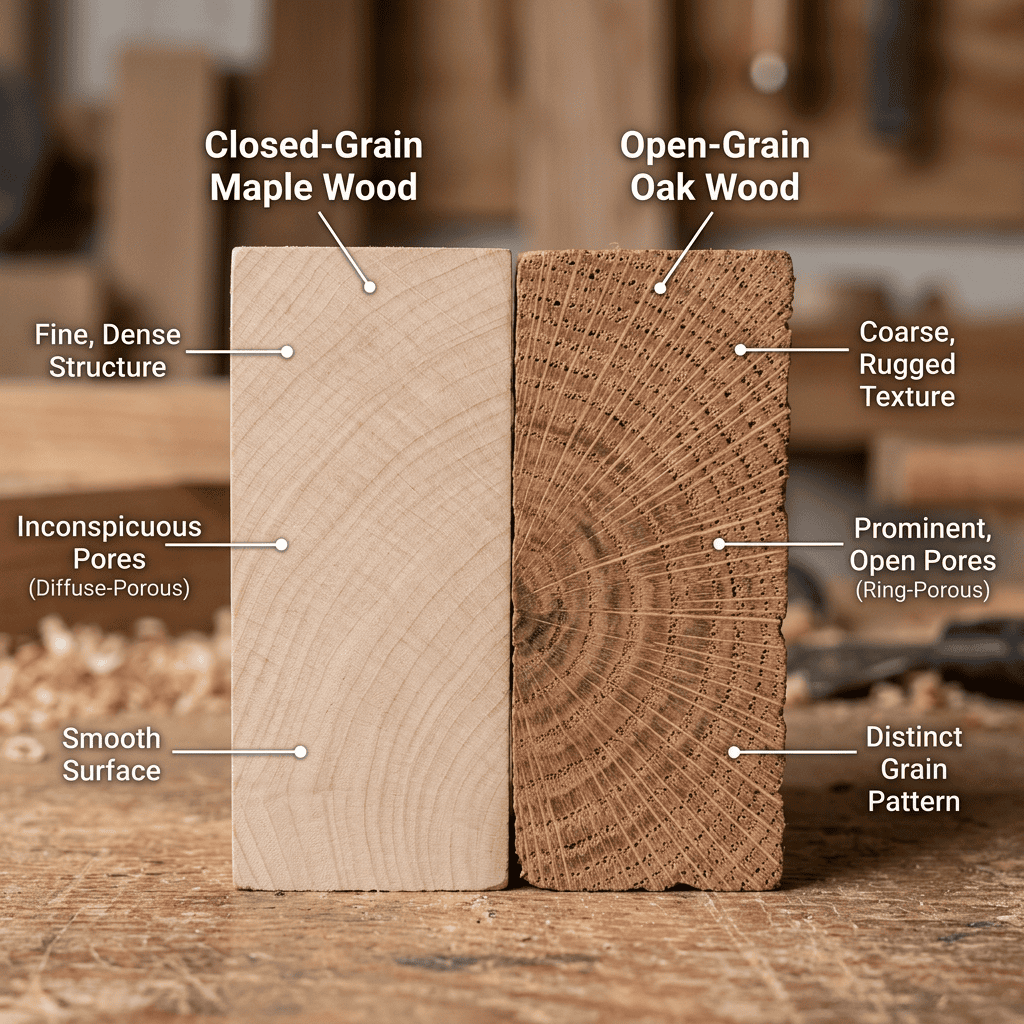
Closed-grain wood for cutting boards has tiny pores that reduce moisture penetration. Less moisture means fewer places for bacteria to survive.
Examples include:
- Hard Maple
- Walnut
- Cherry
Open-grain woods like oak contain larger pores that can trap moisture, making them less desirable for food preparation.
Takeaway: Closed-grain hardwoods are generally the safest choice.
Hardness
Hardness influences durability and knife wear.
The industry commonly measures hardness using the Janka Hardness Scale.
A cutting board should be:
- Hard enough to resist deep cuts
- Soft enough to avoid dulling knives excessively
Finding this balance is key.
Natural Durability
Wood naturally contains compounds that can reduce bacterial survival.
Research has shown that bacteria introduced onto wooden cutting boards often migrate beneath the surface where they gradually die as the board dries, provided the board is cleaned correctly.
This does not make wood self-sterilizing, but it helps explain why properly maintained wooden boards have remained popular in commercial and home kitchens for decades.
Takeaway: Safe cutting boards combine closed grain, balanced hardness, and proper maintenance.
Maple Cutting Board Safety
When professionals discuss the best wood for cutting boards, hard maple usually tops the list.
Why Hard Maple Is Recommended
Hard maple offers an ideal combination of:
- Closed grain
- Moderate hardness
- Excellent durability
- Low porosity
- Minimal moisture absorption
Because of these qualities, hard maple has long been used by:
- Commercial butcher shops
- Professional chefs
- Culinary schools
- Woodworking experts
Its fine grain creates a smooth cutting surface that is easy to clean and maintain.
Maple Janka Hardness
| Wood | Approximate Janka Rating |
|---|---|
| Hard Maple | 1,450 lbf |
| Walnut | 1,010 lbf |
| Bamboo (varies) | 1,300–1,800+ lbf |
Hard maple sits in the ideal middle ground.
It resists knife marks while remaining gentle enough for quality kitchen knives.
Advantages
- Excellent food safety
- Closed-grain structure
- Long lifespan
- Easy to refinish
- Widely available
- Trusted by professionals
Drawbacks
- Heavier than bamboo
- Requires regular oiling
- Premium boards can be expensive
Takeaway: Maple remains the benchmark for cutting board safety and overall performance.
Walnut Cutting Board Safety
Walnut is another outstanding hardwood commonly used for premium kitchenware.
Many homeowners choose walnut because it combines performance with beautiful natural color.
Is Walnut Safe?
Yes.
Walnut cutting board safety is excellent.
Walnut is a hardwood with a relatively fine grain and performs extremely well when properly maintained.
Although slightly softer than maple, it still provides excellent durability for everyday kitchen use.
Benefits
Walnut offers several practical advantages:
- Attractive dark appearance
- Naturally hides knife marks
- Gentle on knife edges
- Stable under changing humidity
- Comfortable cutting surface
Many high-end handcrafted cutting boards combine walnut with maple for both aesthetics and performance.
Potential Limitations
Walnut is:
- More expensive
- Slightly softer
- Can show scratches over many years of heavy use
There is occasional concern regarding tree nut allergies. Current evidence suggests allergic reactions from contact with finished walnut cutting boards are extremely uncommon because allergenic proteins are not typically present in finished wood, but individuals with severe allergies should consult their healthcare provider if concerned.
Takeaway: Walnut is an excellent, food-safe hardwood that balances beauty and performance.
Bamboo Cutting Board Safety
Bamboo has become increasingly popular because of its environmental reputation and affordability.
However, bamboo differs from maple and walnut in one important way.
Technically, bamboo is grass, not wood.
Why Bamboo Performs Differently
Unlike a single piece of hardwood, bamboo boards are manufactured from strips bonded together using adhesives.
The quality of these adhesives varies among manufacturers.
Look for products that state:
- Food-safe adhesive
- Low-VOC
- Formaldehyde-free manufacturing
- FDA-compliant food-contact materials when applicable
Quality manufacturing matters just as much as the bamboo itself.
Advantages
Bamboo offers:
- Rapid renewability
- Excellent sustainability
- Lightweight construction
- Moisture resistance
- Affordable pricing
Drawbacks
Bamboo can also present challenges.
Because it is relatively hard, it may:
- Dull knives more quickly
- Become brittle over time
- Crack if neglected
Lower-quality boards may also use inferior adhesives.
Takeaway: Bamboo can be a safe choice when purchased from reputable manufacturers, but quality varies more than with solid hardwood boards.
Maple vs. Walnut vs. Bamboo Comparison
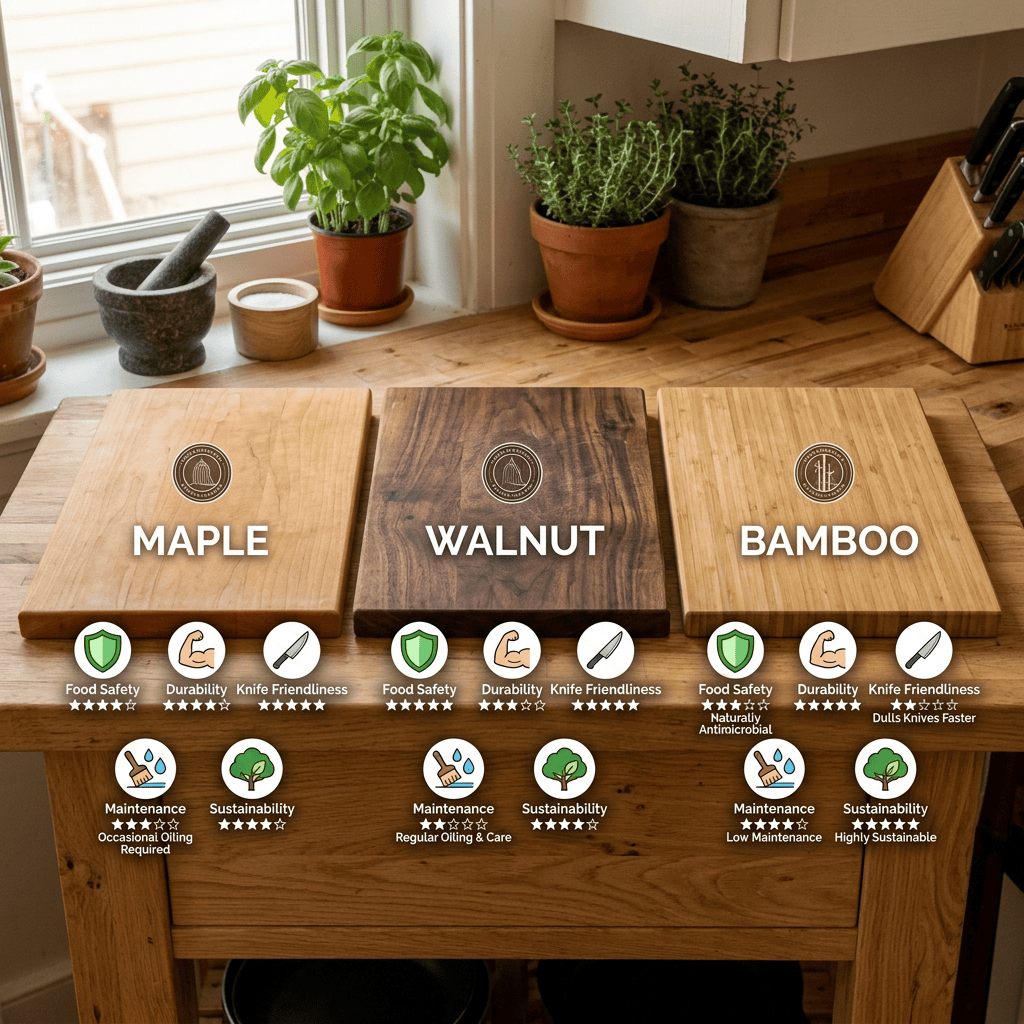
| Feature | Maple | Walnut | Bamboo |
|---|---|---|---|
| Food Safety | Excellent | Excellent | Good to Excellent |
| Closed Grain | Yes | Yes | N/A (Grass Fibers) |
| Moisture Resistance | Excellent | Very Good | Very Good |
| Knife Friendliness | Excellent | Excellent | Moderate |
| Hardness | Medium-High | Medium | Medium-High to High |
| Maintenance | Moderate | Moderate | Low-Moderate |
| Sustainability | Good | Good | Excellent |
| Appearance | Light | Dark | Blonde |
| Professional Preference | Highest | High | Moderate |
Overall Winner:
Hard Maple
Best Premium Choice:
Walnut
Best Eco-Friendly Budget Choice:
Bamboo
End Grain vs. Edge Grain
The construction of the cutting board matters almost as much as the wood itself.
End Grain
End-grain boards expose the ends of wood fibers.
Benefits include:
- Self-healing surface
- Less visible knife marks
- Longer lifespan
- Gentler on knives
These are often called butcher blocks.
Edge Grain
Edge-grain boards display the long side of each board.
Advantages:
- More affordable
- Lighter
- Durable
- Easier to manufacture
Most household cutting boards use edge-grain construction.
Takeaway: End-grain boards generally offer the best long-term cutting performance.
Cutting Board Hardness (Janka) Explained
Many buyers search for cutting board hardness Janka ratings without understanding what they mean.
The Janka test measures the force required to embed a steel ball halfway into the wood.
Higher numbers indicate harder materials.
Too soft:
- Deep cuts
- Faster wear
- Shorter lifespan
Too hard:
- Increased knife dulling
- More difficult resurfacing
Hard maple strikes one of the best balances available.
Cutting Board Maintenance with Mineral Oil
Even the safest wood becomes less sanitary if neglected.
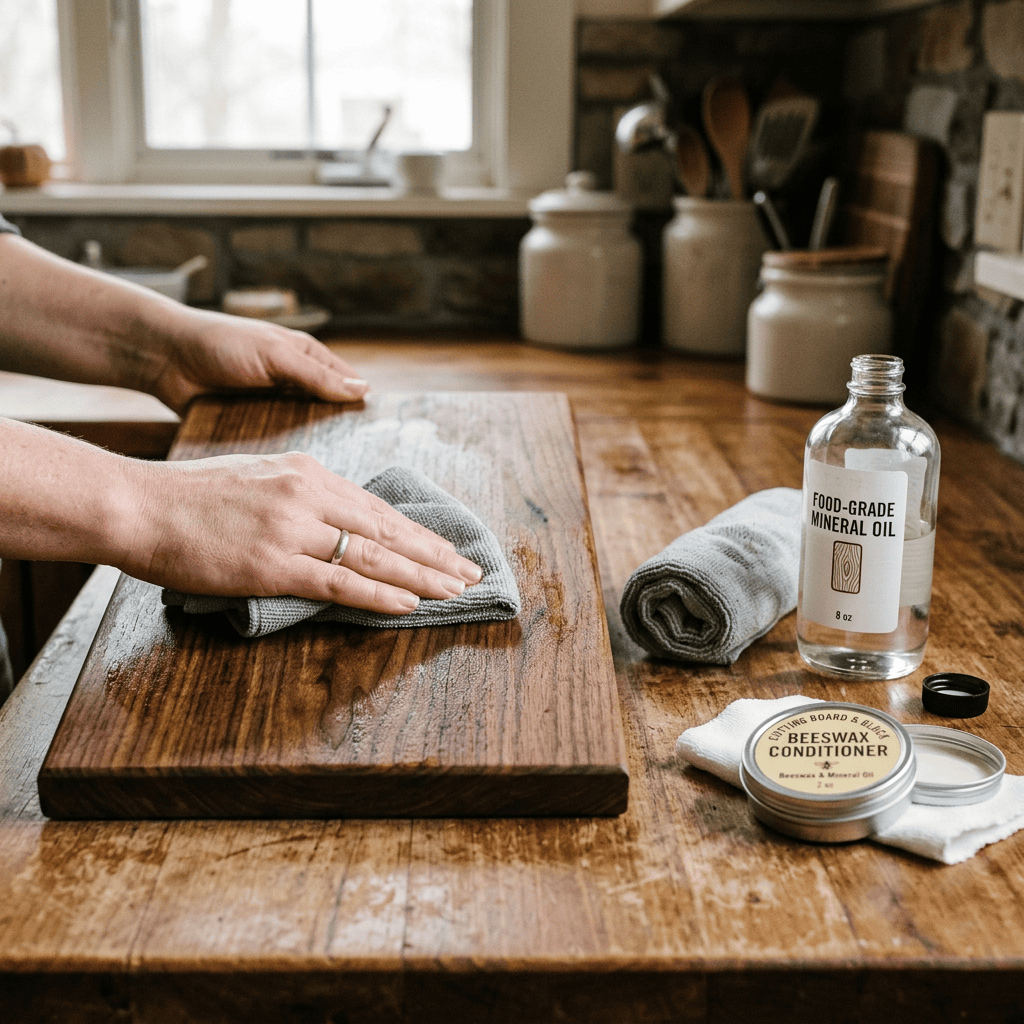
Proper cutting board maintenance with mineral oil greatly extends the life of wooden boards.
Step 1
Wash with warm water and mild dish soap.
Never soak.
Step 2
Dry immediately using a towel.
Stand upright until completely dry.
Step 3
Apply food-grade mineral oil every few weeks or whenever the surface looks dry.
Step 4
Occasionally apply a beeswax/mineral oil conditioner for extra protection.
Avoid
- Dishwasher cleaning
- Long soaking
- Bleach saturation
- Direct sunlight for extended periods
Takeaway: Regular maintenance preserves both food safety and appearance.
Do Wooden Cutting Boards Have Antibacterial Properties?
One of the most debated topics is the antibacterial properties of wood.
Scientific studies indicate that properly maintained wooden boards perform at least as well as plastic boards in many food safety comparisons.
Wood does not magically kill bacteria instantly.
Instead:
- Moisture is absorbed below the surface.
- Many bacteria gradually die as the board dries.
- Proper washing remains essential.
Regardless of material, always:
- Wash after each use.
- Dry thoroughly.
- Separate boards for raw meat and ready-to-eat foods when possible.
Takeaway: Maintenance and hygiene practices are more important than relying on any inherent antibacterial effect.
Best Practices for Choosing a Food-Safe Cutting Board
When shopping for kitchenware, prioritize these characteristics:
- Choose closed-grain hardwood whenever possible.
- Verify food-safe finishes.
- Prefer end-grain for heavy chopping.
- Buy from reputable manufacturers.
- Avoid heavily cracked or warped boards.
- Maintain regularly with mineral oil.
- Replace boards with deep, unsalvageable cracks.
Common Mistakes to Avoid
Many buyers unknowingly shorten the life of their cutting boards.
Common mistakes include:
- Putting wooden boards in the dishwasher
- Leaving boards soaking in water
- Skipping oil treatments
- Choosing decorative woods with open grain
- Buying extremely cheap bamboo boards with unknown adhesives
- Using the same board for raw meat without proper cleaning
Avoiding these mistakes significantly improves both safety and longevity.
How to Choose Between Maple, Walnut, and Bamboo
The right choice depends on your priorities.
Choose hard maple if you want:
- Maximum food safety
- Professional-grade durability
- Long service life
- Excellent knife protection
Choose walnut if you value:
- Premium appearance
- Softer cutting feel
- High-end craftsmanship
Choose bamboo if you prioritize:
- Sustainability
- Lower cost
- Lightweight construction
- Moisture resistance
For most households, hard maple provides the best overall balance.
Common Questions About Safest Woods for Cutting Boards
Is maple safer than walnut?
Both are very safe, but hard maple is generally preferred because of its tighter grain and long history in commercial food preparation.
Is bamboo hygienic?
Yes, provided it is well made, properly cleaned, and manufactured using food-safe adhesives.
What wood should never be used?
Avoid open-grain woods such as red oak because larger pores can trap more moisture.
Is end grain always better?
For heavy chopping, yes. End-grain boards are usually more durable and gentler on knives.
How often should I oil a cutting board?
Typically every 3–4 weeks, or whenever the surface appears dry.
Can wooden boards go in the dishwasher?
No. High heat and prolonged water exposure can cause warping, cracking, and glue failure.
Which wood lasts the longest?
Properly maintained hard maple and walnut boards can last for decades.
Why This Matters
A cutting board is one of the most frequently used tools in any kitchen, making its material an important long-term investment.
Choosing the safest wood isn’t just about preventing bacterial contamination—it also affects knife longevity, maintenance effort, replacement costs, and environmental impact.
Hard maple has earned its reputation through decades of professional use because it offers an exceptional balance of hygiene, durability, and cutting performance.
Walnut provides comparable food safety with a premium aesthetic, while high-quality bamboo appeals to environmentally conscious buyers seeking an affordable option.
By understanding grain structure, hardness, construction methods, and maintenance requirements, you can select a board that performs reliably for years while supporting safe food preparation.
Friendly FAQ
Which is the safest wood for cutting boards?
Hard maple is widely considered the safest wood for cutting boards because of its closed-grain structure, moderate hardness, low porosity, and long history of professional kitchen use. Walnut is also an excellent food-safe hardwood, while bamboo can be safe when manufactured with food-safe adhesives.
Is walnut safe for cutting raw meat?
Yes. Walnut cutting boards are safe for preparing raw meat when they are cleaned promptly with warm, soapy water, dried thoroughly, and maintained regularly. As with any cutting board, avoid cross-contamination by using separate boards or sanitizing between tasks.
Is bamboo better than maple?
Bamboo excels in sustainability and affordability, but hard maple generally offers superior knife friendliness, consistent construction, and a proven track record in commercial kitchens. Bamboo quality also varies more because it is manufactured using adhesive-bonded strips.
Does wood naturally kill bacteria?
Wood has properties that can reduce bacterial survival over time as moisture is absorbed and the board dries, but it does not replace proper cleaning. Safe food handling still requires washing, drying, and routine maintenance after each use.
What is the best way to maintain a wooden cutting board?
Wash it with warm water and mild soap, dry it immediately, and apply food-grade mineral oil every few weeks. Avoid soaking, dishwashers, and prolonged exposure to heat or direct sunlight to prevent cracking and warping.
Final Summary
If you’re looking for the safest wood for cutting boards, hard maple remains the top recommendation thanks to its closed-grain structure, balanced Janka hardness, durability, and proven food safety record.
Walnut is a close second, offering excellent performance with a premium appearance, while bamboo provides a sustainable and budget-friendly alternative when sourced from reputable manufacturers using food-safe adhesives.
Whatever material you choose, consistent cleaning, thorough drying, and regular mineral oil conditioning are the keys to maintaining a hygienic, long-lasting cutting board that supports safe food preparation for years to come.
Choosing the safest wood for cutting boards involves understanding wood anatomy, hardness, and food-contact best practices. The following resources provide reliable information on wood species, material performance, and kitchen safety:
- The Wood Database— Comprehensive information on wood species, grain characteristics, Janka hardness ratings, and woodworking applications.
- Association of Woodworking & Furnishings Suppliers (AWFS)— Educational resources and industry information on woodworking materials and manufacturing.
- USDA Food Safety and Inspection Service (FSIS)—Best practices for safely using and cleaning cutting boards and for preventing cross-contamination in the kitchen.
Build Better Projects with Expert Woodworking Plans
Want to build your own premium cutting boards, butcher blocks, furniture, or workshop projects?
Discover step-by-step woodworking plans and time-saving techniques with Woodworking Shortcut. Whether you’re a beginner or experienced woodworker, you’ll find practical guidance to build beautiful, professional-quality projects with confidence.
👉 Learn more here: https://besthomeshed.com/WoodworkingShortcut/